The family-run Hawar Textile Institute is a paradise for textile enthusiasts.
Teachers from both the Netherlands and abroad come to share their knowledge and skills in the spacious and atmospheric workshop in Oldeberkoop (Friesland). In addition, Hawar offers a well-stocked shop and an inspiring gallery, making it a creative hub where new and traditional materials and textile techniques are (re)discovered.
At the festival, Hawar will be selling a variety of materials and tools for textile lovers, and you can take part in the workshop “Experiment with botanical printing.” You can also purchase the magazine Vezel at the stand.
Vezel shares personal textile adventures and lets you experience the passion of others. Knowledge, skills, and experiences are passed on. Discover new techniques and materials—or new applications of traditional ones. What’s more fun than getting inspired and trying it out yourself? Vezel encourages dreaming, imagining, and hands-on creativity.
What began over 40 years ago as a newsletter on spinning and dyeing has grown into a broad and practical textile magazine. It’s still published today by the Spin & Dye Journal Foundation, a group of volunteers who believe in sharing knowledge of materials and techniques to keep the craft alive and thriving in the modern world.


At our Ambacht in Beeld Repair Shop, master tailor and embroiderer Katja van der Steen will demonstrate the refined craft of invisible mending. This technique lies at the intersection of repair and textile restoration. It is an extremely precise method used to restore damaged textiles think moth holes, tears, or worn spots almost imperceptibly.
Unlike regular sewing or visible repairs, this method replicates the original weave structure thread by thread. Sometimes, thread is sourced from hidden seams of the original garment so that colour and texture match perfectly. The result? A garment that looks as though it was never damaged.
Feel free to bring your cherished sweater, blouse, or trousers to the festival, where Katja will assess the possibilities and potential costs of repair with you. And who knows your garment might be selected during the two-day festival to be repaired on the spot, entirely free of charge, so you can take it home looking as good as new.
Want to learn how to repair clothes yourself? Even if you have never sewn on a button or patched a hole, you’re welcome at our repair table. You will receive a short explanation and can start hands-on right away. We will also have convenient repair kits available for purchase at our stand so you can continue mending at home or on the go. Together, we are taking an important step, not only toward repairing clothing, but toward mending the world of tomorrow. Stitch by stitch.
Katja van der Steen is a master tailor, lace maker, and embroiderer specializing in bespoke menswear, corsetry, and pattern drafting. She honed her craft creating historical, dance, and theatre costumes at the renowned Bolshoi Theatre in Moscow. Katja is skilled in a wide range of needlework techniques, including goldwork, tatting, and haute couture embroidery, which she uses to bring traditional crafts to life. As a passionate educator, she leads inspiring workshops, both online and in person, including at the Embroidery School of CraftsCouncil Netherlands. Through her work, she shares artisanal knowledge, makes it accessible to new generations, and connects tradition with innovation to keep handcraft relevant in the modern world.
Practical Information


In this duo workshop for parent and child, you will be introduced to the Japanese Shibori technique. Learn to experiment with various natural colours and create shapes and patterns by folding, clamping, and tying fabric.
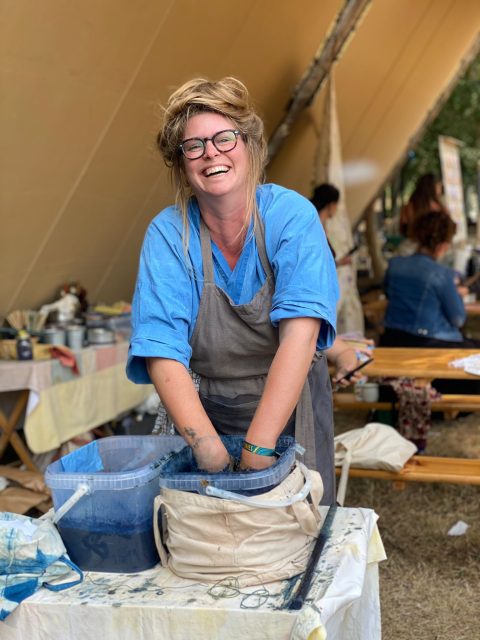
During this dyeing workshop, you will work with natural dyes to create a unique festive garland. You will experiment with plant-based colours such as indigo, madder root, onion skins, turmeric, weld, and logwood. You will learn how the natural dyeing process works, how to create patterns using the Shibori technique, and how to blend colours by layering dyes on the fabric.
Together, you will make 24 flags, enough for a beautiful, personalized garland to take home that will last a lifetime!
Marte Haverkamp is a visual artist who gives the traditional craft of natural dyeing a contemporary twist. She works with dyes derived from plants, flowers, and kitchen waste to colour textiles in a sustainable way. Each colour is a synergy of material, time, and care – a process that requires patience, experimentation, and a connection with nature. In her workshops, Marte demonstrates how this centuries-old technique remains accessible and relevant in today’s world.
Practical information

During this 1-hour introductory batik workshop, you will create your own batik. Making a traditional batik usually takes several weeks, sometimes even months, so in this workshop the focus is on drawing with wax and painting with a brush. You will use a canting (wax pen) to draw with hot beeswax on cotton, afterwards the dye is applied, a technique known in Java as colet.
Batik originates from Indonesia, particularly the island of Java. It is a traditional technique for decorating fabric with wax and dye, where wax is applied to prevent certain areas from absorbing colour during dyeing. This results in vibrant, intricate designs.
You will go home with your own batik piece and instructions on how to remove the wax.
Sabine Bolkis a Dutch visual artist and batik researcher. Since 2009, she has been deeply involved in the study of Javanese batik. Her research has taken her to various batik-related locations, including the islands of Java, Madura, and Bali, as well as Malaysia, Singapore, and several European countries. From 2019 to December 2021, Sabine was a research associate at the Research Centre for Material Culture in Leiden, focusing on batiks in Dutch collections and archives. Her current research not only highlights the maker but also the wearer of batik. In 2023, she curated an exhibition at the Erasmus Huis in Jakarta (ID) titled “Masa Depan Batik I The Future of Batik”. In October 2025, this exhibition will be shown in the Netherlands.
Practical Information:
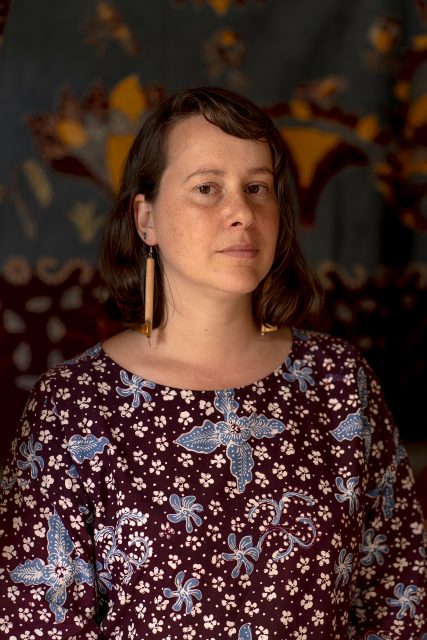
Sabine Bolk. Photo Eliza Bordeaux

On silk organza stretched over a small embroidery frame, you will create a dazzling piece of embroidery. You will have access to over 100 different beads, sequins, cannetilles, and other materials, the same ones used in the major embroidery ateliers. You will learn several techniques to achieve special effects with these beads and sequins.
Broderie d’art is the exquisite embroidery we know from haute couture — think of creations by Chanel and Dior, for example. These rich embroideries often have a three-dimensional effect, achieved by combining varied materials. This type of embroidery is often used as an appliqué on garments, but it is also used to create jewellery such as brooches and earrings. Surprisingly, the technique also has a sustainable side: by creating something beautiful for your clothing, you tend to treat it with more care, you may use an appliqué to hide a flaw, and the garment lasts longer!
You will go home with an embroidery frame holding your work, a booklet with examples and instructions in a little box, and extra materials to finish your piece at home.
Monique van Munster has a fascination with the endless possibilities of traditional embroidery with needle and thread. She experiments with historic embroidery techniques from haute couture to develop new forms of artistic expression. Gold embroidery has become one of her specializations, which she has developed into a unique personal style. Her passion for this refined artisanal craft has brought her into contact with various couturiers and designers who have incorporated her broderie d’art into their collections. Her work has been showcased in fashion shows in Paris, Dubai, and more recently in Palm Springs.
Since 2023, her work has been listed in the Inventory of Intangible Cultural Heritage of the Netherlands. Monique loves to share her knowledge through lessons, masterclasses, and workshops at her studio in Tilburg, at vocational schools across the Netherlands, through the Dutch Fashion Crafts Association, and at other organizations where she is invited to teach.
Practical Information


In this fun and cozy workshop, you will work with beautifully coloured wool, water, and soap. You get to choose the colour of your fish, then let your creativity run free to make, for example, a rainbow fish! Each step is explained calmly so everyone can follow along easily. At the end of the workshop, you will proudly take home your own unique 3D fantasy fish!
Felting is a traditional craft technique in which wool fibres are bonded together to form a sturdy fabric without weaving or knitting. It is one of the oldest textile techniques in the world. There are two main types of felting: Wet felting uses wool fibres, water, soap, and friction. The combination of heat and agitation causes the tiny barbs on the wool fibres to interlock, forming a dense fabric. This technique is commonly used to make hats, bags, slippers, and art pieces.
Dry felting (also known as needle felting) uses special barbed felting needles. By repeatedly poking the needle into the wool, the fibres interlock and form shapes. This method is popular for creating small figures or decorative items.
Amber Paans is a felting instructor and visual artist, specializing in the wet-felting technique. Around 15 years ago, she discovered the art of felting with sheep’s wool and immediately fell in love with the craft. What began as a passion grew through years of self-study and attending inspiring masterclasses into her own felting studio: Ambrosia Naturals. In her studio in Zaandam, she offers various workshops in different felting techniques for both young and old. She also enjoys teaching in schools, passing on this beautiful craft to the new generation!
Practical Information:


Have you always wanted to design your own phone case? In this workshop, you will work with the wet-felting technique and beautiful sheep’s wool. The pouches are created using a 3D technique, formed around a mould. You will choose your own colours and patterns, so your pouch perfectly matches your style. The workshop is suitable for both beginners and more advanced participants each step will be explained clearly and calmly. Once your pouch is finished, you will receive a cord so you can wear it. It will need some time to dry, but after that, you will be able to show off your own unique, handmade phone pouch!
Felting is a traditional craft technique in which wool fibres are bonded together to form a sturdy fabric without weaving or knitting. It is one of the oldest textile techniques in the world. There are two main types of felting: Wet felting uses wool fibres, water, soap, and friction. The combination of heat and agitation causes the tiny barbs on the wool fibres to interlock, forming a dense fabric. This technique is commonly used to make hats, bags, slippers, and art pieces.
Dry felting (also known as needle felting) uses special barbed felting needles. By repeatedly poking the needle into the wool, the fibres interlock and form shapes. This method is popular for creating small figures or decorative items.
Amber Paans is a felting instructor and visual artist, specializing in the wet-felting technique. Around 15 years ago, she discovered the art of felting with sheep’s wool and immediately fell in love with the craft. What began as a passion grew through years of self-study and attending inspiring masterclasses into her own felting studio: Ambrosia Naturals. In her studio in Zaandam, she offers various workshops in different felting techniques for both young and old. She also enjoys teaching in schools, passing on this beautiful craft to the next generation!
Practical Information:

Let your creativity run wild in this workshop, where we will create a unique vase using the traditional wet-felting technique, with step-by-step guidance throughout the process. You will choose the colour of the sheep’s wool, and then we will shape the vase. No two vases are the same! After drying, you could, for example, fill your vase with dried flowers or a small plant. You will go home with your own handmade vase, completely tailored to your taste.
Felting is a traditional craft technique in which wool fibres are bonded together to form a sturdy fabric without weaving or knitting. It is one of the oldest textile techniques in the world. There are two main types of felting:
Wet felting uses wool fibres, water, soap, and friction. The combination of heat and agitation causes the tiny barbs on the wool fibres to interlock, forming a dense fabric. This technique is commonly used to make hats, bags, slippers, and art pieces.
Dry felting (also known as needle felting) uses special barbed felting needles. By repeatedly poking the needle into the wool, the fibres interlock and form shapes. This method is popular for creating small figures or decorative items.
Amber Paans is a felting instructor and visual artist, specializing in the wet-felting technique. Around 15 years ago, she discovered the art of felting with sheep’s wool and immediately fell in love with the craft. What began as a passion grew through years of self-study and attending inspiring masterclasses into her own felting studio: Ambrosia Naturals. In her studio in Zaandam, she offers various workshops in different felting techniques for both young and old. She also enjoys teaching in schools, passing on this beautiful craft to the next generation!
Practical Information:
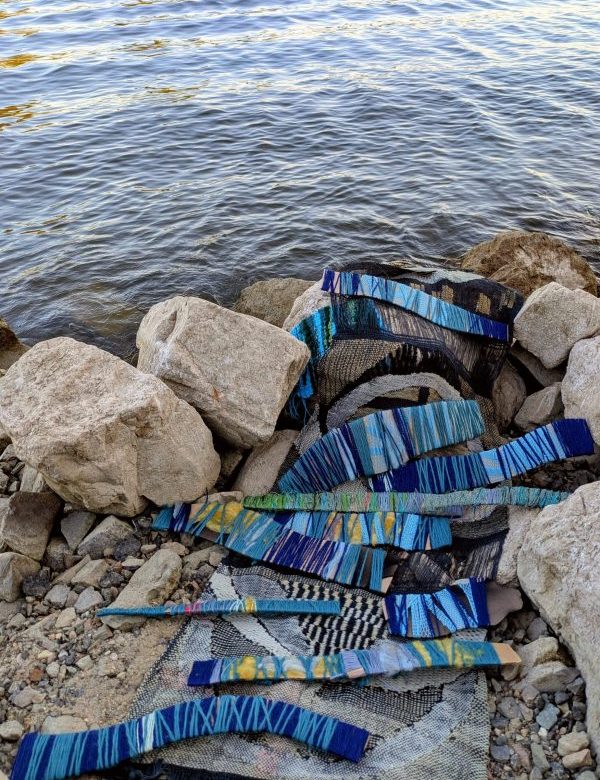
Join in and add one ore more pieces/modules that will attach for a bigger work/installation in the shape of a river.
The work will organically grow and change with every piece attached as continuously process.
We’ll use recycled materials, pieces of textile and yarns which will be knotted, twisted, combined and attached on a harder base to create textured surfaces.
Working together for one project is another layer of the workshop, we will think about the metaphor of the river in each of other lives.
Children can join the process too, together with their parents, everyone can use own imagination and create freely.
The participants can as well create smaller pieces to take home as they would like to.
Mirela Marinescu is an artist born in Bucharest, Romania now living in Arnhem, NL. She graduated at the Academy of Art in Bucharest – design, textile and decorative art and followed a museology master program at The Reinwardt Academy in Amsterdam.
She has worked several years in a museum as restaurator and conservator of a mediaeval textile collection.
“Living abroad, I am more aware and think about the similarities and differences of people, culture, traditions in both my country and the country of adoption. I find the boundaries are sometimes faded, people have similar ideals, qualities, people like to travel, to broaden knowledge, speak more languages, everything is more and more intertwined and connected.
At the moment, living very next to the Rhine River and knowing that it is connected with the Donau River from my country, Romania, I like to imagine the flow of the two waters, the idea that I could take a boat and travel between the countries. I see the River as a symbol or metaphor for connection, a link between hearts, minds, lives and experiences, as blood veins running along, passing through countries and their people.
As artist I use different media and materials to create my artworks, depending on the theme and idea. The idea behind my work is sometimes more important than the finished object, but even though my work may be conceptual I make use of traditional techniques like collages, weaving, graphic techniques to give form to my concept.”

Regular
€7.50 pre-sale online
€10.00 at the door
CJP
€5.00 pre-sale online
€7.50 at the door
Children up to 12 years
Free entrance (with entrance ticket < 13 years).
Stadspas
Free entrance (only at the door upon presentation of your Stadspass, cannot be reserved online).
The prices mentioned include: VAT, service costs and €1.50 entertainment tax for the municipality of Amsterdam.
Please note: everyone who visits the festival needs an entrance ticket, even if you are going to attend a workshop or masterclass.
Festival address:
NDSM Loods
NDSM-Plein 85
1033 WC Amsterdam
Postal address:
Stichting Ambacht in Beeld
Kalf 158
1509AH Zaandam
The Netherlands