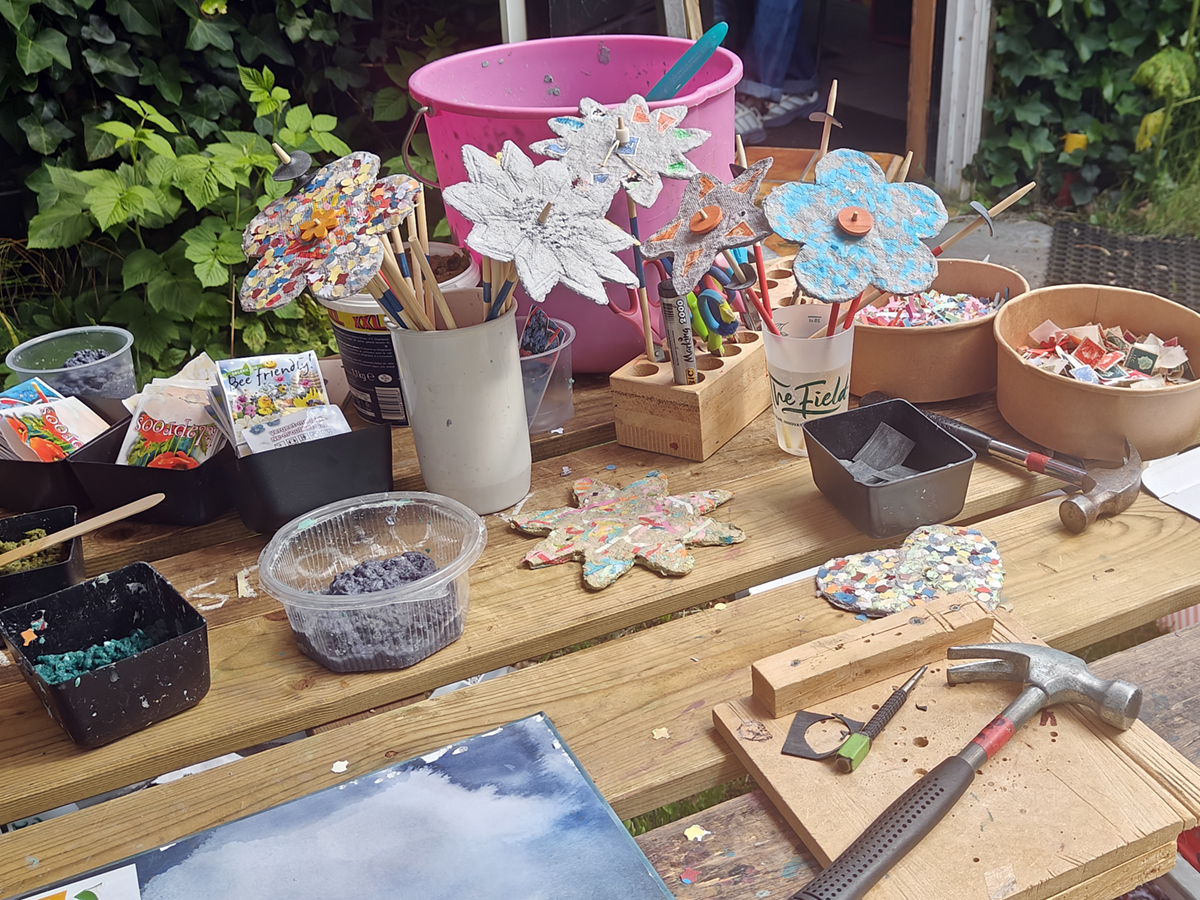
During this continuous workshop, you will make your own seed paper from recycled paper pulp, embedding flower seeds into it. Next, you will shape the paper into a flower, a bee, or a butterfly.
Take your creation home, plant it in a pot or in your garden, and watch real flowers bloom over time!
Technika10 Leiden has existed for over 25 years and aims to promote technical skills and knowledge of technology among children. They organize workshops that inspire wonder and are educational. Real tools and materials are used, such as wood, metal, plastic, and motors powered by batteries or solar cells.

Did you know that weaving is an ancient art form? Indigenous peoples, who live in close connection with nature, have learned to create beautiful and durable objects from natural fibers. Think of bags, baskets, and cooking utensils, all woven by hand!
A wonderful example is the cassava press, or matapi, of the Lokono people of Suriname. It is woven from warimbo, a strong reed, and is shaped like a snake with distinctive patterns. Indigenous weavers often decorate their work with geometric designs inspired by animals from their surroundings, such as the anaconda, jaguar, or swallow.
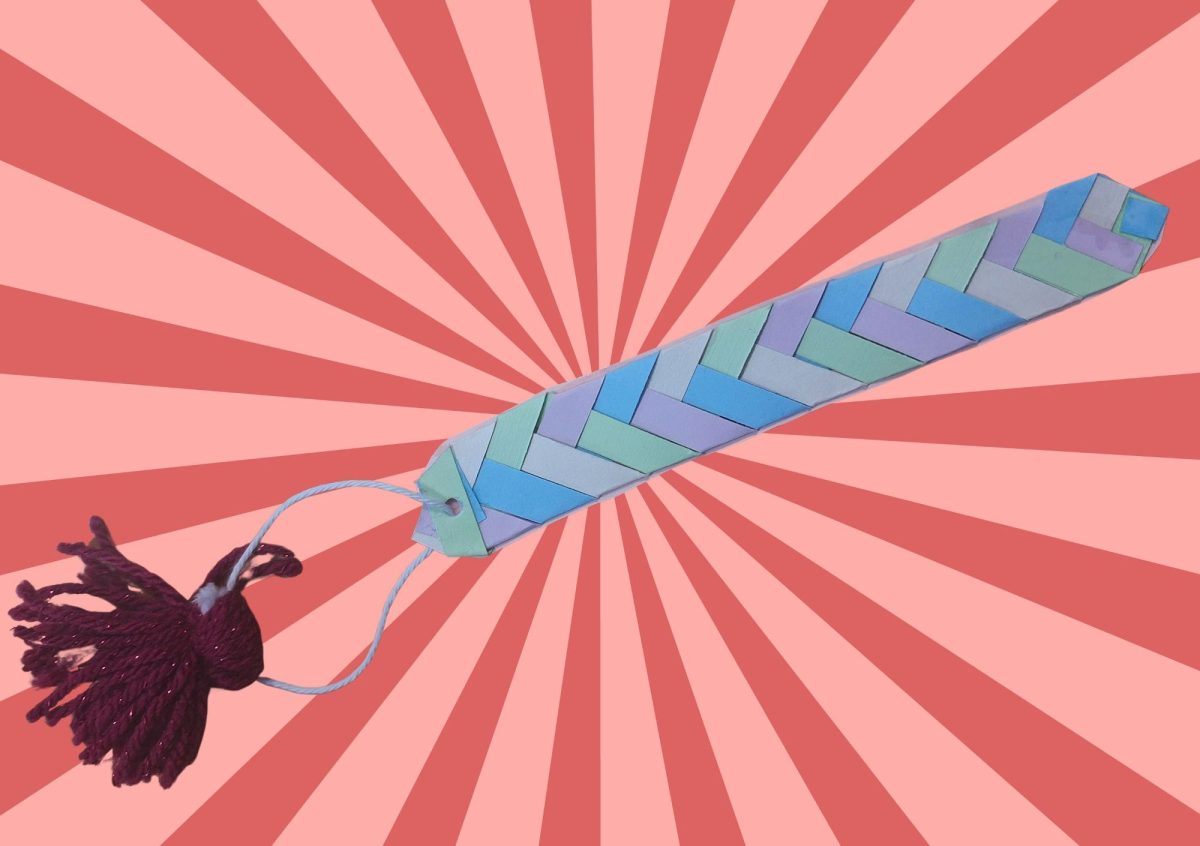
During this workshop, you will learn the basics of this craft! Step by step, you will discover how to weave paper strips together, and by the end you will have made your own bookmark, perfect for your favorite book or your planner.
Weaving is entirely handmade, and that is something special. Working with your hands brings a sense of calm, and when you have made something yourself, you can take extra pride in it!
Carla, Martha Sabajo, and Marilyn van Rijn, all born in Suriname, are proud cultural bearers of the Lokono community. As members of the Wasjikwa Foundation, they dedicate their time to preserving and passing on indigenous cultural heritage. Their motivation comes from a deep connection to their roots. They believe that traditional craft techniques can never be separated from the stories, values, and spirituality woven into them. For Carla, Martha, and Marilyn, passing on Indigenous skills goes far beyond teaching techniques; it is about sharing an entire way of life.
During their workshops, they create a warm sense of community where participants not only learn practical skills but also hear personal stories about the importance of community.

Artists Lindsay van Vliet and Daan Wille have joined forces as Team Blazin. Both have specialised in calligraffiti, a fusion of calligraphy and graffiti.
Inspired by the renowned graffiti artist Shoe, they are all-rounders in giving workshops ranging from stencil like Banksy, doodle like Keith Haring, and of course calligraffiti. Together they also regularly create large-scale murals.
In this workshop, you will create your own artwork with your name on it, guided by them.
This workshop was first offered in 2015, in collaboration with the Street Art Museum Amsterdam. It was also presented at Craft in Focus New York in 2017 and 2019, and in 2024 and 2026 Lindsay gave the workshop at Ambacht in Beeld Brussels. Due to its success, it is back again in Amsterdam this year!
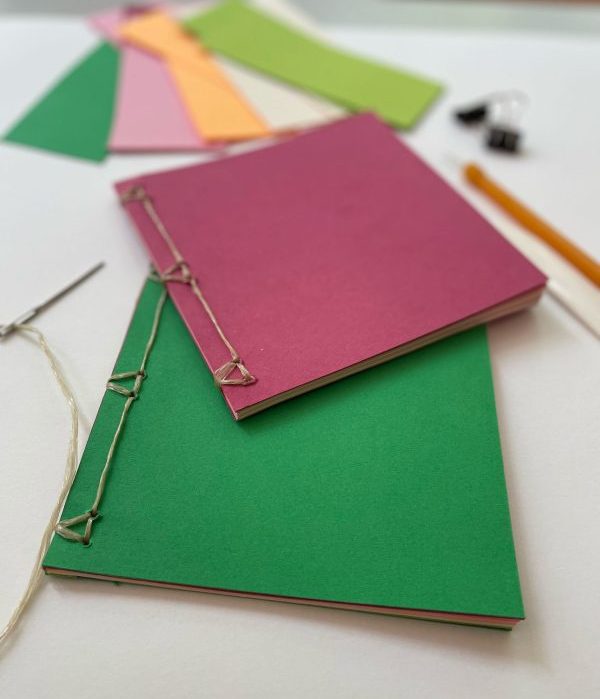
In this workshop for young and old, you will get hands-on experience making and binding a booklet using traditional Japanese techniques. This binding method was used for the famous Amsterdam School art and architecture magazine Wendingen. In it, artists shared their ideas, their inspiration, and their work.
You begin by selecting paper: which colours go well together, and which type of paper will you use for the cover? Then the folding and binding begins. Using a bone folder, needle and thread, and step-by-step instructions, you assemble your own booklet. And if you still have time left, you can draw inspiration from Amsterdam School artists and personalise your booklet.
You will go home with your own handmade booklet.
The artists of the Amsterdam School excelled in craftsmanship. As a reaction to industrialisation over 100 years ago, they returned to fully handmade art objects, often using natural materials. This happened across many disciplines: sculptors were part of the movement, as were ceramics and stained glass artists, woodcarvers, bookbinders, and many graphic artists. The total work of art was important, often meaning that multiple artists from different disciplines collaborated on, for example, a building or interior.
Museum Het Schip is located in a fantastical social housing complex in Amsterdam West, designed by architect Michel de Klerk. This expressionist housing block was built in 1919 for housing corporation Eigen Haard. Because of its distinctive shape, the building became known as “Het Schip” (“The Ship”). It is considered one of the highlights of the Amsterdam School, a movement in architecture and decorative arts that spread throughout the Netherlands and was closely intertwined with the rise of social housing provided by housing corporations.

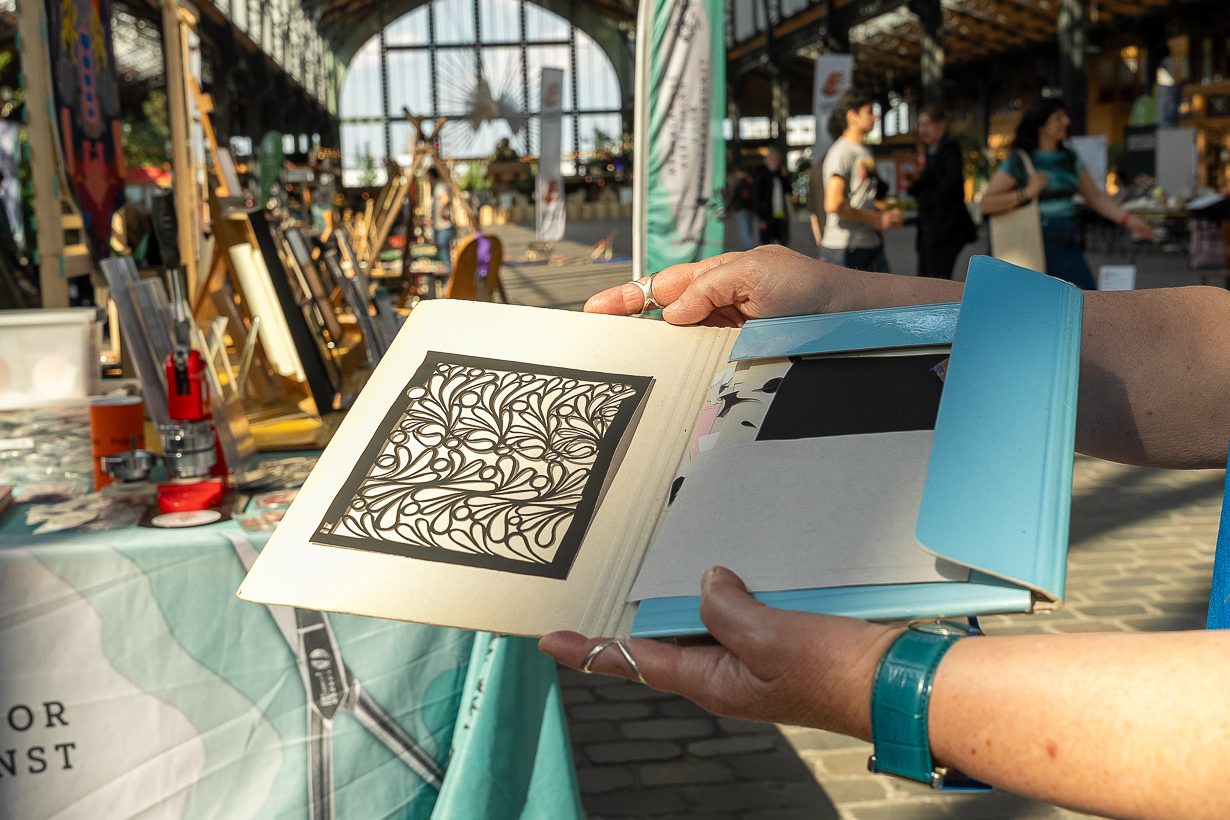
Everyone has put a pair of scissors into a sheet of paper at some point, but in this workshop you will truly go one step further. After a short introduction to the art of paper cutting, you will learn the basic techniques of paper cutting art from an experienced paper cutter. You will then apply these techniques to create your own cut-out design from silhouette paper. You will also learn how to carefully mount it afterwards.
You will go home with a framed artwork. You might want to reserve a spot on your wall at home in advance!
For centuries, thousands of people around the world have enjoyed paper cutting. It is fun and relaxing, and both young and old create beautiful artworks with it. Paper cutting is essentially drawing with scissors. With your scissors, you free your own design, decorations, and letters from the paper. And with so many cutters, there are countless variations.
De Nederlandse Vereniging voor Papierknipkunst is the meeting place for hobby cutters and professional artists. The workshop leaders are members of this association and are specially trained to teach interested participants the tricks of the trade. Most of them regularly exhibit their work. Paper cutting art has been included in the Inventory of Intangible Cultural Heritage in the Netherlands since 2013.

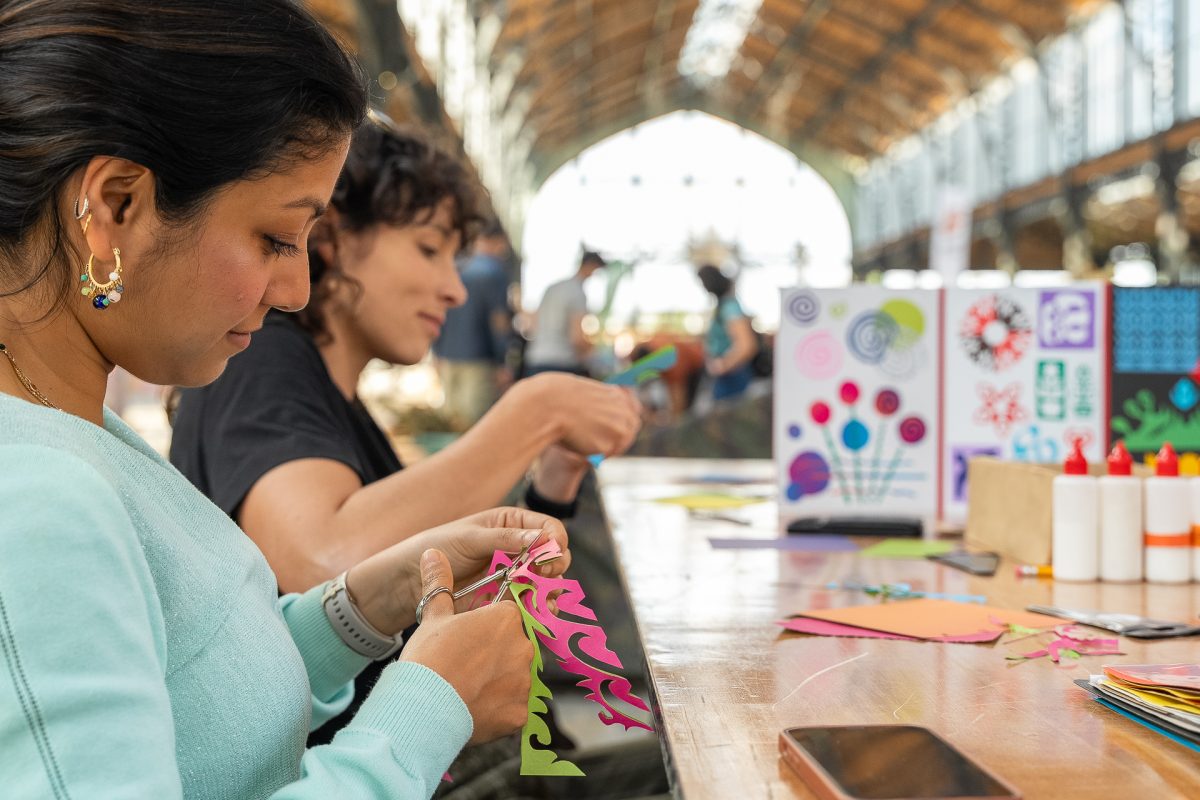
Everyone has put a pair of scissors into a sheet of paper at some point, but in this workshop you will go one step further. After a short introduction, you will learn the basic techniques from experienced paper cutters. You will then apply these in a simple assignment yourself. At the end of the workshop, you will go home with one or two paper-cut artworks. Success guaranteed.
For centuries, thousands of people worldwide have enjoyed paper cutting. It is fun and relaxing, and both young and old create beautiful artworks with it. So many cutters, so many variations. This special craft has therefore been included in the Inventory of Intangible Cultural Heritage in the Netherlands.
The workshop leaders are members of De Nederlandse Vereniging voor Papierkunst, the meeting place for hobby cutters and professional artists. They are specially trained to teach interested participants the tricks of the trade. Most of them regularly exhibit their work.
Regular
€10.00 pre-sale online
€12.50 at the door
CJP
€7.50 pre-sale online
€10.00 at the door
Children up to 12 years
Free entrance (with entrance ticket < 13 years).
Stadspas
Free entrance (only at the door upon presentation of your Stadspass, cannot be reserved online).
The prices mentioned include: VAT & service costs.
Please note: everyone who visits the festival needs an entrance ticket, even if you are going to attend a workshop or masterclass.
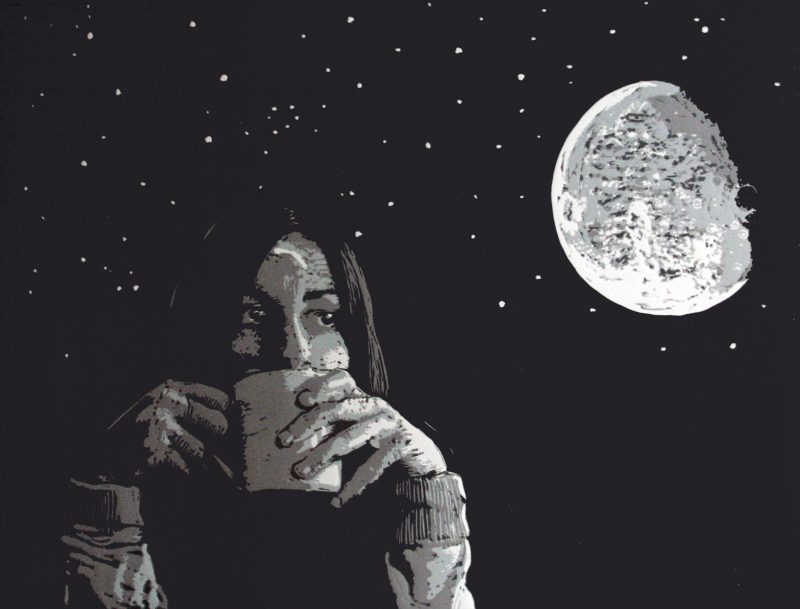
In the series “The Right Side Light”, artist Michalina Małolepsza portrayed people from her immediate surroundings, striving to create work imbued with universal symbolism. This is not only about the likeness of the depicted person, but primarily about capturing the atmosphere and preserving the moment.
Her favorite graphic technique, linocut, played a crucial role in this process. In this technique, an image or pattern is carved into linoleum with a gouge and then transferred to the surface with printing ink. The plate used for printing must be created in mirror image.
In this project, Małolepsza explored the unique qualities of linocut: the mirror image as part of the creative process and the direct, artisanal way of working. The technique forced her to think and design differently, ultimately leading to the development of her own recognizable visual language.
Michalina Małolepsza lives and works in Schiedam, the Netherlands. In 2011, she graduated from the Willem de Kooning Academy of Arts in Rotterdam, where she further developed her passion for art and creativity. During her studies, she decided to specialize in traditional printmaking, with a particular focus on the linocut technique. This technique enables her to bring her artistic vision to life in a unique way. The artist enjoys exploring various themes, and her work is characterized by an interest in humanity.
Michalina is a member of Grafisch Atelier Minnigh in Rotterdam and Stichting KunstWerkt in Schiedam, where she collaborates with other artists and continues to refine her skills. She participates in various art projects in Rotterdam, Schiedam and the surrounding area. Her works have been exhibited in many places throughout the Netherlands, as well as in the United States and Poland.
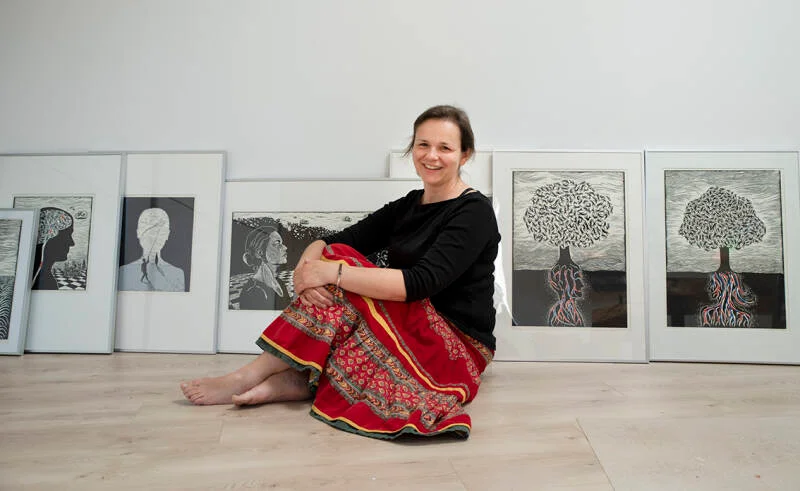

Immerse yourself in the art of paper making during this masterclass and learn to combine Japanese and Western techniques. You’ll work with Kozo, the bark of the paper mulberry tree, a strong fiber traditionally used to make sustainable Washi paper. From preparing the fibers to making the paper, you’ll be involved in every step of the process.
Paper making is a centuries-old craft that flourished in the Netherlands in the 17th century. Using water, rags, and craftsmanship, paper makers transformed simple fibers into beautiful paper. In mills powered by wind or water, pulp was made, scooped into sheets, carefully dried, and pressed. A remarkable pioneer was Jacob Christian Schäffer, a German inventor from the 18th century who developed innovative techniques and made paper making more sustainable. His work also inspired Dutch paper makers to innovate. Today, you can still experience this fascinating process in artisanal workshops, where you can make paper yourself.
At the end of the masterclass, you’ll go home with three unique, handmade sheets of paper. This masterclass is suitable for both beginners and experienced creatives.
Sietske Vernooij of Papierwijs is a passionate papermaker and teacher. Her love for this craft began under the inspiring guidance of Ewald Weijers. The joy of making your own paper and discovering the many possibilities of plant-based fibers is her driving force. The process from pulp to paper is magical, and she’s happy to share that feeling.
Practical Information

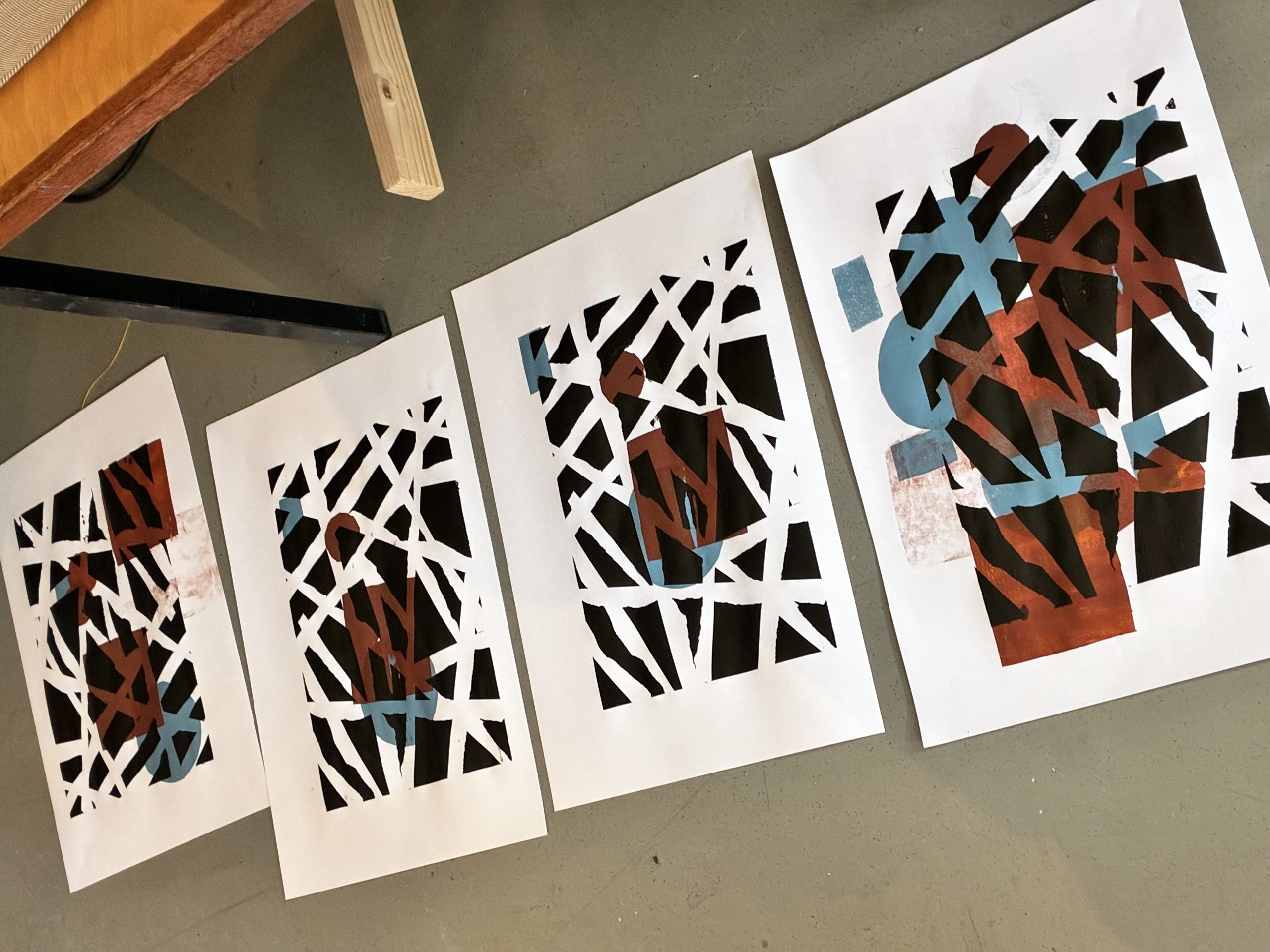
In the screen printing workshop Cut & Play, you’ll explore shape, color, and layering by cutting forms from paper and using tape to create your own playful design. From this design, you’ll make a silkscreen print directly onto your own shirt or sweater.
You’ll head home with a series of experimental prints you created yourself, plus a goodie bag.
Screen printing is a graphic stencil technique suitable for printing on a wide variety of materials such as textiles, paper, cardboard, glass, wood, and plastics. A handmade stencil or light-sensitive emulsion is applied to a mesh screen. Ink is then pressed through the stencil with a squeegee onto the chosen surface.
Michael van Kekem works as an illustrative designer and printmaker. Within the fields of illustration, graphic design, and printmaking, he creates editorial illustrations, prints, visual identities, zines, and a range of other products. He regularly gives printmaking workshops (screen printing, etching, and linocut) at events, for companies, and for private individuals of all ages. Michael also frequently exhibits his personal work.
Practical information
Festival address:
NDSM Loods
NDSM-Plein 85
1033 WC Amsterdam
Postal address:
Stichting Ambacht in Beeld
Kalf 158
1509AH Zaandam
The Netherlands