Kumiko is a Japanese woodworking technique. It is applied to lamps, partition panels, doors and wall decorations. It is a kind of mosaic with wooden strips. In Japan, there are factories where the equipment is made especially for this technique. Outside Japan, it is more seen as a craft. During the workshop, we will give a small introduction and then get to work making some simple patterns ourselves. We do this with a special Japanese saw and specific tools.
Kumiko is a quiet and thoughtful technique that requires a lot of patience and precision. The ancient Japanese woodworking technique involves making patterns of small pieces of interlocking wood. In Japan, it is used for (shoji) lamps, panels or wall decoration.
Work with an accuracy of 0.1mm, otherwise, your piece will fall apart. We will work with a Japanese (draw) saw and have to be careful with a very sharp chisel. You will be introduced to the Izustu-tsunagi pattern. Depending on your skill and perseverance, you will make your first kumiko panel (20 x 20 cm).
Rob Alferink is a builder of wooden lamps. And for many years experienced in using the kumiko technique. It is a challenge every time to learn new kumiko patterns and incorporate them in a lamp. His lamps find their way to Norway, Luxembourg, Canada, the US and several other countries.

Since time immemorial, people have used earth pigments to add color to their surroundings. Pigments were mixed with different binders and fillers to process these dyes in different ways.
Come and work with these beautiful natural colors and create your own artist materials at the Ambacht in Beeld Festival.
Pastels are those beautiful soft crayons that you can use to draw, and you can rub out the colors so beautifully. And no, they cannot be compared to blackboard chalks, the colors are much more full and brighter, and the chalk itself is softer.
Learn how to make beautifully soft artist’s chalk with natural earth pigments. Choose one pigment or mix several pigments. Mix and process all ingredients until you have the right consistency and roll your own pastels. We make this chalk according to a traditional recipe with pure natural ingredients and pigments.
In 1 hour you can make about 4 different colors of chalk, which you will take home in a box. After a few days they are dry and you can draw beautifully with them!
Including:
Material for various crayons
Box to take the crayons with you
Short job description on paper
Twirre van Kraaijenoord is the founder of Handmade Heaven, she is a creative designer and uses different crafts and techniques in her designs. She followed a course for Trompe-l’oeil painting in which, in addition to painting marble and wood, the craft of oil paint was also taught. She has done research into natural dyes for textiles. Twirre has continued her search for natural colors and now makes her own extracts, paints, inks and pastels. In the television program “The secret of the master” which can be seen in October, she makes the artist’s material with ingredients from the master!


Language: English
In this workshop you will learn about the world of violin making with important basic techniques. The goal is to make a technically and aesthetically important part of the instrument yourself: the sound hole. Under guidance, and with the help of essential violin making tools, you will draw shapes, cut and saw spruce wood. At the end you will varnish your workpiece and proudly bring home your self-made part of the violin.
Musical instrument making has a tradition of many centuries. Violin making has been a profession in its own right since the Renaissance. Naturally, the first thing everyone thinks of is the Great Stradivarius from Italy. But many do not know that there is also a great tradition in violin making in Germany. The university Westsächsische Hochschule Zwickau (WHZ), University of Applied Sciences that offers this workshop works in this tradition. Today, in addition to modern technologies, violin making is still connected to old traditions and experiences. Besides craft techniques, a large part of this profession is a knowledge of history and styles. You will get an insight into this, when you visit this workshop.
This workshop will be led by young violin makers Hannah and Karl from Germany. Hannah is a master violin maker based in Markneukirchen. Hannah finished her apprenticeship in 2017. Today she works at the place of her studies on the sidelines of teaching and helps the students with their scientific work. She also has an instrument making workshop with her partner. Karl finished his apprenticeship in 2019. Afterwards he did an internship in the Netherlands for eight months. Currently he is also studying Musical Instrument Technology.


This is really special: we have invited three Venetian glass blowers to teach workshops and share their knowledge.
Chiara Lee Taiarol, Mariana Oliboni and Andrew Dougherty work in this female run studio El Cocal in Murano, home of the original Ventian glass work. Traditionally, the craft has been male dominated and the trade was passed on from father to son, which makes this studio really stand out.
During this workshop you can learn how to make a wave vase or a wave bowl. There will be a maximum of two participants for a one hour workshop.
Disclaimer: glass is fragile, it may break during cooling down. NB it has to cool down for 24 hours, so you can pick up your work the next day.
“Why did I choose glass? Actually, it chose me. I have tried many materials but glass has a strength, when you work with it you have to be present. You have to respect it, it’s alive. In a certain sense it has led me to live life to the full”
Chiara Lee Taiarol


Discover the ancient Japanese Shibori technique, in which white fabric is transformed into a colorful whole with beautiful patterns through folding, binding, clamping and sewing. Using natural dye baths made from avocado, onion, turmeric and indigo, you will create your own unique design on your t-shirt, bag or other fabric. Join us and let your creativity run wild!
Please bring your own white piece of clothing or a white cotton bag.
Roua Alhalabi, a Syrian specialist in natural dyes, inherited the magic of natural colors from her grandmother in her hometown. With a wealth of knowledge and expertise, she has developed recipes and techniques for different fibers and materials. Through her workshops for children and adults, Roua shares her passion for nature and the joy of working with her hands.


During this workshop you will learn everything about the maintenance of your shoes and other leather items. You will learn exactly what to do to keep these beloved items in a good condition for as long as possible. We also show you how to carry out minor repairs. Consider, for example, the placement of rags.
What we will also do during the workshop is a crash course in cleaning sneakers. You will learn which cleaning products you can best use for the different parts of your shoes. Bring your own sneakers!
A shoemaker’s shop is a place where you can go with different items. If the zipper of your boot is broken, we will install a new one. Do your shoes need new heels, we can also arrange that. We take care of your items with personal attention, so that you can keep them with you for a long time and experience even more stories and experiences with them. We always say; every shoe has a story!
Femke Dix has been a shoemaker for more than five years. “The craft really came my way. When I walked into a nice shoemaker’s shop, I immediately fell in love with the profession and have never let it go.” She is now the proud owner of Sole shoe repair shop in Hilversum and is every day ready for new challenges and stories that walk into the store. (Do you want to become a shoemaker yourself? Femke still has room for one trainee!).


At the goldsmith stand, you can have your jewellery cleaned for free so that it sparkles like never before. Also have a look at the discovery laboratory where you can use a microscope to search for the inscription/engraving and impurities in a cut diamond. Using a Mohs hardness scale including rough diamonds, you will learn more about the raw material diamond from the diamond expert and dive into the world of diamond polishing.
The Amsterdam City of Diamonds Foundation will also be present during the Ambacht in Beeld Education Days. They have been offering in-house diamond polishing training for several years. As an apprentice diamond polisher, you go straight to work under the guidance of one of the master diamond polishers, according to the principle of ‘learning on the job’. Within a few years, you can master the trade of diamond polisher.


Language: English
This is really special: we have invited three Venetian glass blowers to teach workshops and share their knowledge.
Chiara Lee Taiarol, Mariana Oliboni and Andrew Dougherty work in this female run studio El Cocal in Murano, home of the original Ventian glass work. Traditionally, the craft has been male dominated and the trade was passed on from father to son, which makes this studio really stand out.
During this workshop you can learn how to make an ornament or paper weight. There will be a maximum of four participants for a one hour workshop.
Disclaimer: glass is fragile, it may break during cooling down. NB it has to cool down for 24 hours, so you can pick up your work the next day.
“Why did I choose glass? Actually, it chose me. I have tried many materials but glass has a strength, when you work with it you have to be present. You have to respect it, it’s alive. In a certain sense it has led me to live life to the full”
Chiara Lee Taiarol
Please note: Participation at your own risk. Avoid wearing flammable clothing.
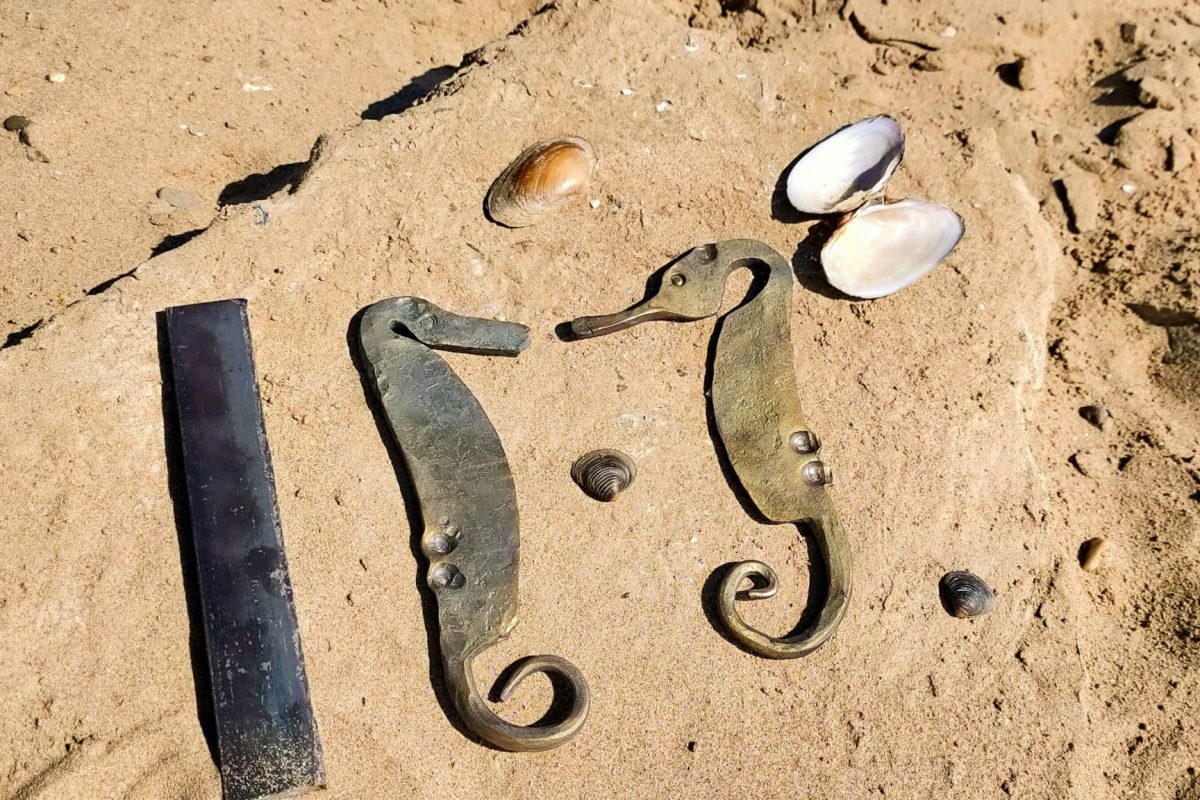
Witness the fascinating transformation of solid metal into an elegant seahorse, guided by heat and skilled craftsmanship.
After a brief introduction by our blacksmith, you’ll have the opportunity to shape a provided metal strip into your very own seahorse. Using a hammer and anvil, and under the guidance of our experienced blacksmith, you’ll learn the techniques involved while creating your unique piece.
Cees Pronk, a former professional in the metal industry, discovered a gap in blacksmithing training courses in the Netherlands back in 1999/2000. Unable to find a suitable program, he decided to develop his own. With approval from the Ministry of Education, Culture and Science, he established the Opleiding Smeden in Andelst and Mondra Opleidingen. Alongside the Opleiding Smeden, workshops and masterclasses are offered for people of all ages and backgrounds, including artists and primary school students. These sessions take place at Forge Cornelis Pronk, a hub for learning about forging techniques.

Language: English.
Kids: make your own bamboo animal! You will learn how to make two to three bamboo animals during the workshop.
Join a master bamboo weaver from Luang Prabang, Laos, and learn about the many uses of bamboo in Laos. During this interactive workshop, you will learn the bamboo weaving craft using no tools other than your hands and creativity.
They consume it (such as in bamboo soup), craft musical instruments, fashion weapons for hunting and traps for capturing animals, and even utilize it for paper production. They incorporate it into constructing houses, walls, roofs, and even bridges. They skillfully split bamboo in various techniques to intricately weave it into baskets, hats, traps, ceremonial items, woven walls, and mats.
Many bamboo creations are dark brown in colour because they have been hung over the house fire in the smoke to harden the bamboo and kill off any insects living in the bamboo. In the villages, cloth weaving is done mainly by women, but men usually do bamboo weaving. It is an important skill, and some people say a man cannot get married unless he can weave bamboo.
There are over 1000 varieties of bamboo worldwide; four main ones are used in Laos. These varieties have multiple uses, which depend on the width of the bamboo stems and the age of the plant. In the countryside, people from the region venture into the forest to cut bamboo, selecting stems that possess the appropriate length between joints. Subsequently, the bamboo is meticulously split and peeled. It is then subjected to scraping, rendering it smooth and flat. Following this, it undergoes a soaking process, often in the river, which can last for several days. This soaking serves to soften and enhance the flexibility of the bamboo, as well as to eliminate any insects that may be present within the bamboo.
At Ock Pop Tok Living Crafts Centre, the value of traditional crafts and their teachings to visitors is significant. This is done not only to keep these crafts alive and thriving but also to encourage visitors to gain a deeper appreciation of the various crafts of Laos, including bamboo weaving.
Originally from Ngoi District, Ae moved to Luang Prabang in 2006 to become a monk. Like many young Lao boys, he was taught the art of bamboo weaving from a young age by his father. While bamboo has many uses in Laos, it’s hard to make a living out of it in Laos. Ae thus decided to take a new direction in 2010. With the hopes of increasing his chances of working in tourism – Luang Prabang is a UNESCO heritage town, and its hospitality scene offered many opportunities – Ae decided to study English. He joined Ock Pop Tok in 2012 and then left in 2017 to gain more experience. Throughout, he never let go of his love for bamboo weaving and would always find some time to practice.
Working at Ock Pop Tok made this easier for him as Ock Pop Tok promotes the traditional crafts of Laos through workshops. Ae rejoined the Ock Pop Tok family at the end of 2022 as Assistant Hospitality Manager, jumping in to teach bamboo weaving classes to tourists visiting Luang Prabang and thus sharing his love for the art of bamboo weaving. He loves that his job allows him to learn new things every day while meeting people worldwide. In his spare time, you will find Ae fishing on the banks of the Mekong, often using bamboo traps and baskets he fashioned himself.
Connected through Craftscurator.


Festival address:
NDSM Loods
NDSM-Plein 85
1033 WC Amsterdam
Postal address:
Stichting Ambacht in Beeld
Kalf 158
1509AH Zaandam
The Netherlands