Creating handmade buttons has been a cherished tradition for centuries, adding unique accents to garments, such as the iconic Zeeuwse buttons made of silver worn as jewelry.
In this workshop, you will craft two artisanal buttons of your choice. Monique will provide various examples and ample materials like ribbons, beads, embroidery threads, allowing you to customize your buttons to reflect your personal style. She will teach you how to use these beautiful materials, along with simple rings, needles, and thread, to create your own buttons.
Monique van Munster has devoted over thirty-five years to exploring handcraft techniques, specializing in embroidery. She is fascinated by the endless possibilities of needle and thread, constantly investigating various techniques and applications. Her focus is not only on reproducing historical and traditional embroideries but also on using them as inspiration for new interpretations. Monique values preserving her craft and enjoys sharing her skills, teaching workshops at her studio in Tilburg and wherever she’s invited to share her knowledge, such as at the Ambacht in Beeld Festival.


Create your own sheet of paper from pure cotton! Cotton is the most sustainable paper due to its high cellulose content, making it a favorite among artists.
In this workshop, you’ll go home with a hand-scooped sheet of paper, optionally decorated with flower petals. Although the sheet will still be wet, it will be provided in a folder for you to take home.
Papermaking by hand was common until around 1720, after which a rotating sieve was used. All the steps—pulp making, scooping, couching, pressing, drying, and burnishing—are essential in a large papermaking machine. Understanding and mastering these steps are crucial for producing quality paper.
With over 23 years of experience, the Papierschepperij in Bruges offers demonstrations and workshops for both adults and children, either at their facility or on location.
Piet Moerman, born and trained in graphics, discovered his passion for papermaking during a visit to the book town of Redu, where he saw a papermaker at work. This experience stayed with him, leading him to order his first professional scooping frames from the “museum für papier und druck” in Basel. In 1999, he established a dedicated papermaking workshop in the center of Bruges. Today, the Papierschepperij boasts an exclusive collection of hand-scooped greeting cards, printed with designs by renowned Bruges calligraphers.


During the free drop-in workshop, you’ll discover the traditional ‘Staphorster Stipwerk’ and create your own stamped card.
‘Staphorster Stipwerk’ is a special, unique technique used to print and decorate fabrics and other materials. Initially, this technique was applied to fabrics used for the traditional clothing of Staphorst.
This printing process uses stamps made from items like wooden bobbins or corks, with nails, pins, and other bits of metal affixed to them. These stamps are dipped in paint and then applied to the material. Stamps with various motifs are combined to create patterns. Each ‘stipper’ (the name for someone who practices Staphorster Stipwerk) develops their own patterns. Some patterns and motifs are commonly repeated among ‘stippers,’ such as leaf and flower designs or folk art examples like the sun wheel, beehive, and six-pointed star.
Not only the motifs, but also the colors of the dots, carry specific meanings. Traditions around mourning heavily influence color choices, where blue, white, and green are mourning colors, and red is not used during mourning periods.
Staphorster Stipwerk is included on the national list of intangible cultural heritage.
The workshop instructors are all craftswomen who have completed the official vocational training in Staphorster Stipwerk.

During the workshop, you will learn to create beautiful tassels that can be used as stylish accessories or unique decorations for your clothing. Discover the joy of combining traditional craftsmanship with contemporary style and take home a stunning handmade tassel!
From skilled artisans of ancient Egypt and Persia to the trendsetters of London Fashion Week, tassels have been a timeless medium for artistic expression. The art of handcrafting tassels has evolved from simple bundles of thread to intricate, decorative pieces that reflect rich cultural and artistic influences. As tailoring advanced in the 16th century and garments became more elaborate, passementerie (the art of making elaborate trimmings) became integral in showcasing craftsmanship. Passementerie encompasses braids, fringes, cords, embroidery, pom poms, lace, appliqués, and tassels. In the 20th century, designers like Coco Chanel and Christian Dior blended traditional techniques with modern fashion, incorporating passementerie into their bespoke pieces.
The workshop begins with winding, tying, steaming, and trimming threads to create a smooth and straight tassel. It may seem simpler than it is; artisans spend hours perfecting this process. You will learn to use materials that make this process faster and easier. Additionally, we will add a decorative bead element for an extra luxurious touch.
During the workshop, all necessary materials will be provided, and additional materials will be available for purchase to continue making tassels at home. You will also receive guidance on the best materials and where to source them. We will share inspiration from modern fashion designers who incorporate tassels into their clothing collections.
By the end of the two-hour workshop, you will have created a beautiful tassel that can be used as jewelry, an accessory, or a clothing decoration. This passementerie element will give your creations a unique, personal touch!
Katja van der Steen is a master cutter specializing in bespoke tailoring for men’s clothing, as well as theater and dance costumes. She has worked on various projects at the Bolshoi Theater in Moscow and undertakes commissions for the Dutch National Opera & Ballet in Amsterdam, the National Dance Theater in The Hague, several museums, and other cultural institutions.
In addition to her theater work, her expertise lies in historical pattern drafting and garment construction, bespoke tailoring, various traditional embroidery techniques, and tatting lace. As a true textile enthusiast, she promotes the craft of handmade through various masterclasses and private lessons, including embroidery, traditional garment making, and textile processing.


In Morocco, the art of geometry is referred to as at-Tasṭīr and it means the ‘art of straight lines’. Each Moroccan ornament and each geometric shape carries a special colloquial name and a story. This masterclass will unfold these untold methods and narratives and will shed light on the artisanal perspectives.
Using a compass, divider and ruler, we’ll learn how to draw a variety of geometric ornaments original to Morocco. We’ll draw together, ask questions and share—all the while, visually visiting Morocco alongside artisan & author Hamza El Fasiki to gain a better understanding of the cultural and practical applications of the art. This masterclass is open to anyone interested in learning about geometric arts and celebrating the richness of arts and crafts of the kingdom of Morocco, and Fes Medina in particular! You get to keep your drawings.
Hamza El Fasiki is an artisan and author. Hamza has apprenticed under his father at Dar-Attamania Studio in Fes, Morocco between 2011 and 2021. Hamza holds an MA degree on Moroccan Cultural Studies with an academic research focus on the cultural history of Moroccan traditional crafts from Sidi Mohamed Ben Abdellah University in Fes. Hamza is specialist in traditional Moroccan geometric patterns, brass engraving, and bookbinding. He has also published academic works in the field and traveled around 16 countries while learning and teaching Moroccan culture.


Neon was discovered in the UK, and the first neon gas tube was illuminated in 1898 in London. Neon lights are beautifully simple: neon gas is harnessed from the air we breathe, put in a vacuumed glass tube, and excited by electricity. Neon lights are 100% recyclable, 100% biodegradable, and comparable in their energy efficiency to LEDs. In 2022, neon was placed on the ‘Red List of Endangered Crafts’ of Heritage Crafts.
Over a two hour session, participants will get the rare chance of learning to make neon by bending and blowing glass tube with flames over a paper circle template, you will see your attempts come to life as the tutors process your glass on the Electron Bombarder and fill it with the red rare noble gas: neon. The workshop includes a power supply and wall fixings, so you take home a working light.
Starting with a straight glass tube, you will learn to cut, bend and blow glass, making use of a flame over a circle template. Then watch as we process your circle shape with gas on our Electron Bombarder – light creating machine. We’re not expecting you to make the perfect O. This would take many hours of practice. Our aim is for you to leave with your own beautiful imperfect versions of a circle :) . Illuminate your home as a reminder and appreciation for human skill. We are working with clear glass tube and neon gas – which glows red when excited by electricity.
Richard William Wheater is an artist using performance and installation to discuss our relationship with the natural environment. Recent work remains loyal to his fascination with glass and neon, which he performs and exhibits worldwide. In 2010, Wheater established the company Neon Workshops. Neon Workshops Ltd. specializes in the development and manufacturing of neon lighting for the creative industry. They organize global shipping and installation of projects and host an annual exhibition program of neon-related work. Based in Wakefield, their facilities include neon-making, a gallery, and a significant public resource library on the subject, all housed under one roof.
April Key is a sculptor who primarily uses illuminated glass and sculpted base body materials. She began working with neon while living in Istanbul. Coming from an architecture background, Key is interested in manipulating light through structure and color. This interest led to discovering neon glass making and general sculptural practice, two prominent elements in her work. April is deeply passionate about retelling memories and historical stories through this visual language, drawing much inspiration from locality and individuals.


Görkem Şen is an artist, inventor, composer, multi-instrumentalist, sound engineer, and sound designer. In his journey to search for the essence of music, after thoroughly understanding the elements of traditional and electronic music, he created the instrument called the ‘yaybahar’, which can produce complex sounds in a completely acoustic form.
Şen’s desire to explore new techniques and unusual sounds in his music is a fundamental part of his art.
Şen is known for his exploratory and innovative approaches; he aims to push the boundaries of musical expression. With his invention, spring family instruments, he creates entirely new sound textures and melodic structures beyond traditional musical forms. Şen’s approach to music has encouraged other artists to seek new forms of musical expression and create their own unique musical instruments.
His invention has been studied both from a musical perspective and through the lens of physical principles around the world and has been taught in renowned universities.
He has given more than 40 solo concerts in Europe, America, and Asia.


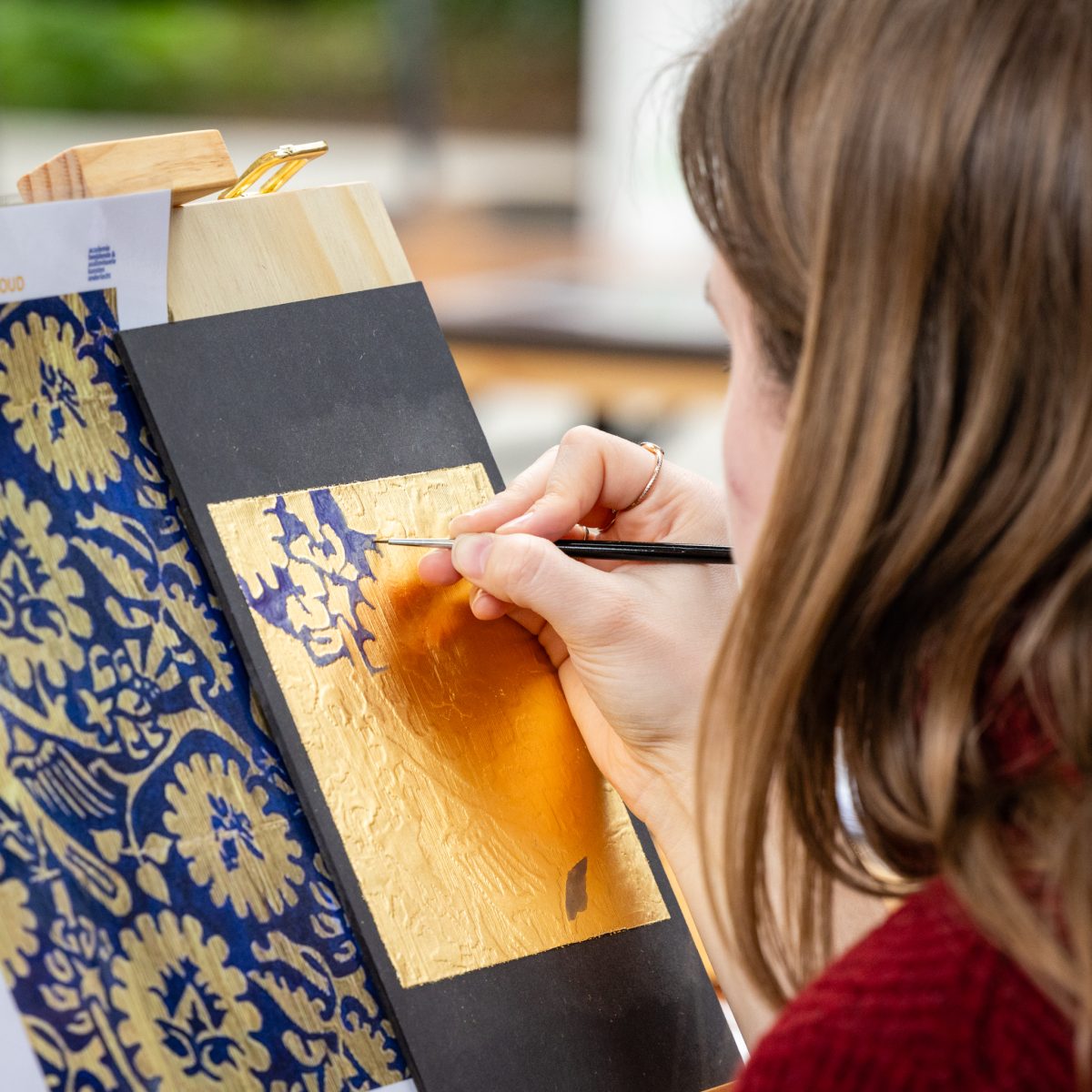
Pressed brocade is a late Gothic decorative technique that imitates woven silk brocade fabrics. These brocade fabrics, enriched with gold and/or silver threads, were replicated using a reproductive technique. We find “pressed brocade” as relief work on polychromed sculptures, panels, and in historical interiors. In this masterclass, you will create a “pressed brocade” piece based on a 15th-century example and go through the entire process to produce your own sheet of “pressed brocade” to take home.
By following this historical decorative technique step by step, you will learn the production of “pressed brocade” in all its intricacies. In an engraved mold, the three-dimensional shape of a textile fabric is copied using tin foil. This imprint is then gilded and painted with pigments. The final expression of the fabric is determined by the texture of the opaque or transparent paint layer in blue, red, or green hues. The hatching in the brocade sheet imitates the gold threads of a silk brocade fabric.
This masterclass is offered in collaboration with the Craftsmanship and Polychromy Workshop of the Academy of Fine and Audiovisual Arts Anderlecht, where historical painting and decoration techniques such as gilding and silvering with leaf metals, as well as techniques like pastiglia, pressed brocade, sgraffito, punchwork, gemstone decorations, are taught.
Sandy van Wissen (born 1968) works in the cultural heritage sector in Belgium, focusing on hands-on conservation, research, and restoration of polychromed sculptures. She is also part-time lecturer at the Craftsmanship and Polychromy Workshop, teaching both historical and modern decorative techniques.

The family-owned business Hawar Textielinstituut is a paradise for textile enthusiasts. Teachers from both the Netherlands and abroad come to share their knowledge and skills in the spacious and atmospheric workshop located in Oldeberkoop, Friesland. Additionally, there is an extensive shop and an inspiring gallery, making it a breeding ground where new and old materials and textile techniques are rediscovered.
During the festival, Hawar sells various materials and tools for textile enthusiasts, you can also purchase the magazine “Vezel” at Hawar’s booth.
Hawar also teaches the workshop “Experiment with Botanical Printing.”
In “Vezel,” you’ll read about personal textile adventures and be inspired by others’ enthusiasm. Knowledge, skills, and experiences are shared, offering opportunities to discover new techniques and materials or innovative applications of traditional ones. What could be more enjoyable than putting these ideas into practice? “Vezel” encourages inspiration, creativity, and trying out things yourself.
What started over 40 years ago as a newsletter about spinning and dyeing has evolved into a comprehensive and practical textile magazine, still published by the Stichting Spin- & Verfkrant—a group of volunteers dedicated to sharing the importance of material knowledge, techniques, and experiences, keeping the craft vibrant and alive in today’s world.
For 42 years, “Vezel” has been created by and for textile enthusiasts. It serves as a platform where everyone can share their textile adventures, making “Vezel” truly special.


In this inspiring workshop, you’ll learn how to create unique handmade jewelry using beautiful gemstones. Guided by designer Fatima Essahsah, known for her attention to detail and passion for natural materials, you’ll explore a world of colors, textures, and shapes that will ignite your creativity.
Fatima will take you on a creative journey where you’ll not only learn simple techniques to craft stunning jewelry but also discover the stories behind the stones, their symbolism, and their energy. The focus of the workshop is on creating jewelry pieces that tell a story. Rather than just aesthetics, participants are encouraged to use their jewelry as a form of personal expression. Whether you’re a beginner or have some experience, these workshops are designed to inspire and challenge everyone. You’ll learn how to use fishing wire to string different gemstones, creating patterns that reflect the story you want to tell.
Fatima Essahsah is the passionate founder of Stones Stories and a talented jewelry designer. Her unique pieces are crafted in Morocco using traditional Jewish and Moroccan craft techniques. Drawing inspiration from her road trips across Morocco, Fatima discovers stories that reflect the rich diversity of North Africa. Founded in 2017, Stones Stories is more than just a jewelry brand; it’s a platform that brings the cultural heritage of North Africa to life.
Fatima’s work extends to international museums where it is exhibited, and she gives lectures emphasizing cultural diversity. She also regularly organizes workshops and social experiments aimed at connecting people from different cultures. Her jewelry not only showcases beauty but also carries a deeper narrative—a narrative that invites people to explore the rich history and traditions of North Africa.

Photographer: Frederique Peckelsen
Festival address:
NDSM Loods
NDSM-Plein 85
1033 WC Amsterdam
Postal address:
Stichting Ambacht in Beeld
Kalf 158
1509AH Zaandam
The Netherlands