Create your own unique herbal blend! Guided by tea sommelier Benita Roetman from Thee & Kaart, embark on a journey through scents and flavors to develop your personal tea blend. Let your sense of smell lead you and create a tea that perfectly suits you. Be surprised and inspired during this workshop. And after the workshop, you can continue to enjoy your personal tea at home.
In this fascinating herbal workshop, you will discover the art of brewing the perfect cup of herbal tea. Step by step, you will learn how to create a balanced herbal blend, using only your sense of smell to select the herbs. By setting aside your thoughts and following your intuition, you’ll find yourself making choices that you might not have expected. The exciting part is that you won’t know which herbs you are smelling, allowing you to select them purely by scent. This ensures a unique and surprising experience.
One thing is certain: at the end of the workshop, you will go home with your own unique, personal herbal blend that you have created yourself. So you can continue to enjoy this special workshop at home.


Beadwork has a long history in East Africa and often carries significant cultural meaning. Colors and patterns can indicate age, ethnic group, or marital status. Women typically learn beadwork from their mothers and grandmothers, making it a skill they can carry with them, rely on, celebrate, and pass down to their children. South Sudanese women are talented bead stringers and have used this heritage skill as a means of generating income after being forcibly displaced.
In this workshop, two forcibly displaced South Sudanese women, working with MADE51, a global brand by UNHCR, will teach participants about their heritage skill of beadwork. Participants will leave this workshop with an understanding of the cultural significance of beadwork in South Sudan and a bracelet to take home.
The workshop begins with an introduction to the two artisans, who will familiarize the participants with their equipment, including a loom, needle, thread, and beads. They will then demonstrate the stringing technique and offer tips for making bracelets. Participants can choose from three patterns to create their bracelets for the rest of the workshop. Meanwhile, the artisans will walk around to assist in the bracelet-making process and share stories about their heritage craft and experiences with displacement.
NB Due to visa challenges, this workshop will be taught via video connection, with live assistance.
More than 120 million people worldwide are forcibly displaced, driven from their homes by war, persecution, or disaster. Among this vast group are incredible artisans who possess the talent, culture, and heritage to create objects of true beauty.
MADE51 is a global brand, an initiative of UNHCR, the UN Refugee Agency, connecting these artisans with social enterprises. Using Fair Trade principles, they support the design, development, and marketing of the unique products that form the MADE51 collection. Through MADE51, those forced to flee have the opportunity to earn an income while in displacement. For consumers, these pieces are more than beautiful examples of craftsmanship and heritage; they are expressions of hope.
Sunday Adee Michael is a South Sudanese refugee living in Kenya. She is a member of the Kalobeyei Women’s Handicraft Cooperative and specializes in beadwork. At 21 years old, she is the youngest leader in the cooperative. In 2016, Sunday arrived at the Kakuma refugee camp at the age of 13 with her 9-year-old brother. As a young girl, Sunday took full responsibility for her brother and herself, ensuring they received education and met their essential needs as the head of her household. Beadwork with the cooperative has played a crucial role in paying for their school fees and books.
Sunday demonstrates resilience in every situation. She joined the cooperative at 19 in 2021 and has since become one of its leaders. She hopes to complete her education and eventually attend university to earn a degree in business administration. After completing her studies, she plans to start her own small business and employ members of her community.
Nyanachiek Padiet is an internally displaced South Sudanese woman living in South Sudan. Nyanachiek has been working with Roots, a MADE51 social enterprise partner, for over eight years. She specializes in beadwork, a traditional skill passed down from her mother, and supports Roots with storekeeping, training artisans, and quality control for large orders. Nyanachiek is a member of the MADE51 Artisan Speakers Group and uses her voice to help others understand her refugee experience and the importance of craft in her life. On World Refugee Day 2023, she spoke remotely at a MADE51 event at the UK House of Lords. She also participated with MADE51 at the 2023 Global Refugee Forum in Geneva.


Photo credits: Erin Flannery en Ala Kheir

Discover the art of designing and making foldable hand fans in this special workshop led by experienced fan maker Victoria Ajoku. She encourages using the pleated fan leaves as a canvas for decorative exploration. In this session, you will learn about fan design, the history of fans, terminology, and the intricate methods of fan assembly. By the end of the workshop, you will have your own unique, personalized foldable hand fan to take home and display as a piece of art.
Did you know that the art of fan making in the United Kingdom is on the list of ‘endangered crafts’ and at serious risk of dying out completely? Fan making is an ancient tradition that incorporates therapeutic physical rhythms in the design phase, offering a creative and expressive range that invites the collaboration of various art methods in the creation process.
Victoria Ajoku is the founder of ‘Fan The Glory With Tori‘ and focuses on reviving the ‘concept of the fan’ for all communities to partake in and enjoy. Victoria holds a BA Hons in Drama, Theatre, and Performance and an MA in Creative Research and Performance. She discovered her love for hand fans through her years of performing, studying, and traveling. Victoria is certified by the CPD Standards Office as an art therapist, well-versed in cultural heritage studies, and also certified by the ‘European Reminiscence Network’.
In collaboration with Heritage Crafts.


Join this inspiring workshop and learn how to make your own natural cosmetics. We’ll use our star ingredient shea butter, along with other pure, nourishing ingredients, to create products that leave your skin silky smooth.
What can you expect from our workshop? Learn step-by-step how to work with shea butter, essential oils, and other organic ingredients. The workshop is led by Altagracia Kotzebue, founder of Urban Africa Naturals. With her passion for natural skincare and years of experience in creating natural products, she shares her expertise and enthusiasm with all participants. Receive handy tips and tricks to continue at home and take your self-made, skin-friendly products with you.


We take you on a journey into the magic of enameling during this workshop. First, we’ll discuss the ancient process of enameling, a technique that has been used for many centuries BC. What is enamel, what is it used for, since when has it been used, what are its applications, what different techniques exist, and why is this material so unique? We’ll also show examples of artworks created with enamel. Enamel can be applied to steel, copper, silver, and gold, using various materials and techniques.
We’ll start with simple basic techniques. A copper plate will be cleaned, and we’ll teach you how to apply enamel powder. It may seem easier than it is. The piece will then be fired in an enameling kiln at temperatures of 800-950 degrees Celsius. When it comes out of the oven, it will be red-hot, and as it cools down, the colors will emerge, transforming the powder into glass. This moment is truly magical!
There is usually a degree of unpredictability: how will it look coming out of the oven? Have the colors turned out exactly as planned? Are there unintended oxides that have surfaced? This unpredictability adds excitement to the enameling process. After cooling, the piece can be further embellished by adding colors or materials before being fired again. This can be repeated several times. Everyone will leave with one or two unique pieces and a hands-on experience in the craft and application of enameling in art.
At the Craft in Focus Festival, six experienced artists and instructors will lead the workshops. Christine vd Ree, Marrie Schipper, and Hanneke Klievink will be there on Saturday; Annemarie Timmer, Hoi-Shan Mak, and Mariet Lohman on Sunday. They have exhibited their work nationally and internationally and have mastered various techniques. All are members of the Association of Dutch Enamelers (VNE), founded in 1983 with the aim of promoting enameling as an art form. The VNE currently has over 70 members and several donors. They organize workshops annually in Amersfoort and hold exhibitions in galleries or museums.


Did you know that you can create beautiful fish leather from fish skins? It’s a zero waste solution with stunning results!
Fish leather is a strong and durable type of leather that was historically used on a large scale by the North Pacific peoples to make bags, parkas, boots, mittens, and other clothing.
Happy van der Heide, a skilled craftswoman and circular artist, is one of the few individuals in the Netherlands practicing the ancestral skill of transforming fresh fish skins into fish leather.
In this workshop, you will learn how to ecologically clean a fresh fish skin and remove the scales. Then, the skin will be treated using environmentally friendly techniques to tan it. Softening the leather requires some effort, but the end result will be a unique, soft, and supple piece of fish leather. The visible texture of the scales gives the leather an elegant appearance.
You will take home a piece of salmon leather and a newfound appreciation for fish leather.
Happy van der Heide, raised and educated amidst the wetlands between Joure and Sneek, is the owner of ‘Hip & Happy – craftsmanship & design’, a studio dedicated to raising awareness for a livable Earth. Through exhibitions, lectures, workshops, and masterclasses, she inspires people of all ages, offering opportunities to learn and re-learn traditional skills, alongside showcasing inspiring innovations rooted in nature.


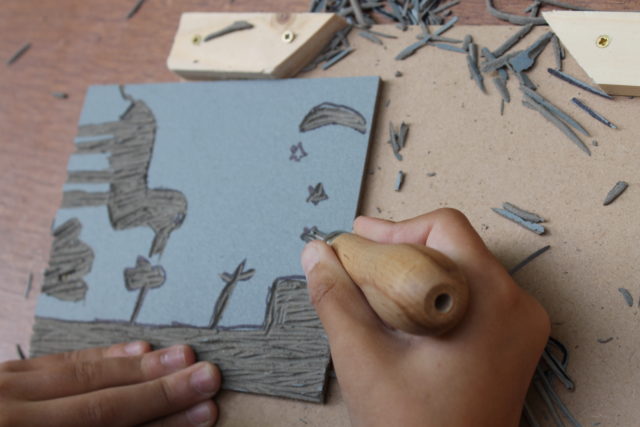
Step into the shoes of a true artist and create your own graphic artwork! In this workshop, you’ll experiment with color, shape, and lines. You’ll use carving tools and ink, and make the printing press work overtime to produce a beautiful linocut.
The artists of the Amsterdam School were true polymaths. In addition to stunning architecture, furniture, and everyday objects, many were also involved in typography and graphic design. They frequently used printmaking techniques to create posters or book covers. And now, you can do the same!
Whether young or old, everyone is welcome in this workshop. Special materials are available for children under eight to ensure their safety.
This workshop is hosted by Museum Het Schip, the museum dedicated to the Amsterdam School in architecture, decorative arts, and public housing.
The workshop runs continuously, and you can purchase a ticket to join whenever a spot is available.


Learn Traditional Hand Engraving with Master Engraver Jacqueline Jimmink! In this workshop, you’ll discover the art of traditional hand engraving on copper. Engraving is essentially drawing on metal. Using a burin (engraving tool), you’ll engrave decorations or letters on a pre-formed copper plate of your choice. You’ll work with authentic hand engraving tools, just like the masters did in the past. This program is challenging for everyone and is tailored to each participant’s level.
The workshop will explain how to use burins to manually engrave lines and shadings. The tremble technique, which creates contrast in the engraving, will also be covered. Each participant will leave with a self-engraved piece, such as a nameplate, keychain, and/or piece of jewelry. This is an experience for anyone interested in learning about this endangered craft.
The Dutch Center for Hand Engraving will offer all-day demonstrations of hand engraving alongside the workshops during the Ambacht in Beeld festival.
As of June 14, 2024, Hand Engraving has been included in the Network of Intangible Cultural Heritage. This initiative was taken by the Dutch Center for Hand Engraving, founded by Jacqueline Jimmink. Intangible cultural heritage can only be nominated by practitioners or direct stakeholders, recognizing this cultural expression as intangible heritage. The Dutch Center for Intangible Cultural Heritage has confirmed that Hand Engraving meets the criteria for intangible cultural heritage as outlined in the UNESCO Convention for the Safeguarding of Intangible Cultural Heritage.


Learn to make your own record player with sound artist Jacob Plooij!
In a short time, create your own phonograph with a pencil, a record, and a piece of paper.
Materials will also be available for you to collaborate on building one or two larger machines that will remain throughout the weekend.
Jacob will also bring a real wind-up gramophone with a large horn!

During the festival, children can create their own mosaics using various items, from waste materials to toys and trinkets that everyone typically has lying around.
There will be materials available for children to choose from to create their own mosaic. They can decide whether to fill in a drawn silhouette or sort colors to create a more realistic image.
Ultimately, the panels created by the children will form one colorful wall.
Ismaël studied installation art at KASK in Ghent and started making mosaics years ago using all sorts of discarded materials. He began with simple silhouettes filled with colorful materials, first on boards and then on the wall of his room. Because he enjoyed it so much, he eventually decorated the entire garden wall of his house.
Festival address:
NDSM Loods
NDSM-Plein 85
1033 WC Amsterdam
Postal address:
Stichting Ambacht in Beeld
Kalf 158
1509AH Zaandam
The Netherlands