During the Ambacht in Beeld Festival, Ambachtelijk Vakmanschap Nederland will be present to inform you about this new national platform for the crafts sector.
Ambachtelijk Vakmanschap Nederland is a platform and a network of and for professionals. Together, we aim to improve visibility and connections within the field of artisanal craftsmanship, with the goal of addressing urgent challenges.

Are you interested in the origins of photography? Do you want to learn about one of the first photography processes, the wet plate collodion process? Then register for this introductory workshop.
In this practical workshop you will get to know the basics of this 19th century process; from pouring collodion on the plate, developing and fixing to working with a large format camera 4×5 Cambo.
Afterwards you will not only return home with a handmade portrait, but also with a deeper understanding of how these unique portraits were created in 1851.
Wet plate or Collodion photography is a traditional photographic technique that was invented in 1851. With this method, collodion is poured onto a plate of glass or aluminum (formerly asphalted tin). This is then made light-sensitive with silver. As long as the plate is wet it can be exposed, hence the name ‘wet plate’. The warmer the environment, the shorter the time to expose your plate. This traditional method results in unique portraits built up from extremely small silver particles. Portraits that will certainly last hundreds of years.
Wet plate studio Amsterdam was founded by Sanne Paul. A traditional portrait studio where ‘wet plate’ portraits are made on aluminum or glass in various sizes. In her work as a wet plate photographer, Sanne finds the tranquility and the craft, which sometimes threaten to be lost in this digital age.


Discover the lost art of French beading. By learning a combination of techniques, you’ll create your own everlasting flower—skills that you can use in the future to craft your own stems and designs.
This course is suitable for all levels, under the inspiring guidance of Holly Parr from Beaded Blooms (UK).
With small glass seed beads and wire, you’ll be amazed at how ethereal your finished stem looks. Although it’s a solid, sculptural piece, these glass bead designs appear soft and delicate, transforming under various light conditions. Patterns are provided to assist you, along with demonstrations and plenty of personal support as you are guided through creating your chosen stem.
By the end of the course, you will have completed a design that will stand the test of time.
You can choose from four different workshops, per workshops one design is created:
Saturday morning 10:30 – 12:30 uur Wheat stem
Saturday afternoon 14:30 – 17:30 uur Daisy stem
Sunday morning 10:30 – 12:30 uur Lavender stem
Sunday afternoon 14:30: 17:30 uur Cornflower stem
French Beading is a 19th century art form that has gone through waves of popularity. Believed to have originated in both Italy and France the craft was predominantly favoured by women in order to earn a little money of their own and to decorate their homes. There was even a time when French beading patterns were accessible in popular literature and magazines. In the Victorian era French Beading became associated with the passing of a loved one as many memorials were created using the technique. French beading is beginning to become popular once again. With beads of just about every colour available it is possible to create stunning flowers, even when they are out of season.
Holly researches each natural bloom she replicates before designing the flower she has selected. With flowers having such a powerful impact on us, creating memories, improving our mental health and sending messages it is really important to Holly that her designs are as accurate as possible and that they capture the splendour of the blooms she replicates.


Marqueterie de Paille, or Straw Marquetry, originated in 17th-century France. In this masterclass, you will be introduced to the technique of marqueterie de paille. You will learn how to select and process the straw. For two hours, you will immerse yourself in this unique technique and go home with a handmade book featuring a straw marquetry cover. With simple tools and a few basic techniques, you will create a luxurious gift for yourself or someone else.
Originally, this technique was practiced by prisoners and monks. Since the beginning of the last century, marqueterie de paille has seen a strong revival. It can be applied to various objects such as furniture, jewelry boxes, wall panels, and accessories. The technique uses colored straw that is carefully flattened to create beautiful patterns and designs. The result is a stunning play of colors that gives each creation a unique shine and appearance. Due to the simplicity of the materials and the complexity of the technique, marqueterie de paille is both accessible and challenging for beginners and experienced artists alike. It is fascinating to see how a simple material like straw, with its natural luster, can produce such a special effect.
Arlette Damiaens on why this craft means so much to her: “Sometimes a material can cross your path and you are immediately captivated. The vibrant colors and mysterious shine of the straw made it love at first sight. Two days after I first saw a photo of the processed straw, I was in Paris to discover what the straw and the technique could mean for me. I now know that the mysterious shine of the straw is very natural. No varnish is involved. I love to share the beauty of the colorful straw in the hope that the craft will also captivate others.”


Over 120 million people have been forcibly displaced across the world, driven from their homes by war, persecution or disaster. Amongst this vast group of people, there are incredible artisans that possess the talent, culture and heritage to create objects of true beauty.
MADE51 is a global brand, an initiative brought to life by UNHCR, the UN Refugee Agency, who connects these artisans with social enterprises. By utilizing Fair Trade principles, they support the design, development and marketing of the unique products that make up the MADE51 collection. Through MADE51, those who have been forced to flee have an opportunity to earn an income while in the midst of displacement. For consumers, these pieces are more than beautiful examples of craftsmanship and heritage, they are expressions of hope.
During the festival we present an exhibition and sales stand with objects made by refugee artisans.

Step into the world of a student at the Hout- en Meubileringscollege (HMC). In the Creative Craftsman program, students learn to combine the latest techniques with traditional craftsmanship.
The leather pattern pieces for the make-up bag are cut out using a laser machine. You choose the leather and thread color you want to use. During the workshop, you will be introduced to hand stitching and learn various decorative stitches. After the workshop, you will leave with a hand-stitched makeup bag.
Since 1929, HMC has been an independent vocational school. As a relatively small school, we offer a personal and safe environment. We train students for careers in interior design, furniture, technology, and design. We offer programs for various professions including furniture maker, interior advisor, creative craftsman, home sales advisor, carpenter, upholsterer, and piano technician. We also provide courses and training for adults.


Create a personalized phone case from ‘waste’ leather.
In this workshop, you will learn to work with leather and how to hand-stitch it. We use the saddle stitch, an ancient and very strong stitch. We will guide you extensively through the making process. You will learn the basic techniques for working with leather and how to create a beautiful, simple, and functional accessory.
Atelier Rosanne Bergsma creates shoes and accessories designed to last a lifetime. Through a combination of craftsmanship and a passion for functionality, we have developed a timeless collection. Everything we make is handcrafted using the best and most sustainable materials. We also produce on demand, ensuring nothing goes to waste.
Thanks to Leer en Meer for sponsoring supplies.

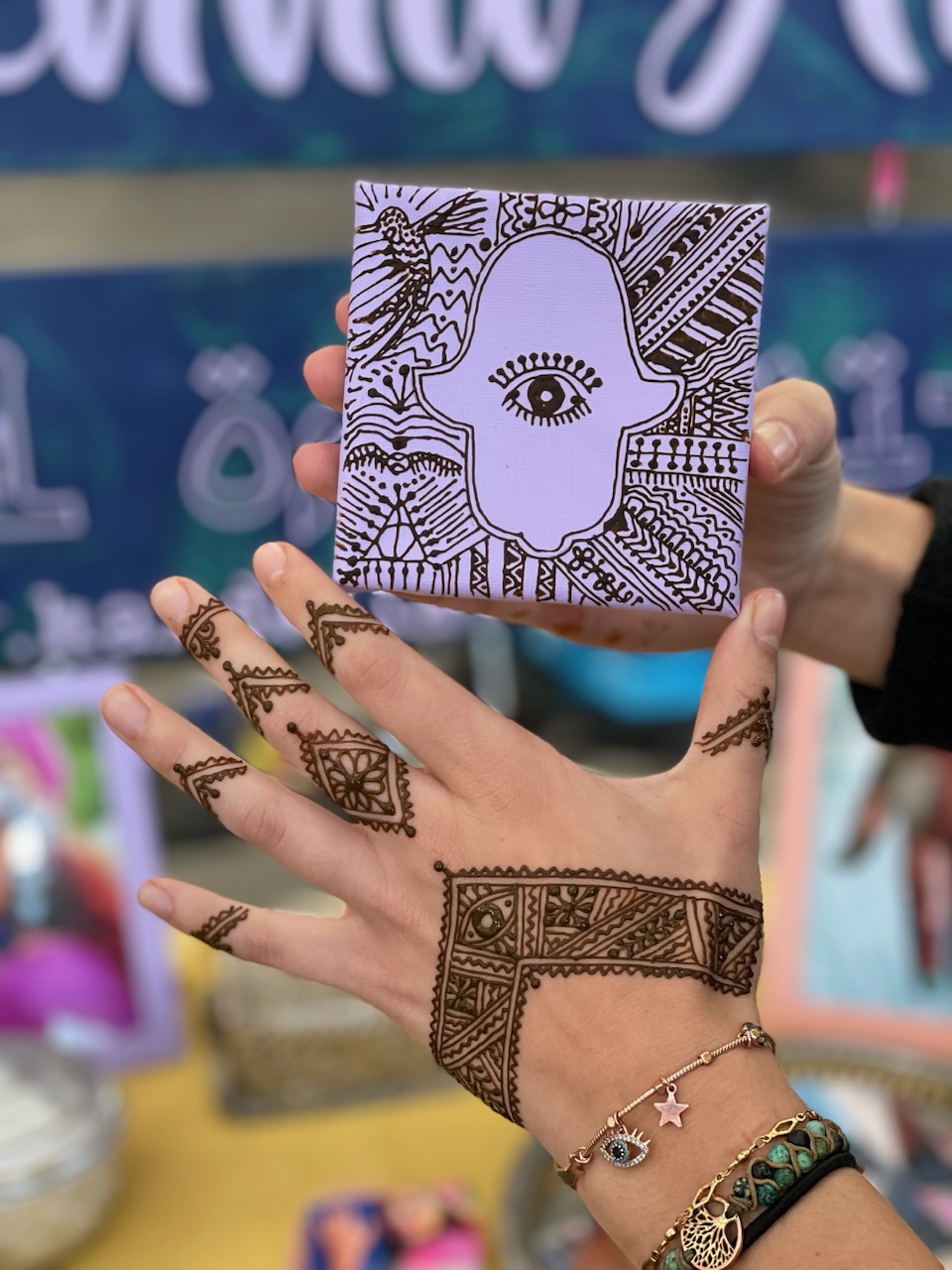
During this workshop, we start with a brief introduction to the world of Moroccan henna art. Do you know, for instance, why henna is used and the meanings of certain patterns? What technique is used to apply the patterns? During the workshop, you will learn this and also get hands-on with the technique. Using a cone filled with henna paste, you will create a pattern on a small canvas in five steps. This needs to dry, so by the end of the day, you can pick up your henna artwork and take it home. With a bit of luck, you might also get a decoration on your hand from our professional henna artist.
Moroccan henna art is a craft traditionally passed down from mother to daughter or spread organically within women’s communities. The craft is characterized by a specific technique, namely applying henna with a cone. Geometric patterns are often applied to hands and feet. The henna binds to the keratin in the skin, making the orange-brown decorations visible for 1 to 2 weeks.
Henna is best known as a ceremonial part of a Moroccan wedding, where the bride’s hands and feet are decorated with henna. But henna is much more than a beautiful skin decoration. It encompasses a whole world of symbolism, meaningful rituals, and empowering traditions.
At the age of four, Fatima Oulad Thami experienced her first henna ritual during a visit to her grandmother in Morocco. A neighbor girl drew a herringbone pattern on her hands and feet with a stick and henna paste. This experience would change her life forever. Every summer, the henna ritual became a fixed tradition of the holiday. At the age of fourteen, she began to self-teach to become a neqacha. Now she has 30 years of experience and is a sought-after henna artist both nationally and internationally. With Moroccan henna art as her expertise and her passion as her drive, she has achieved much under the name Hand of Fatima. She has an online learning platform, a webshop with henna supplies, the Henna Academy for group lessons, commissioned work, a master-apprentice trajectory via the Cultural Participation Fund, and much more. Fatima is now not only a neqacha but also a speaker, teacher, artist, and socially engaged creator.
NB: Fatima also teaches a masterclass during the festival.


The goal of this masterclass is to decorate a bndir with henna patterns. A bndir is a traditional round hand drum made from animal hide. This parchment can be painted with henna, which is traditionally done. Unlike on living skin, a henna decoration on parchment is permanent, making the bndir a beautiful art object that you can hang on the wall or place a light behind for an extra beautiful effect.
During this masterclass, you will first receive an introduction to Moroccan henna art. What is the cultural background? What meanings are associated with the patterns, and why is henna used? Then participants will then move on to the practical part. We will practice the piping technique: how to draw long, thin lines, how to make drops and leaves in one movement, and how to balance speed and pressure.
Moroccan henna art is a craft traditionally passed down from mother to daughter or organically spread within women’s communities. The craft is characterized by a specific technique, namely applying henna with a cone. Geometric patterns are often applied to hands and feet. The henna binds to the keratin in the skin, making the orange-brown decorations visible for 1 to 2 weeks.
Henna is best known as a ceremonial part of a Moroccan wedding, where the bride’s hands and feet are decorated with henna. But henna is much more than a beautiful skin decoration. It holds a whole world of symbolism, meaningful rituals, and empowerment traditions.
At the age of four, Fatima Oulad Thami experienced her first henna ritual during a visit to her grandmother in Morocco. A neighbor girl drew a herringbone pattern on her hands and feet with a stick and henna paste. This experience would change her life forever. Every summer, the henna ritual became a fixed tradition of the holiday. At the age of fourteen, she began to self-teach to become a neqacha. Now she has 30 years of experience and is a sought-after henna artist both nationally and internationally. With Moroccan henna art as her expertise and her passion as her drive, she has achieved much under the name Hand of Fatima. She has an online learning platform, a webshop with henna supplies, the Henna Academy for group lessons, commissioned work, a master-apprentice trajectory via the Cultural Participation Fund, and much more. Fatima is now not only a neqacha but also a speaker, teacher, artist, and socially engaged creator.
NB: Fatima also teaches a workshop during the festival.

Gold leaf has been used for centuries to enrich and beautify objects, from religious icons to architectural details, making them appear more precious and esteemed. A fascinating application was in ancient manuscripts, where scribes meticulously applied gold leaf to letters and margins, creating dazzling effects that captured the light and symbolised the sacred or important nature of the text. This practice not only enhanced visual appeal but also reflected the wealth, power, and devotion of the patron who commissioned the work. The ability of gold leaf to elevate the status of objects continues to fascinate and inspire even today.
Dietmar Feldmann from Lower Bavaria is a master craftsman, running a restoration company with ten employees for 40 years. His signature adorns 70 churches, and he has restored over 1,500 paintings and 100 altars. Additionally, he has reconstructed or repainted 20 altars and trained more than 20 apprentices and 800 master students as a renowned course leader. Fun fact: he also gilded the guitars of hardrock band The Scorpions.
Join this master class on Sunday or have a look here for the beginner workshop on Saturday. In this master class, you will have the opportunity to gild your own treasures. Bring your shells, stones, or other objects that hold memories and emotions, and learn to use gold leaf, metal leaf, adhesives, and tools like gilding brushes. In this advanced course professional applications and the combination of adhesives, Instacoll, and Permacoll are taught and practised.
In collaboration with The ARCH.

Festival address:
NDSM Loods
NDSM-Plein 85
1033 WC Amsterdam
Postal address:
Stichting Ambacht in Beeld
Kalf 158
1509AH Zaandam
The Netherlands