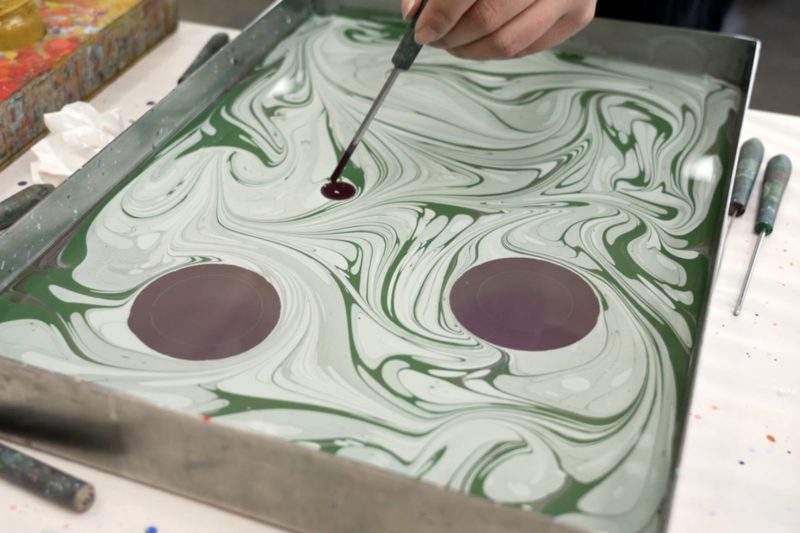
Ebru art is an ancient painting technique that has been around for 1,500 years. In this technique, we paint on water. During the workshop, we will practice ebru art in the most traditional way, with water, paint and brushes, precisely as our ancestors did 1500 years ago.
Okan Akin is an artist born and raised in Turkey. He completed his art education in 1991, specialising in textile design. He worked for five years as a teacher at a vocational school in Turkey. In 1997, Okan moved to the Netherlands. In 2006, he decided to start his studio, Atelier Okan Akin, in Amsterdam, at the NDSM Loods. Here he still works full of enthusiasm and passion as an artist.
“I learnt traditional art techniques at an art academy in Turkey. Besides traditional art, I also studied modern art. My ultimate challenge is to apply and combine general art techniques in my contemporary work. Ebru art (paper marbling) is an example of this.”

When you think about lace making, you may associate it with lace collars in paintings by the old masters and dresses at your grandmother’s house. But even today, there are lace makers who have the dedication and patience for this craft. And of course, this craft, too, has evolved. The lace making technique is not only used in art, textile art, fashion and jewellery. Even steel fencing has been made using the technique of bobbin lace. So, with bobbin lace, much more can be done.
Once you have mastered the basics, you can make choices in which direction and with which application you want to continue. Maybe you have no idea how to make lace. Perhaps you have been looking at a bobbin lace pillow with bobbins shooting in all directions, and you have wondered how someone knows which bobbin goes in which direction and when… In either case, we challenge you to come and experience what it is like to sit behind a bobbin lace pillow and make something small with bobbins. You will go home with a happy little octopus and an idea of how those experienced lace makers know which bobbin, when, should go where.
We got to know each other at various lace bobbin courses at home and abroad. Meanwhile, Corrie has started teacher training in Germany, and Rit is chairman of a large lace society in the Netherlands. We no longer want to keep our enthusiasm for making lace with bobbins to ourselves but share it with the world. That may seem a bit ambitious, but for the Ambacht in Beeld Festival, we are happy to pull out the lace bobbin pillows, bobbins and pins.
Photos: Kika Booy.


A pop-up book is something magical. Every time you turn a page, a three-dimensional and/or moving surprise appears. There are most spectacular pop-up books, hugely complex structures made of paper. But an exciting pop-up does not necessarily have to be complicated if you use the basic techniques cleverly and combine them!
In this workshop, Rianne will take you on an adventure into the world of pop-up books. For inspiration, you will be shown some of her favourite examples. Then you will create the magic yourself. You will learn some simple techniques that form the basics of pop-ups. With these, you will develop at least one design into your own pop-up card. More is, of course, allowed, whether or not bound together into a booklet. Finally, you will take home your sketches, plus a lot of inspiration and tips, so you can experiment further if you feel like it. And if you want to develop more skills during the festival, you can also take this workshop with Rianne.
Rianne van Duin is a Paper Adventurer and professional tinkerer. She invents and creates interactive 2D/3D worlds from paper. For children and with children (from 0-100 years old).
Rianne’s work ranges from illustrated pop-up books to life-size foldable theatre sets, from children’s newspapers to paper animation. Interaction is central to her creations. They stimulate the imagination and invite one to play, manipulate and experience them.
Rianne built her studio on the NDSM-Werf. From there, she works on commission for publishers, theatre productions and festivals, independently or in collaboration with (the work of) illustrators such as Fiep Westendorp and Leo Timmers. She also initiates personal projects such as Your Adventure, her independently published interactive children’s book, without batteries or electronics.

Old2Gold processes beloved pieces of clothing as lining in a bag made from reused leather. For many, garments contain a special memory: the first baby clothes, your wedding dress, a blouse of a deceased loved one or simply a favourite pair of trousers. For many, throwing these kinds of items away is difficult, resulting in a box of clothes sitting unused in the attic for a long time.
Old2Gold makes this memory tangible by incorporating recognisable elements of that special piece of clothing as a lining into a bag. Each bag is made from reused leather from old furniture, trimmings or samples to prevent high-quality, usable material with a special and personal story from ending up in the trash.
You will use recycled materials during this workshop to make your personalised phone bag. This phone bag will be made from reused (furniture) leather and lined with your beloved piece of clothing! This way, we give existing materials a second life, and you go home with a super cute and personalised bag.
During this workshop, Jolien will teach you the basic facets of the bag-making craft. She will take you from the first idea to realisation. How do you design a bag? How do you make the patterns? What tools do you use? Meanwhile, you get to work behind the special sewing machine (single-needle free-arm sewing machine with triple feed) to stitch your bag together yourself. The bag is 20 cm high, 11 cm wide and 2 cm deep, therefore suitable for phones up to 16.4 inches.
Would you like to make this personalised phone bag? Then don’t forget to bring your beloved piece of clothing or another precious piece of textile for the bag’s lining. Please note that you will need at least two pieces of 20×15 cm fabric. It is nice when this fabric is not too thick (like a knitted jumper) or too ‘open’ (like a lace blouse).
This workshop will be run by Jolien Roesthuis, bag designer, memory artist and owner of Old2Gold. “Because of my background in textiles, I constantly came into contact with the many abuses in the textile industry, so I decided I wanted to do something about it. I truly believe that we should no longer see used textiles as waste but as raw material for special products with a personal story. This mission, my interest in fashion and my fascination with craft and workmanship made me open the doors of my studio in 2017. I draw inspiration from timeless classics, existing shapes, textures, and materials. I am creative, conceptual and practical in my designs. After all, a bag from Old2Gold should be something you can wear anytime, anywhere, so you can take your special memory with you every day.”
In collaboration with Andrevo Sewing Machines.


A pop-up book is something magical. Every time you turn a page, a three-dimensional and/or moving surprise appears. The most spectacular pop-up books are hugely complex structures made of paper. But an exciting pop-up does not necessarily have to be complicated if you use the basic techniques cleverly and combine them!
This workshop is for anyone who already has a little experience with pop-ups (e.g. if you attended the pop-up basic techniques workshop). Rianne shows a number of alternative book shapes, such as a carousel, star book and leporello, in which you can incorporate pop-up elements. You will choose a book shape and make your own pop-up mini-book, which you will take home afterwards, of course. Plus your sketches, inspiration and tips to continue experimenting at home.
Rianne van Duin is a Paper Adventurer and professional tinkerer. She invents and creates interactive 2D/3D worlds from paper. For children and with children (from 0-100 years old).
Rianne’s work ranges from illustrated pop-up books to life-size foldable theatre sets, from children’s newspapers to paper animation. Interaction is central to her creations. They stimulate the imagination and invite one to play, manipulate and experience them.
Rianne built her own studio on the NDSM-Werf. From there, she works on commission for publishers, theatre productions and festivals; independently or in collaboration with (the work of) illustrators such as Fiep Westendorp and Leo Timmers. She also initiates personal projects such as Your Adventure, her self-published interactive children’s book without batteries or electronics.

Enamelling is applying powdered glass to metal under high temperatures. This gives you a composition that is resistant to climatic and weather influences. This technique was already used many centuries before Christ. Depending on, for example, the colour and composition of the glass powder, the temperature during firing is higher or lower (but usually between 750 and 950 degrees Celsius). You can apply enamel to steel, copper, silver and gold. There are different materials and techniques you can apply to it. You can make and enamel utensils, jewellery, and autonomous works of art. You can create tiny works and very large ones. There is usually a degree of unpredictability: how does it come out of the kiln? Did the colours turn out exactly as planned, even relative to the other colours? Did no unintended oxides emerge? This makes enamelling an always exciting and magical process.
In this workshop entitled ‘Magical Enamel’, we will take you into the magic of making a piece of work in enamel. We will first tell you something about the age-old process of enamelling. What is enamel, what is it used for, since when, what applications are there, and why is the material so unique? Very different pieces of work are on display. We will point out the various techniques used.
Museum Elburg and its cloister garden display works of art by members of our association and foreign artists. We have the catalogue of that exhibition with us for inspiration. Now that you have got some idea of what is possible with enamel, you will get to work yourself with the basic techniques. We will teach you how to clean a copper plate and apply enamel powder. This may seem easier than it is, but we take you through this step by step. The work is fired in an oven at 850 degrees.
The work comes out very hot and red-hot. This is a magical moment! Slowly, the colour appears, and the powder becomes glass. Afterwards, you can edit the piece further by adding dyes or materials, and then it goes back into the kiln. You will eventually go home with a unique piece of work.
In addition, you will have gained some knowledge and experience about the craft process and its application in art. Have we made you enthusiastic about learning more about enamelling? We will tell you where you can take classes or workshops and what you need for your workshop.
The Association of Dutch Enamelists (VNE) was founded in 1983, so this year marks its 40th anniversary. To mark the occasion, a jubilee exhibition with over 200 enamel works of art by Dutch and foreign artists has been set up in Museum Elburg. According to its statutes, the VNE promotes enamelling as an artistic expression. The VNE currently has over 70 members and several donors. A general members’ meeting (ALV) is held twice a year. In addition, the VNE organises several workshops in Amersfoort every year (also open to non-members) and, if possible, an exhibition in a gallery or museum. A Newsletter is published four times a year, and members are also kept informed of activities and events by other means. Members can also visit each other’s studios and exchange knowledge and skills.


Amsterdam-based artist Daan Wille, also known as Blazin, has mastered calligraffiti, a fusion of calligraphy and graffiti. Taking inspiration from the well-known graffiti artist Shoe, Daan is now an allround designer who creates logos, fonts and especially calligraphy.
In this workshop, you will closely examine Blazin at work and, with his help, create your own artwork with your name on it.
We first offered this workshop in 2015, collaborating with the Street Art Museum Amsterdam. Daan also gave workshops during Craft in Focus New York in 2017 and 2019. This year, due to success, again in Amsterdam!

Buttons have been used for centuries as a special accent to a garment; think of the silver Zeeland buttons worn as jewellery.
Handmade buttons from fabric, ribbon, beads and embroidery threads are made around a simple ring or fabric button. You can make them as simple or elaborate as you like; you can embroider them!
In this workshop, you will make two craft buttons of your choice. Monique will bring several examples and many materials, such as ribbons and bands, beads and embroidery threads so that you can customise your buttons to your taste. She will teach you how to make a button using beautiful materials, a simple ring, a needle, and thread.
Monique van Munster has immersed herself in craft techniques for over thirty-five years and is now an embroidery specialist. She has a fascination for the infinite possibilities of needle and thread. Wanting to know how something is made, she researches many techniques and applications. The research does not focus on being able to reproduce historical and traditional embroideries but serves more as inspiration and interpretation. Monique values preserving her craft and wants to share her skills with others, so she teaches in her studio in Tilburg, wherever she is invited to share her knowledge, such as now at the Ambacht in Beeld Festival.


“Drawing with the sewing machine” is what Riëtte Sommerdijk calls her craft. Among connoisseurs, it is also known as free-motion embroidery. A specific sewing machine setting allows the needle to move freely over the fabric. Quilters widely use this craft. Using this technique differently, you can draw yourself, using the needle as a pencil, on cloth. You can create the most beautiful representations by moving the fabric with your hands under the needle. You can stitch freely or use an existing image as a starting point. Various transfer techniques can be used. Furthermore, you can endlessly vary and combine with other techniques.
During the workshop, you will learn the principles and create a small drawn embroidery in a short time. You will work with stencils that you transfer to fabric with a water-soluble marker. Feel free to bring your fabric (size A4, not stretchy.) Or else use my second life textile. You will go home with a homemade thread drawing in an embroidery hoop. No experience is needed. You will surprise yourself.
Under the name ‘Riëtte geeft VORM‘, Riëtte works in a beautiful studio near the Textielmuseum in Tilburg on products related to textiles. In different ways, she (re)uses fabrics. Among other things, she is inspired by old painters and nature. The products are characterised by refinement and humour. She also makes personalised butterflies, panels, comfort gifts and stitched portraits on commission. Now and then, she picks up her old profession as a costume designer.

Filography is an art form that originated in the Middle East and spread to both the West and the Far East. Although more information is needed about its origins, it is known that it was widely practised by many people in the Ottoman Empire. This art form is relatively new in Europe.
During this workshop, you will create your own filography artwork with a beautiful 3D effect. The primary material of filography is 0.30 mm copper wire and a specially coated filography nail.
Following the lines in the pattern, you hammer nails into the board and then remove the pattern paper. You choose the suitable coloured copper wire and start threading between the nails. First, the basic part, then a visual feast is presented by threading in accordance with the pattern. With about 17 different wire techniques, many patterns can be made.
Filography requires patience. It calms the soul and creates beautiful psychological effects. Another beauty is that there is no pattern limitation, and the patterns increase at the same rate as the imagination.
Kezban Arslan will teach this workshop. Born in Amsterdam, she studied art history and art therapy.
After engaging in various art forms, she became interested in philography in 2016. She developed a passion for this art form. In Bursa, Turkey, she received training from highly experienced professional masters. In July 2018, she obtained her certificate and approval from her teachers.
In March 2020, she organised her first exhibition in Amsterdam, presenting 100 designs. This was also the first filography exhibition in the Netherlands. In December 2021, she received the titles of Filography State Artist and Bearer of Cultural Heritage (UNESCO) from the Turkish Ministry of Culture.

Festival address:
NDSM Loods
NDSM-Plein 85
1033 WC Amsterdam
Postal address:
Stichting Ambacht in Beeld
Kalf 158
1509AH Zaandam
The Netherlands