Weaving is an ancient craft that transforms loose threads into beautiful, unique textile creations. Imagine turning a simple collection of yarn into a colorful pattern, a warm scarf, or another artistic creation using just your hands and a loom. However, weaving is much more than just a technical skill. It’s a meditative and creative experience that allows you to experiment with color, pattern, and material.
In this workshop, you’ll get to do just that. You’ll work with colors and see how your ideas come to life, thread by thread.
A table loom, threaded with cheerful colors, will be ready for you. During the workshop, you’ll explore and experiment with colors and patterns. What happens when we blend colors evenly in the fabric? What if we use light or very dark colors? And what if we choose a different pattern? You’ll have the chance to try all of this.
This is a hands-on workshop where you’ll create your own unique piece to take home.
The Ambachtshuis Brabant is a leading educational organization specializing in practical training based on the master-apprentice model, where artisans serve as our masters. We strongly believe in this model, where learning by doing is central. Our doors are open to all (young) adults who want to work with their heads, hearts, and hands, regardless of their education, background, or skills. We offer everyone the opportunity to discover and further develop their passion for craftsmanship. Craftspeople are increasingly valued and in the spotlight! The demand for fair products and products with a story is growing. Through our training programs, we contribute significantly to this movement.

Felting wool is an ancient technique that has evolved over the years. All you need is wool, soap, water, and a pair of hands.
In the workshop, you’ll learn the first steps of felting wool using the layering technique. We work with the wet felting technique, which involves working with wool, water, and soap. Once you master this technique, you can create any animal. After making the basic shape—the body and head—the arms and legs are attached. Then the real work begins: felting the wool. Once the frog is sufficiently felted, the eyes are added using a felting needle. During this workshop, you will make one frog.
Jolanda Smit: “I discovered felting about 20 years ago. From that moment on, it became the only material I wanted to work with. The possibilities are endless, and they continue to fascinate me to this day. I love working with basic materials, and I find it wonderful that you only need wool, water, soap, and hands to create the most beautiful shapes. Through ‘De Vrolijke Kikker’ (The Happy Frog), I teach workshops and sell my work at markets. I enjoy passing on the technique; it’s really exciting to see what others do with what I teach them. The animals I create are usually made from Tyrolean mountain sheep wool, sometimes from merino wool. They each have their own character but are all cheerful.”

In our free repair workshop “From Damaged to Renewed,” you will learn practical techniques for repairing damaged clothing. Under the guidance of experienced instructors, you will use basic tools such as needle, thread, scissors, and various repair materials. You will learn how to mend holes, replace buttons, and fix other small damages.
Bring your own garments and discover how to give them a new lease on life. At the end of the workshop, you’ll leave not only with renewed clothing but also with new skills and a deeper understanding of sustainability in fashion.
Special at the festival: we will also be using Carhartt repair kits! Do you have Carhartt workwear that needs some love? Come by, and we’ll repair it together!
We are an enthusiastic group of women who have completed the Sewing Training at Amira. With the knowledge and skills we’ve gained, we aim to help others discover and develop their technical talents in fashion and craft. We encourage the use of local materials and contribute to a more sustainable world. Together, we create an inspiring environment where enjoyment and satisfaction are central.
Stichting Aminah, with its meeting center Amira in Bos en Lommer, offers a warm and informal atmosphere for vulnerable people in the neighborhood. Our Basic Sewing Training and Repair Workshop help women with barriers to employment discover their talents and progress to further development and work. Join us and explore the possibilities of craft sewing!


Carhartt is the authentic workwear brand founded in 1889 in Detroit, Michigan, USA. For over 130 years, Carhartt has been known for its rugged construction, innovative designs, exceptional quality standards, durability, and comfort. Carhartt workwear has become legendary among skilled craftsmen and artisans.
Carhartt’s first products were overalls made from duck and denim fabrics. Today, their workwear ranges from tough, comfortable work pants and sturdy work jackets to stain-resistant and odor-fighting work shirts, as well as certified safety shoes and work boots. Carhartt takes pride in supporting and protecting hardworking men and women in industries such as construction, engineering, manufacturing, transportation, and agriculture, as well as outdoor enthusiasts.
During the Ambacht in Beeld Festival, Carhartt will showcase part of its collection. There will also be a fun activity at their stand where visitors can win Carhartt beanies and caps.
In addition, at the repair workshops by Stichting Aminah, you can learn how to sustainably repair your workwear using a Carhartt repair kit.

During the Ambacht in Beeld Festival, the documentary that Wendy van Wilgenburg made in collaboration with Arne Verbrugh about gold brocade weaving in Fez will premiere.
Moulay Ismail Ouazzani, one of the last gold brocade weavers of Fez (and of the world), will come to the festival to share his knowledge.
Fragments from the film will be presented with a detailed explanation of the specific technique (which involves a second person at the loom, for the patterns). He will bring materials and examples of work.
Particularly interesting for textile enthusiasts, professional and hobby weavers.
The Fès brocade is a luxury silk fabric enhanced with designs embroidered with gold and silver according to the techniques specific to the city of Fez in Morocco. This weaving is a tradition that has disappeared elsewhere in North Africa. The last workshop still making this weaving is located in the Medina of Fez.
Several craftsmen are involved in the weaving of brocad:
The zouaq who is the craftsman sketching the shapes and colors of the pattern on the paper using the appropriate pencils. The shape and colors are agreed between the master craftsman and the client.
The nyar who is the craftsman who makes the blade and the loom, is an independent who works outside the production unit.
The medewar which is the one that wraps the bamboo rods with thread, this step precedes the weaving operation. This process is called “winding” or “counting”.
The jebbad who is the craftsman who pulls with his hands the hair threads in bundles, one after the other because it is all these piles that form the desired drawing.
The maalem who is the master craftsman, the one who accompanies all the stages of production and who dictates to each intervener in the weaving process his mission and controls their work. Its function is the most important both inside and outside the workshop. It is he who winds lemtawa with the silk threads, who chooses the shape and color of the patterns in consultation with the customer and the designer, who sets the price, buys the yarns and prepares them. In general, it is he who takes care of all the tasks that are part of the weaving process. In particular, it determines the number of drawings and threads that will form the pattern in order to obtain the required product.
The film was made in collaboration with the Centraal Museum Utrecht, and is also part of the MODA exhibition, which can be seen from October.


What do you think about the rise of artificial intelligence (AI)? Will AI breathe new life into craftsmanship, replace it, or do you have a completely different idea? We invite you to share your opinion in a unique and creative way! Join an interactive data visualization where we, together with other visitors of the Ambacht in Beeld Festival, design a carpet that reflects the diverse opinions on AI and craftsmanship. Your contribution will be part of a collective artwork. Come and show your voice in color and form.
Tufting is a craft where you create a carpet by inserting yarn into a fabric. It has been around for nearly 100 years and gained popularity during the corona pandemic in countries like the Netherlands, aided by social media. You can compare it to getting a tattoo, but on fabric with thick thread and a special device called a tufting gun. It is a creative and fun way to turn your own designs into a soft and colorful artwork. Hang it on the wall, make clothing out of it, or use it as a rug.
Sarah Ben Messaoud (1994) is a creator from Amsterdam Nieuw-West. With a background in digital design and sociology, she combines these disciplines in carpet and word art that reflect social experiences. Her carpet was featured in the ‘Hairpower’ exhibition at the Wereldmuseum in 2022/2023, and she will exhibit at DAY Collective at the end of 2024, where she will focus on the tolerance of queer Andalusia. With her word art, she has performed on various stages, including Melkweg Expo, Pakhuis de Zwijger, and Theater van Deyssel (Frascati). She has also given presentations on NPO Radio 1, including an ode to Amsterdam Nieuw-West, and expressed her concerns about the earthquake in Morocco.


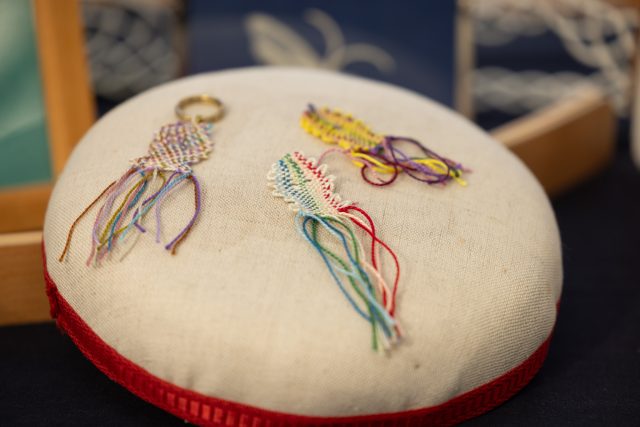
You might think of lace making in terms of traditional costumes, lace collars in paintings by the old masters, or doilies at your grandmother’s house. Perhaps you have no idea how lace is made. Maybe you’ve watched a lace-making pillow with bobbins darting every which way and wondered how anyone knows which bobbin goes where and when.
In either case, we invite you to experience for yourself what it’s like to sit behind a lace-making pillow and create something small with bobbins. You will leave with a cheerful little fish and an idea of how experienced lacemakers know which bobbin goes where and when.
We (Corrie and Rit) met through various lace-making courses we have taken both domestically and internationally. Corrie is currently pursuing a teaching qualification in Germany, and Rit is the chairperson of a large lace-making group in the Netherlands.
With other enthusiastic lacemakers, we have formed a group (Lace Group Kanthousiast) that meets once a month to exchange information about lace-related topics. This ranges from new techniques to interesting lace-making books, designs, colors, and more.

The Dutch Hat Association (NHV) has been active since 2004. The association aims to bring hats back into fashion, promote the quality of the hat-making craft, and support the professional development of hat makers.
This unique association brings together around 300 members from various backgrounds: people who are professionally involved with different aspects of hat making, hobbyists, and hat enthusiasts. The NHV aims to serve as a platform for all these members by focusing on education and organizing competitions, social events, and more.
One example of an event organized by the NHV is the annual NHV Hat Day. At such events, the hat takes center stage, and members, along with anyone interested in hats, have the opportunity to exchange knowledge, skills, and ideas about hats and hat making. By organizing competitions and exhibitions, the NHV seeks to profile and promote the hat within the fashion industry. In 2006, they started a series of annual NHV Hat Competitions.
Hatlines is the glossy magazine of the NHV that is published four times a year and sent to all members. In Hatlines, you can read all about the activities of the Dutch Hat Association, tips and techniques, interviews, photo reports of hat events, and more.
By participating in the Craft in Focus Festival, the NHV aims to showcase the hat-making craft and provide insight into the process of making hats. This includes measuring the size, using hat molds, different materials and finishes, and presenting a custom-made hat as the end result. Through demonstrations and discussions about hat making and wearing, the association aims to inspire visitors with the hat as a fashion accessory.


This masterclass focuses on high-level techniques, particularly rust dyeing. When iron comes into contact with water and various elements like humidity and temperature, it forms rust, as naturally occurring in the environment. Rust dyeing offers a magical way to create unique patterns on fabrics using different natural materials. Participants will learn various techniques during this 3-hour masterclass. We will design a bag or bandana that you can take home with you.
Roua Atelier is a sustainable, natural dye studio that aims to make a positive impact on the textile industry by developing natural dye pigments, new techniques, and materials. We work closely with textile companies and designers to incorporate eco-friendly materials into their production and design process. We collaborate with farmers to grow local plants and spread knowledge about our natural dye methods. One of our key activities is educating people about the magic of natural dyes and helping them integrate this into their daily practices and uses.
Roua Alhalabi is a Syrian natural dye developer. She learned about the magic of color from her grandmother. She absorbed all the knowledge her grandmother shared with the young children and expanded it by learning from various experts. This led her to develop her own methods and techniques for creating colors. She wants to share her love for color with others, which is why she will teach a different technique each day at the festival. Have a look here at the other workshop on Sunday.


In this masterclass, you will learn about the rich heritage of the Meghwaad-Gurjar women. You will discover their specific embroidery techniques while uncovering the story behind them, and learning more about their historical connection with the Netherlands.
Under the guidance of experienced craftswoman Geetaben Meriya and translator/facilitator Lipika Bansal from De Textielfactorij, you will master the art of Kutchi embroidery by creating a brooch. The distinctive effect of this colorful embroidery is highlighted when small mirrors, known as abhla, are sewn into geometric and floral patterns. By the end of the masterclass, you will have embroidered a brooch featuring a mirror and cotton embroidery thread.
Women from the Meghwaad-Gurjar community create intricate embroidery for personal use, for their animals, and for their homes. They are known for their technical skill in embroidery. This art is passed down from mother to daughter, characterized by bold colors, dense stitching, the use of mirrors, and an abundance of floral motifs.
Geetaben Meriya learned the embroidery technique and traditional symbolism from her native community as a young girl, from her mother and grandmother. As a sixth-generation embroiderer, she is strongly motivated to preserve and promote Meghwaad-Gurjar embroidery to a diverse audience.


Festival address:
NDSM Loods
NDSM-Plein 85
1033 WC Amsterdam
Postal address:
Stichting Ambacht in Beeld
Kalf 158
1509AH Zaandam
The Netherlands