Participation at your own risk. Do not wear highly flammable clothing!
After a brief explanation of the history of the poppy, you will create a flower from copper yourself. Using a hammer, you will work the provided copper petals on an anvil into graceful flower petals. The petals are then shaped on a hollowed-out plastic disc. The brass stem is threaded so that the petals can be attached to the stem.
In addition to iron/steel, several other metals can be used, such as copper, aluminum, bronze, and tin. Copper is a metal that we also work with in our forge. Copper is a relatively soft material that is easy to work with. We shape the copper by hammering it on an anvil and a plastic mold. Sometimes copper is heated to process it properly, but relatively thin copper can also be worked as is.
Having started as a freelancer in the metal industry, Cees Pronk conducted research on blacksmithing courses in the Netherlands in 1999/2000. However, a good vocational training no longer existed, which led him to develop a blacksmithing course himself. The end terms he wrote, approved by the Ministry of Education, Culture, and Science (OCW), served as the basis for compiling and writing teaching materials for the Blacksmithing Course in Andelst and the establishment of Mondra Training. In addition to the Blacksmithing Course, various workshops and masterclasses are also offered for young and old, artists, and primary school students. All of this takes place at the Cornelis Pronk Forge, the place to gain knowledge about forging techniques.
As of January 1, 2024, Cornelis Pronk Forge has been handed over to his daughter Lotte Pronk, keeping the business in the family.


Participation at your own risk. Do not wear highly flammable clothing!
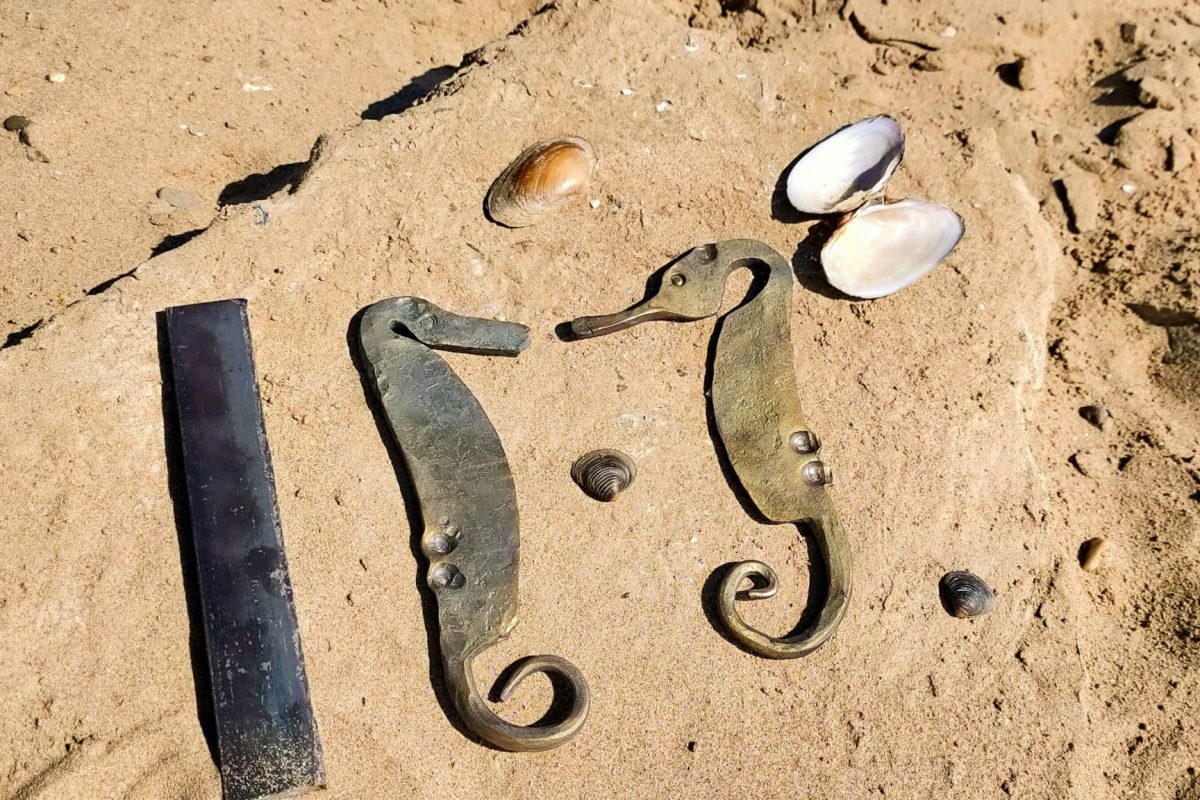
From a hard piece of metal, a seahorse is born through heat and force.
After a brief explanation from the blacksmith, you will forge a seahorse yourself. A provided strip of metal will be heated in the fire, and then you’ll hammer your very own seahorse on the anvil. This will be done with extensive guidance and example drawings from the blacksmith.
Having started as a freelancer in the metal industry, Cees Pronk conducted research on blacksmithing courses in the Netherlands in 1999/2000. Finding that a good vocational training no longer existed, he developed a blacksmithing course himself. The end terms he wrote, approved by the Ministry of Education, Culture, and Science (OCW), served as the basis for compiling and writing teaching materials for the Blacksmithing Course in Andelst and the establishment of Mondra Training. In addition to the Blacksmithing Course, various workshops and masterclasses are also offered for young and old, artists, and primary school students. All of this takes place at the Cornelis Pronk Forge, the place to gain knowledge about forging techniques.
As of January 1, 2024, Cornelis Pronk Forge has been handed over to his daughter Lotte Pronk, keeping the business in the family.

Children’s workshop (age 11 and up). Parents/guardians are responsible at all times. Participation at your own risk, do not wear highly flammable clothing.
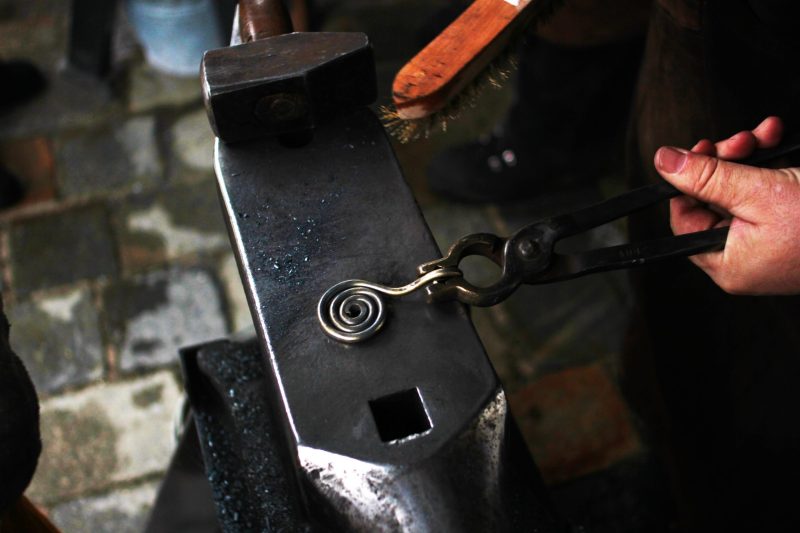
Together with the blacksmith, a bar of iron is heated in the fire, and this glowing iron is forged into a keychain. This is done by hammering the hot material on an anvil. You will go home with a unique keychain.
Two children can forge per 20-minute slot, with hourly time slots, so you may have to wait your turn.
Having started as a freelancer in the metal industry, Cees Pronk conducted research on blacksmithing courses in the Netherlands in 1999/2000. However, a good vocational training no longer existed, which led him to develop a blacksmithing course himself. The end terms he wrote, approved by the Ministry of Education, Culture, and Science (OCW), served as the basis for compiling and writing teaching materials for the Blacksmithing Course in Andelst and the establishment of Mondra Training. In addition to the Blacksmithing Course, various workshops and masterclasses are also offered for young and old, artists, and primary school students. All of this takes place at the Cornelis Pronk Forge, the place to gain knowledge about forging techniques.
As of January 1, 2024, Cornelis Pronk Forge has been handed over to his daughter Lotte Pronk, keeping the business in the family.

Have you always wanted to weld? Are you curious about what it takes to lay down a perfect weld seam? Do you want to see steel melt under intense heat? This is your chance to get acquainted with it. Do you have that steady hand, the insight, and above all, the feel for the molten pool? The best part is: experience or skill is not required.
In this workshop, taught by De Openbare Werkplaats, you will experience what it is like to TIG weld and what it involves. You will receive a brief explanation of what it is and how it works, but you will primarily experience it by doing it yourself. First, you will practice on some pieces of steel to lay down a nice weld seam by getting the molten pool right. You will learn exactly what this entails during the workshop. Then, you will weld together a small container, and as a test to see if it was successful, we will fill it with water. If the container does not leak, the welding was successful. We provide all the safety equipment, such as a welding helmet, gloves, and possibly an apron or smock.
Metalworking is truly a craft. It requires knowledge, skills, and a lot of practice to become proficient at it. This field ranges from making constructions to creating art and everything in between. One of the most important aspects of metalworking is welding. There are various techniques with different results. To weld metal together in a really beautiful way, or for very fine work, TIG welding is the ideal method. This way, you can lay down the most beautiful weld seam that can either be visible or not, depending on your preference. Both are possible.
De Openbare Werkplaats is the location for craft courses and offers individuals, self-employed persons, and companies the opportunity to use a professional workspace with professional machines on a half-day or project basis.


Learn Traditional Hand Engraving with Master Engraver Jacqueline Jimmink! In this workshop, you’ll discover the art of traditional hand engraving on copper. Engraving is essentially drawing on metal. Using a burin (engraving tool), you’ll engrave decorations or letters on a pre-formed copper plate of your choice. You’ll work with authentic hand engraving tools, just like the masters did in the past. This program is challenging for everyone and is tailored to each participant’s level.
The workshop will explain how to use burins to manually engrave lines and shadings. The tremble technique, which creates contrast in the engraving, will also be covered. Each participant will leave with a self-engraved piece, such as a nameplate, keychain, and/or piece of jewelry. This is an experience for anyone interested in learning about this endangered craft.
The Dutch Center for Hand Engraving will offer all-day demonstrations of hand engraving alongside the workshops during the Ambacht in Beeld festival.
As of June 14, 2024, Hand Engraving has been included in the Network of Intangible Cultural Heritage. This initiative was taken by the Dutch Center for Hand Engraving, founded by Jacqueline Jimmink. Intangible cultural heritage can only be nominated by practitioners or direct stakeholders, recognizing this cultural expression as intangible heritage. The Dutch Center for Intangible Cultural Heritage has confirmed that Hand Engraving meets the criteria for intangible cultural heritage as outlined in the UNESCO Convention for the Safeguarding of Intangible Cultural Heritage.


Meet embossing: an ancient technique for applying drawings and shapes onto metal. Embossing, within the craft of goldsmithing, is the age-old method of creating a relief on sheet metal.
The Egyptians used it to make masks for mummies, and in the Middle Ages, book covers were lavishly decorated with it.
During the workshop, you’ll adorn a 50 x 50 mm copper plate with a relief. You can choose from various decorations or come up with your own design. Tar will be heated to secure the copper, and you’ll wield a hammer and punches to gradually raise the relief. With each tap of the hammer, the design becomes clearer.
Sacha knew from a young age that she wanted to be a visual artist, and she started making jewelry at twelve using paperclips and beads. At seventeen, she chose to study gold and silversmithing at the Vakschool voor Edelsmeden in Amsterdam. Since 1999, she has worked as a goldsmith and jewelry designer. Sacha’s favorite technique is embossing, which is ideal for the organic forms she loves to give her jewelry. Gradually, the material takes shape under the influence of hammer and punch, later transformed into the unique and fairytale-like jewelry pieces in her collection.

Please note: Participation at your own risk. Avoid wearing flammable clothing.
Witness the fascinating transformation of solid metal into an elegant seahorse, guided by heat and skilled craftsmanship.
After a brief introduction by our blacksmith, you’ll have the opportunity to shape a provided metal strip into your very own seahorse. Using a hammer and anvil, and under the guidance of our experienced blacksmith, you’ll learn the techniques involved while creating your unique piece.
Cees Pronk, a former professional in the metal industry, discovered a gap in blacksmithing training courses in the Netherlands back in 1999/2000. Unable to find a suitable program, he decided to develop his own. With approval from the Ministry of Education, Culture and Science, he established the Opleiding Smeden in Andelst and Mondra Opleidingen. Alongside the Opleiding Smeden, workshops and masterclasses are offered for people of all ages and backgrounds, including artists and primary school students. These sessions take place at Forge Cornelis Pronk, a hub for learning about forging techniques.
Children’s Workshop. Minimum age 11 years old. Parents/guardians are responsible at all times. Participation at your own risk, do not wear highly flammable clothing.
A bar of iron is heated in a fire with the blacksmith, and this glowing hot iron is forged into a keychain. This is done using a hammer to work the hot material on an anvil. You will go home with a unique keychain.
There can be two children forging per 20 minutes, the time slot goes by the hour, so you may have to wait your turn.
Once started as an independent worker in the metal industry, Cees Pronk already did research in 1999/2000 about training in the field of forging in the Netherlands. It turned out, however, that an excellent vocational training program no longer existed, which was why he developed his own training in blacksmithing. The final attainment targets he wrote, approved by the Ministry of Education, Culture and Science, were the starting point for compiling and writing teaching materials for the Opleiding Smeden in Andelst and the establishment of Mondra Opleidingen. Besides the Opleiding Smeden, various workshops and master classes are given for young and old artists and elementary school pupils. All this takes place in the Forge Cornelis Pronk, the place to gain knowledge about forging techniques.
Festival address:
NDSM Loods
NDSM-Plein 85
1033 WC Amsterdam
Postal address:
Stichting Ambacht in Beeld
Kalf 158
1509AH Zaandam
The Netherlands