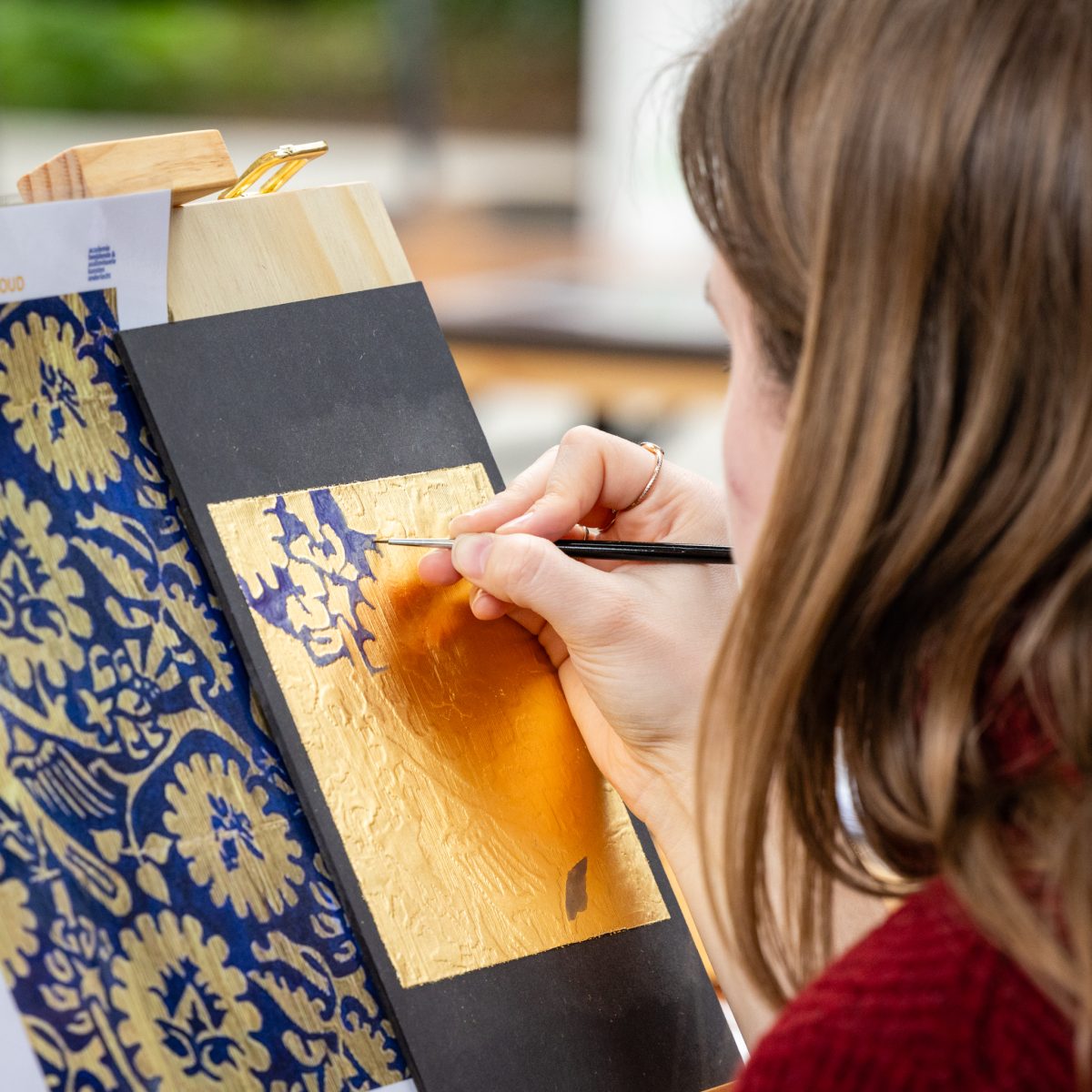
Pressed brocade is a late Gothic decorative technique that imitates woven silk brocade fabrics. These brocade fabrics, enriched with gold and/or silver threads, were replicated using a reproductive technique. We find “pressed brocade” as relief work on polychromed sculptures, panels, and in historical interiors. In this masterclass, you will create a “pressed brocade” piece based on a 15th-century example and go through the entire process to produce your own sheet of “pressed brocade” to take home.
By following this historical decorative technique step by step, you will learn the production of “pressed brocade” in all its intricacies. In an engraved mold, the three-dimensional shape of a textile fabric is copied using tin foil. This imprint is then gilded and painted with pigments. The final expression of the fabric is determined by the texture of the opaque or transparent paint layer in blue, red, or green hues. The hatching in the brocade sheet imitates the gold threads of a silk brocade fabric.
This masterclass is offered in collaboration with the Craftsmanship and Polychromy Workshop of the Academy of Fine and Audiovisual Arts Anderlecht, where historical painting and decoration techniques such as gilding and silvering with leaf metals, as well as techniques like pastiglia, pressed brocade, sgraffito, punchwork, gemstone decorations, are taught.
Sandy van Wissen (born 1968) works in the cultural heritage sector in Belgium, focusing on hands-on conservation, research, and restoration of polychromed sculptures. She is also part-time lecturer at the Craftsmanship and Polychromy Workshop, teaching both historical and modern decorative techniques.

Learn how to manually carve text into wood. We will begin the workshop with the basic principle of the letter “I”. Afterwards, you will create a letter of your choice, starting with straight lines for beginners, as curves might be more challenging. The letter can either be carved into the wood, or you can carve away the wood around the letter, creating a raised effect where the letter sits “on” the wood.
In today’s world, everything can be done with computers and milling machines. However, manual carving offers way more possibilities, allowing for greater creativity with space and dimensions, and it obviously has its own charm.
Sculptor Rein Veldboer primarily works with wood, creating large solid wood sculptures. Additionally, he crafts texts in wood and enjoys experimenting with the dimensions of letters. He has been teaching wood sculpting for many years.

Print your own poster with wooden letters? You can do that! GWA (Grafische Werkplaats Amsterdam) is bringing a small printing press, antique wooden letters, and ink to the Ambacht in Beeld Festival. With these tools, you can design and print your own personalized poster.
GWA houses an extensive collection of traditional graphic materials at their workshop nearby in the NDSM Loods: printing presses, wooden letters, lead type, and everything you need for linocut, woodcut, and bookbinding. The organization offers courses and workshops for anyone interested in exploring traditional printing techniques. This includes school classes, graphic design students, artists, and handmade print enthusiasts. Step away from the computer!
This workshop is open to participants aged 8 and above. You’ll work together with one other participant to create your own poster. The poster won’t be immediately dry, so it’s best to leave it hanging for as long as possible before taking it home or picking it up later at the workshop.

(if you read this you’re crazy! hahaha!)


The Amsterdam-based artist Daan Wille, also known as Blazin, has mastered calligraffiti, a fusion of calligraphy and graffiti. Inspired by the renowned graffiti artist Shoe, Daan has evolved into a versatile designer creating logos, typefaces, and especially calligraphy.
In this workshop, you’ll get a close look at Blazin’s techniques and create your own artwork with his guidance, featuring your name.
We first offered this workshop in 2015 in collaboration with the Street Art Museum Amsterdam. Daan also conducted workshops during Craft in Focus New York in 2017 and 2019. Due to its success, we are offering it again this year in Amsterdam!


In this inspiring workshop, you’ll learn how to create unique handmade jewelry using beautiful gemstones. Guided by designer Fatima Essahsah, known for her attention to detail and passion for natural materials, you’ll explore a world of colors, textures, and shapes that will ignite your creativity.
Fatima will take you on a creative journey where you’ll not only learn simple techniques to craft stunning jewelry but also discover the stories behind the stones, their symbolism, and their energy. The focus of the workshop is on creating jewelry pieces that tell a story. Rather than just aesthetics, participants are encouraged to use their jewelry as a form of personal expression. Whether you’re a beginner or have some experience, these workshops are designed to inspire and challenge everyone. You’ll learn how to use fishing wire to string different gemstones, creating patterns that reflect the story you want to tell.
Fatima Essahsah is the passionate founder of Stones Stories and a talented jewelry designer. Her unique pieces are crafted in Morocco using traditional Jewish and Moroccan craft techniques. Drawing inspiration from her road trips across Morocco, Fatima discovers stories that reflect the rich diversity of North Africa. Founded in 2017, Stones Stories is more than just a jewelry brand; it’s a platform that brings the cultural heritage of North Africa to life.
Fatima’s work extends to international museums where it is exhibited, and she gives lectures emphasizing cultural diversity. She also regularly organizes workshops and social experiments aimed at connecting people from different cultures. Her jewelry not only showcases beauty but also carries a deeper narrative—a narrative that invites people to explore the rich history and traditions of North Africa.

Photographer: Frederique Peckelsen

Batik is an ancient traditional technique of fabric pattern design using wax and various tools made of copper, brass, wood, brushes, and dyes.
During this workshop, you will experiment with creating spontaneous designs on pre-framed canvases. You’ll work with different oils such as fish oil, castor oil, cooking oil, and various textile dyes. You’ll take home your own framed artwork.
The workshops can be conducted in English, Dutch, Mandarin, and Indonesian.
Shuen-Li Spirit studied as an art educator in Singapore and officially moved to the Netherlands in 2016. She offers international Batik masterclasses in the Netherlands as part of her commitment to preserving her mixed Chinese-Malay-Indonesian heritage. She is also passionate about ecological sustainability and incorporates reused food products in practicing traditional crafts and upcycling her clothing and bags.


Saggar firing is a fascinating technique within the ceramic process that allows for the creation of unique and intriguing effects on ceramic objects. During saggar firing, the objects are placed in a saggar, in this case made of aluminum foil.
Inside the saggar, organic materials and chemicals are added, such as sawdust, salts, metals, and even hair or textiles. These materials react with the ceramics during the firing process, producing special and unpredictable color effects and patterns on the surface of the object.
Using a raku kiln—a fast and intense method of ceramic firing—the saggar is heated to high temperatures, typically around 900-1000 degrees Celsius. The combination of heat, combustion of the added materials, and the sealed environment of the saggar results in spectacular coloring of the objects.
In this workshop, you will have the opportunity to transform two pre-fired objects using the exciting saggar firing technique. At the end of the workshop, these objects will be fired for 45 minutes in a raku kiln, allowing you to closely observe the entire process. The objects will be transformed by the magical interaction of heat and added materials in the saggar, giving them an entirely new appearance and character. After the workshop, you can take home the artworks you’ve created.
Danielle van Assema is a raku ceramicist passionate about creating ceramic artworks. Her work focuses mainly on raku and saggar firing techniques, where she achieves unique effects and textures. She enjoys sharing her knowledge and passion by teaching workshops on alternative firing techniques for ceramics. “As an artist, my approach is characterized by the motto ‘the beauty of imperfection.’ I believe that true beauty in ceramics lies in the imperfections and unexpected elements of the creative process.”


Temari is an ancient Japanese needlecraft. “Te” means hand, and “mari” means ball in Japanese.
A temari is a ball decorated with threads in geometric shapes and patterns. In a wrapping pattern, the needle is only used for starting and finishing. The division created on the ball allows for various patterns, you can choose which patterns you want to use, from the displayed pieces. You then select your own yarn colors for the project, ensuring that everyone is able to create a personal temari. There will be ample personal attention for each participant.
About Sandra: “Temari entered my life over 30 years ago and has never left. Over the years, I have had the privilege of teaching many classes both in the studio and especially on location in the Netherlands and Belgium. To support independent development of temari knowledge, I have authored several workbooks. The use of colors continues to fascinate me, as do the geometric shapes of the patterns.”

How beautiful is this? Your own handmade pendant for a necklace!
In this one-on-one workshop, you’ll learn woodturning techniques to create a flat, round shape. There are various types of wood to choose from.
You’ll bring home the pendant in brass with a cord, as shown in the photo, ready to wear right away.
RADIUS, the Dutch Association of Woodturners, was founded in 1994 and has since grown to approximately 750 members. The association consists of 16 active regional departments.
While a small number of members practice woodturning professionally, most are active hobbyists. They turn functional and artistic objects at various skill levels based on their training, experience, and interests. Several members are well-known both nationally and internationally, and their creations can be found at prominent exhibitions.
The association publishes a full-color quarterly magazine called AktieRadius and hosts an annual woodturning day at a central location in the Netherlands. This day includes demonstrations, lectures, information sessions, and the sale of woodturning supplies by various vendors.

Leaves can naturally transfer their color onto fabric. In eco-dyeing, also known as plant printing, patterns are created on fabric using leaves from various plants. Since the publication of India Flint’s books, this dyeing technique has gained popularity. The art lies in ensuring that the leaf not only leaves a colored spot but also makes the vein pattern visible in the print. The instructors at Hawar Textielinstituut know exactly how to achieve this effect. They teach about the natural dyes present in different leaves and how to create sharp, clear prints.
In this workshop, you will print a soft and summery scarf made of Etamine de Laine with your own pattern using various leaves. You don’t need to bring anything for the workshop as we will provide a wide selection of leaves. Part of the workshop involves fixing the colors, which takes about an hour. You don’t need to stay for this process, but please note that you won’t be able to take the scarf home immediately after the workshop. If you enjoy experimenting, you can also bring your own leaves from plants, trees, or flowers. While we may not know exactly what color each leaf will produce, the surprise often results in even more beautiful outcomes!
Harm Harms is a teacher and owner of the family-run Hawar Textielinstituut, where instructors from both the Netherlands and abroad share their knowledge and skills in a large and inviting workshop space. The institute also houses an extensive store and an inspiring gallery, making it a hub for discovering and rediscovering new and old materials and textile techniques. During the festival, Harm leads workshops alongside Floor de Bruijn. She has a background as a designer at Humanoid and teaches at Hawar in the reuse and restyling of clothing and fabrics.

Festival address:
NDSM Loods
NDSM-Plein 85
1033 WC Amsterdam
Postal address:
Stichting Ambacht in Beeld
Kalf 158
1509AH Zaandam
The Netherlands