We take you on a journey into the magic of enameling during this workshop. First, we’ll discuss the ancient process of enameling, a technique that has been used for many centuries BC. What is enamel, what is it used for, since when has it been used, what are its applications, what different techniques exist, and why is this material so unique? We’ll also show examples of artworks created with enamel. Enamel can be applied to steel, copper, silver, and gold, using various materials and techniques.
We’ll start with simple basic techniques. A copper plate will be cleaned, and we’ll teach you how to apply enamel powder. It may seem easier than it is. The piece will then be fired in an enameling kiln at temperatures of 800-950 degrees Celsius. When it comes out of the oven, it will be red-hot, and as it cools down, the colors will emerge, transforming the powder into glass. This moment is truly magical!
There is usually a degree of unpredictability: how will it look coming out of the oven? Have the colors turned out exactly as planned? Are there unintended oxides that have surfaced? This unpredictability adds excitement to the enameling process. After cooling, the piece can be further embellished by adding colors or materials before being fired again. This can be repeated several times. Everyone will leave with one or two unique pieces and a hands-on experience in the craft and application of enameling in art.
At the Craft in Focus Festival, six experienced artists and instructors will lead the workshops. Christine vd Ree, Marrie Schipper, and Hanneke Klievink will be there on Saturday; Annemarie Timmer, Hoi-Shan Mak, and Mariet Lohman on Sunday. They have exhibited their work nationally and internationally and have mastered various techniques. All are members of the Association of Dutch Enamelers (VNE), founded in 1983 with the aim of promoting enameling as an art form. The VNE currently has over 70 members and several donors. They organize workshops annually in Amersfoort and hold exhibitions in galleries or museums.


Did you know that you can create beautiful fish leather from fish skins? It’s a zero waste solution with stunning results!
Fish leather is a strong and durable type of leather that was historically used on a large scale by the North Pacific peoples to make bags, parkas, boots, mittens, and other clothing.
Happy van der Heide, a skilled craftswoman and circular artist, is one of the few individuals in the Netherlands practicing the ancestral skill of transforming fresh fish skins into fish leather.
In this workshop, you will learn how to ecologically clean a fresh fish skin and remove the scales. Then, the skin will be treated using environmentally friendly techniques to tan it. Softening the leather requires some effort, but the end result will be a unique, soft, and supple piece of fish leather. The visible texture of the scales gives the leather an elegant appearance.
You will take home a piece of salmon leather and a newfound appreciation for fish leather.
Happy van der Heide, raised and educated amidst the wetlands between Joure and Sneek, is the owner of ‘Hip & Happy – craftsmanship & design’, a studio dedicated to raising awareness for a livable Earth. Through exhibitions, lectures, workshops, and masterclasses, she inspires people of all ages, offering opportunities to learn and re-learn traditional skills, alongside showcasing inspiring innovations rooted in nature.


Transform Empty Wine Bottles into Unique Glasses. Learn the art of cutting, sanding, and painting. Discover the magic of upcycling and take home your own painted glass along with new skills to continue experimenting!
With a focus on sustainability and craftsmanship, we will cut the bottles in half using a glass cutter and thermal shock method (ice water and boiling water). We will then sand the sharp edges smooth and decorate them with glass paint. These unique glasses can serve as drinking glasses, charming tealight holders, and much more. You will also learn various painting techniques to personalize your creations. Explore the joy of rescuing your glassware from the recycling bin and turning them into beautiful, functional art pieces!
IMPORTANT INFO: Don’t forget to bring your own empty bottles. For this workshop, please bring two empty wine bottles made of dark glass (green or brown). Please remove any label. Champagne bottles are not suitable for this workshop.
Luna Schröer says, “The goal is not only to promote the reuse of waste materials but also to show people that with minimal creative experience and a small investment in basic supplies like glass paint, you can create beautiful items for your home. Moreover, there’s nothing more satisfying than using your own unique creations, such as beautiful drinking glasses and reusable oil bottles, every day! My work emphasizes the beauty of imperfection in handmade products. I strongly believe in the positive impact of a creative outlet. In a world where the emphasis often lies on academic achievements and business success, many people unfortunately lose sight of their creative side. Through La Salamandre studio, I aim to help people relax more and show them how enjoyable it is to work with your hands.”


Discover the art of upcycling and decoration as you create a unique eyecatcher step by step. Learn various painting techniques and materials, and leave with your own artwork and new skills to continue experimenting!
Learn how to breathe new life into old glass bottles by removing labels, adding a pour spout, and transforming them into beautiful eyecatchers with a painted olive design. Guided step by step by Luna Schröer from Atelier La Salamandre, you’ll explore the design process using techniques like glass paint and relief paint. You’ll also receive handy tips to rescue other glassware from the recycling bin and further develop your artistic skills. At the end of the workshop, you’ll take home your own unique olive oil bottle and the knowledge to continue painting at home, transforming old glassware into beautiful functional artworks.
Luna Schröer says, “I strongly believe in the positive impact of a creative outlet. In a world where the emphasis often lies on academic achievements and business success, many people unfortunately lose sight of their creative side. Through Atelier La Salamandre, I aim to help people relax more and show them how enjoyable it is to work with your hands.”
IMPORTANT INFO: Don’t forget to bring your own empty bottles. For this workshop, please bring two empty dark glass bottles (green or brown). These can be wine bottles or any other bottles you find appealing for your kitchen as a new olive oil bottle! Ensure the glass is dark, has a smooth surface for painting, and can accommodate a cork. Please remove any label beforehand.

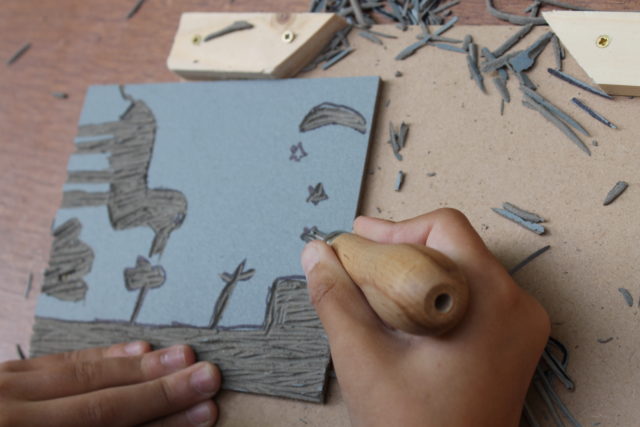
Step into the shoes of a true artist and create your own graphic artwork! In this workshop, you’ll experiment with color, shape, and lines. You’ll use carving tools and ink, and make the printing press work overtime to produce a beautiful linocut.
The artists of the Amsterdam School were true polymaths. In addition to stunning architecture, furniture, and everyday objects, many were also involved in typography and graphic design. They frequently used printmaking techniques to create posters or book covers. And now, you can do the same!
Whether young or old, everyone is welcome in this workshop. Special materials are available for children under eight to ensure their safety.
This workshop is hosted by Museum Het Schip, the museum dedicated to the Amsterdam School in architecture, decorative arts, and public housing.
The workshop runs continuously, and you can purchase a ticket to join whenever a spot is available.


Learn Traditional Hand Engraving with Master Engraver Jacqueline Jimmink! In this workshop, you’ll discover the art of traditional hand engraving on copper. Engraving is essentially drawing on metal. Using a burin (engraving tool), you’ll engrave decorations or letters on a pre-formed copper plate of your choice. You’ll work with authentic hand engraving tools, just like the masters did in the past. This program is challenging for everyone and is tailored to each participant’s level.
The workshop will explain how to use burins to manually engrave lines and shadings. The tremble technique, which creates contrast in the engraving, will also be covered. Each participant will leave with a self-engraved piece, such as a nameplate, keychain, and/or piece of jewelry. This is an experience for anyone interested in learning about this endangered craft.
The Dutch Center for Hand Engraving will offer all-day demonstrations of hand engraving alongside the workshops during the Ambacht in Beeld festival.
As of June 14, 2024, Hand Engraving has been included in the Network of Intangible Cultural Heritage. This initiative was taken by the Dutch Center for Hand Engraving, founded by Jacqueline Jimmink. Intangible cultural heritage can only be nominated by practitioners or direct stakeholders, recognizing this cultural expression as intangible heritage. The Dutch Center for Intangible Cultural Heritage has confirmed that Hand Engraving meets the criteria for intangible cultural heritage as outlined in the UNESCO Convention for the Safeguarding of Intangible Cultural Heritage.


Learn to make your own record player with sound artist Jacob Plooij!
In a short time, create your own phonograph with a pencil, a record, and a piece of paper.
Materials will also be available for you to collaborate on building one or two larger machines that will remain throughout the weekend.
Jacob will also bring a real wind-up gramophone with a large horn!

Are you fascinated by the workings of a marionette or the play with traditional rod puppets? In this workshop, you will gain insight into the construction of a wooden theater puppet. As a participant, you will learn the basic techniques of carving with sharp knives in linden wood. During this collaborative project, participants will work for two hours on a part of a theater puppet. By the end of the day, the torso, arms, hands, legs, feet, and character head will come together to form a complete figure.
You will gain experience in wood carving: you will carve a small hand from linden wood to take home as a project.
Marc Beuten is a puppet maker and puppeteer at vzw Poppentheater Pierewiet. He has attended workshops and courses with international puppet makers from Belgium, the UK, the Czech Republic, and Iceland. His specialty is making hand, rod, string, and table puppets from linden wood. Besides designing figures for his own performances, he creates theater puppets on commission for puppet theaters and storytellers. Both novice and experienced puppeteers and makers are welcome in his studio in Bruges to explore the wide range of theater puppets or to share experiences.
As a member of the West Flanders Union of Puppet Theaters, Marc, along with Alain Verhelst of Draadpoppentheater Roeselare/Das de Puppe, brings the figurative theater as intangible heritage into the spotlight. The project ‘Das de Puppe’ was nominated as an inspiring example by Immaterieel Erfgoed Vlaanderen.


Dive into the world of weaving, a realm of threads, structures, and colors, and weave your own fabric for a cushion. Each participant will have a loom with pedals ready. Choose your own yarns and colors and get started. Experience the feeling of weaving on a standing loom, watching the fabric grow slowly under your hands. At the end of the workshop, you can leave the woven fabric on the loom. We will sew it into a cushion, and a few days later, you’ll receive your own fabric in the form of a cushion at home (Workshop price includes shipping costs).
Hand-weaving is an ancient technique for producing fabrics, but it’s also an inexhaustible game of patterns, yarns, textures, and colors. In her hand-weaving studio, Eva Klee revives this old craft in an artisanal way, creating exclusive, high-quality, custom handwoven fabrics, unique pieces, and reproductions of fabrics. The goal of each fabric design is exquisite quality with an eye for detail.
Eva Klee took over her mother’s Swedish loom at the age of eleven, making weaving feel like a second nature to her. In her studio, she constantly explores new fabric designs, an endless interplay of patterns, materials, and colors. Small changes in the weaving process can lead to unexpected and fascinating results. It is the process of discovery along the way and critically questioning technical perfection that fuels her ongoing research. Her work is characterized by great technical skill combined with creativity.
Eva Klee completed a three-year training in hand-weaving in Southern Germany. She subsequently studied Monumental Design at the Royal Academy of Art in The Hague.


Creating handmade buttons has been a cherished tradition for centuries, adding unique accents to garments, such as the iconic Zeeuwse buttons made of silver worn as jewelry.
In this workshop, you will craft two artisanal buttons of your choice. Monique will provide various examples and ample materials like ribbons, beads, embroidery threads, allowing you to customize your buttons to reflect your personal style. She will teach you how to use these beautiful materials, along with simple rings, needles, and thread, to create your own buttons.
Monique van Munster has devoted over thirty-five years to exploring handcraft techniques, specializing in embroidery. She is fascinated by the endless possibilities of needle and thread, constantly investigating various techniques and applications. Her focus is not only on reproducing historical and traditional embroideries but also on using them as inspiration for new interpretations. Monique values preserving her craft and enjoys sharing her skills, teaching workshops at her studio in Tilburg and wherever she’s invited to share her knowledge, such as at the Ambacht in Beeld Festival.

Festival address:
NDSM Loods
NDSM-Plein 85
1033 WC Amsterdam
Postal address:
Stichting Ambacht in Beeld
Kalf 158
1509AH Zaandam
The Netherlands