Sign up for this workshop and experience the joy of working with wood yourself. During the workshop, you will engage in fine woodworking. Unlike carpentry where you use nails and a hammer, you will work primarily with chisels and a saw.
Working with wood brings together craftsmanship, creativity, and skill. It starts with selecting the right piece of wood, with the scent of freshly cut timber stimulating your senses. You then transform this natural material using tools and techniques, with each chisel stroke and saw cut revealing more of your project or piece of furniture.
Not only will you derive satisfaction from your own creation, but the birds in the garden will also enjoy the results!
Peter Pothoven is a vocational teacher of furniture making at Het Ambachtshuis Brabant in Den Bosch.


Beadwork has a long history in East Africa and often carries significant cultural meaning. Colors and patterns can indicate age, ethnic group, or marital status. Women typically learn beadwork from their mothers and grandmothers, making it a skill they can carry with them, rely on, celebrate, and pass down to their children. South Sudanese women are talented bead stringers and have used this heritage skill as a means of generating income after being forcibly displaced.
In this workshop, two forcibly displaced South Sudanese women, working with MADE51, a global brand by UNHCR, will teach participants about their heritage skill of beadwork. Participants will leave this workshop with an understanding of the cultural significance of beadwork in South Sudan and a bracelet to take home.
The workshop begins with an introduction to the two artisans, who will familiarize the participants with their equipment, including a loom, needle, thread, and beads. They will then demonstrate the stringing technique and offer tips for making bracelets. Participants can choose from three patterns to create their bracelets for the rest of the workshop. Meanwhile, the artisans will walk around to assist in the bracelet-making process and share stories about their heritage craft and experiences with displacement.
NB Due to visa challenges, this workshop will be taught via video connection, with live assistance.
More than 120 million people worldwide are forcibly displaced, driven from their homes by war, persecution, or disaster. Among this vast group are incredible artisans who possess the talent, culture, and heritage to create objects of true beauty.
MADE51 is a global brand, an initiative of UNHCR, the UN Refugee Agency, connecting these artisans with social enterprises. Using Fair Trade principles, they support the design, development, and marketing of the unique products that form the MADE51 collection. Through MADE51, those forced to flee have the opportunity to earn an income while in displacement. For consumers, these pieces are more than beautiful examples of craftsmanship and heritage; they are expressions of hope.
Sunday Adee Michael is a South Sudanese refugee living in Kenya. She is a member of the Kalobeyei Women’s Handicraft Cooperative and specializes in beadwork. At 21 years old, she is the youngest leader in the cooperative. In 2016, Sunday arrived at the Kakuma refugee camp at the age of 13 with her 9-year-old brother. As a young girl, Sunday took full responsibility for her brother and herself, ensuring they received education and met their essential needs as the head of her household. Beadwork with the cooperative has played a crucial role in paying for their school fees and books.
Sunday demonstrates resilience in every situation. She joined the cooperative at 19 in 2021 and has since become one of its leaders. She hopes to complete her education and eventually attend university to earn a degree in business administration. After completing her studies, she plans to start her own small business and employ members of her community.
Nyanachiek Padiet is an internally displaced South Sudanese woman living in South Sudan. Nyanachiek has been working with Roots, a MADE51 social enterprise partner, for over eight years. She specializes in beadwork, a traditional skill passed down from her mother, and supports Roots with storekeeping, training artisans, and quality control for large orders. Nyanachiek is a member of the MADE51 Artisan Speakers Group and uses her voice to help others understand her refugee experience and the importance of craft in her life. On World Refugee Day 2023, she spoke remotely at a MADE51 event at the UK House of Lords. She also participated with MADE51 at the 2023 Global Refugee Forum in Geneva.


Photo credits: Erin Flannery en Ala Kheir

Discover the art of designing and making foldable hand fans in this special workshop led by experienced fan maker Victoria Ajoku. She encourages using the pleated fan leaves as a canvas for decorative exploration. In this session, you will learn about fan design, the history of fans, terminology, and the intricate methods of fan assembly. By the end of the workshop, you will have your own unique, personalized foldable hand fan to take home and display as a piece of art.
Did you know that the art of fan making in the United Kingdom is on the list of ‘endangered crafts’ and at serious risk of dying out completely? Fan making is an ancient tradition that incorporates therapeutic physical rhythms in the design phase, offering a creative and expressive range that invites the collaboration of various art methods in the creation process.
Victoria Ajoku is the founder of ‘Fan The Glory With Tori‘ and focuses on reviving the ‘concept of the fan’ for all communities to partake in and enjoy. Victoria holds a BA Hons in Drama, Theatre, and Performance and an MA in Creative Research and Performance. She discovered her love for hand fans through her years of performing, studying, and traveling. Victoria is certified by the CPD Standards Office as an art therapist, well-versed in cultural heritage studies, and also certified by the ‘European Reminiscence Network’.
In collaboration with Heritage Crafts.


Have you always wanted to weld? Are you curious about what it takes to lay down a perfect weld seam? Do you want to see steel melt under intense heat? This is your chance to get acquainted with it. Do you have that steady hand, the insight, and above all, the feel for the molten pool? The best part is: experience or skill is not required.
In this workshop, taught by De Openbare Werkplaats, you will experience what it is like to TIG weld and what it involves. You will receive a brief explanation of what it is and how it works, but you will primarily experience it by doing it yourself. First, you will practice on some pieces of steel to lay down a nice weld seam by getting the molten pool right. You will learn exactly what this entails during the workshop. Then, you will weld together a small container, and as a test to see if it was successful, we will fill it with water. If the container does not leak, the welding was successful. We provide all the safety equipment, such as a welding helmet, gloves, and possibly an apron or smock.
Metalworking is truly a craft. It requires knowledge, skills, and a lot of practice to become proficient at it. This field ranges from making constructions to creating art and everything in between. One of the most important aspects of metalworking is welding. There are various techniques with different results. To weld metal together in a really beautiful way, or for very fine work, TIG welding is the ideal method. This way, you can lay down the most beautiful weld seam that can either be visible or not, depending on your preference. Both are possible.
De Openbare Werkplaats is the location for craft courses and offers individuals, self-employed persons, and companies the opportunity to use a professional workspace with professional machines on a half-day or project basis.


Japanese Kumiko is a refined woodworking craft used to create shoji (room dividers). This traditional technique, practiced in Japan for centuries, requires great precision and craftsmanship. Each piece of wood is carefully cut and tailored to fit perfectly into the pattern, resulting in a seamless and sturdy construction. No glue or nails are used in the process. The patterns range from simple to extremely complex and often have symbolic meanings. Kumiko combines functional sturdiness with visual elegance and reflects the Japanese appreciation for craftsmanship, simplicity, and harmony with nature.
In the Japanese Kumiko workshop, you will learn the basic techniques of cutting and shaping wooden strips using Japanese tools. Precision is key to forming a beautiful geometric pattern, as no nails or glue are used. You will create your own small Kumiko panel, which can be finished with rice paper and is perfect as a decorative artwork for your home, a coaster, or a window hanger. All necessary materials and tools will be provided, and you can also order them to continue working on this refined technique at home.
The Beemsterschool for Furniture Making is a school dedicated to both professional furniture makers and hobbyists. Located in the picturesque Beemsterpolder, the school offers an inspiring setting for anyone interested in learning the art of woodworking. The Beemsterschool is known for its hands-on approach, where participants start working with their hands from day one. Experienced instructors guide them in developing both traditional and modern techniques. The school offers a variety of courses and workshops. With a strong focus on quality and sustainability, the Beemsterschool aims to train craftsmen and hobbyists who are capable of creating high-quality, artisanal furniture pieces.

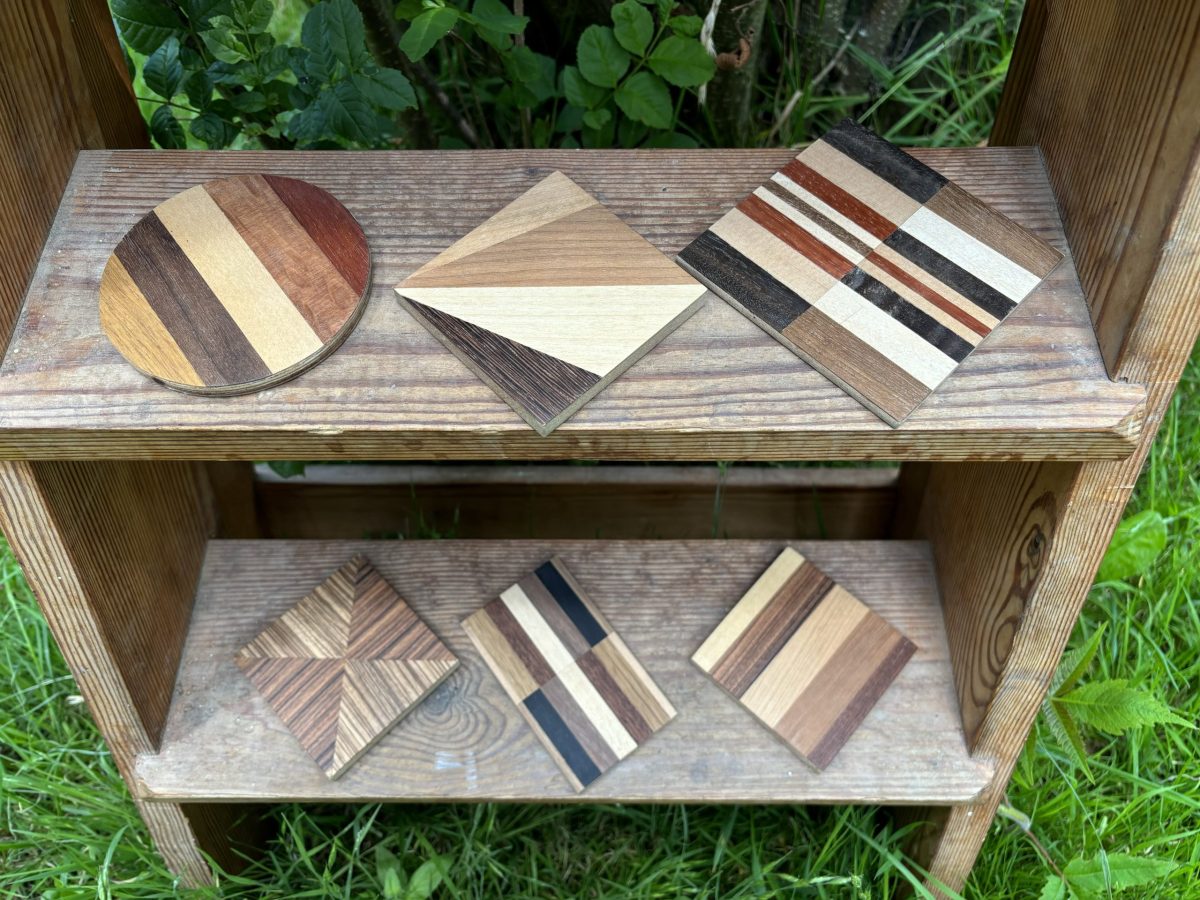
Marquetry is an ancient woodcraft technique where very thin wood is cut, assembled, and glued onto a core wood. By using different types of wood with their natural colors, a unique image is quickly created. This refined work requires great craftsmanship and precision; each piece of veneer must fit perfectly to form a seamless whole. The result is a unique and decorative surface that highlights the natural beauty and variety of wood. This technique is applied in furniture, artwork, and interior elements, offering a special combination of visual refinement and artisanal skill.
In this workshop, you will learn how to combine different types of wood veneer to create beautiful, unique patterns. The thin wood is carefully cut and assembled into a composition designed by you, then it can be glued and finished. At the end of the workshop, you will take home a handmade, decorative coaster that is both functional and stylish.
The Beemsterschool for Furniture Making is a school dedicated to both professional furniture makers and hobbyists. Located in the picturesque Beemsterpolder, the school offers an inspiring setting for anyone who wants to learn the art of woodworking. The Beemsterschool is known for its hands-on approach, where participants start working with their hands from day one. Experienced instructors guide them in developing both traditional and modern techniques. The school offers various courses and workshops. With a strong focus on quality and sustainability, the Beemsterschool aims to train craftsmen and hobbyists who are capable of creating high-quality, artisanal furniture pieces.


Join this inspiring workshop and learn how to make your own natural cosmetics. We’ll use our star ingredient shea butter, along with other pure, nourishing ingredients, to create products that leave your skin silky smooth.
What can you expect from our workshop? Learn step-by-step how to work with shea butter, essential oils, and other organic ingredients. The workshop is led by Altagracia Kotzebue, founder of Urban Africa Naturals. With her passion for natural skincare and years of experience in creating natural products, she shares her expertise and enthusiasm with all participants. Receive handy tips and tricks to continue at home and take your self-made, skin-friendly products with you.


Fassi embroidery, also known as Tarz al Fassi, is a traditional style of embroidery from the city of Fès in Morocco. It is renowned for its intricate, geometric, and reversible designs. Fassi embroidery is typically carried out on a large scale, with large tablecloths and napkins taking months to complete.
In this workshop, you will learn the basic stitches of traditional Fès embroidery. With just thread, a needle, and some fabric, you can take home a piece of Moroccan heritage in the form of a napkin.
The embroidery school is part of the Fadila El Gadi Foundation for the Arts of Embroidery, founded in October 2015 and located in the Hay Salam district of Salé. The foundation was established by the Moroccan designer Fadila El Gadi, who had the dream of perpetuating and passing on the art of traditional embroidery to young people. The mission of the Fadila El Gadi Foundation for the Arts of Embroidery in Salé is to train young people from disadvantaged backgrounds in crafts related to traditional embroidery. In doing so, the foundation contributes to the preservation and promotion of Moroccan cultural heritage and improves the social conditions of young people by facilitating their access to the job market.
Nabila was a student at the Fadila El Gadi Foundation for the Arts of Embroidery. She graduated in 2020 and is now an embroidery teacher, working freelance on embroidery projects. She is 24 years old and lives in Salé.
Aissa was also a student at the Fadila El Gadi Foundation for the Arts of Embroidery. He graduated in 2021 and has since been collaborating with Fadila El Gadi and other workshops. He specializes in pearls and maalam embroidery.


Get to know blueprinting with indigo and dye your cotton with this purely natural dye.
Blueprinting is a cotton printing technique, an ancient craft used to decorate fabrics. In this centuries-old printing technique, a protective paste is applied to fabric to create a pattern. After the paste dries, the fabric is dipped one or more times into a blue vat to dye it blue. The paste is then washed out, leaving a white pattern on the blue dyed fabric. Indigo is one of the oldest dyes globally used to dye textiles blue. In Europe, historically, the blue dye plant used for blueprinting was woad. From the 16th and 17th centuries, stronger indigo arrived from India, which allows for entire fabrics to be dyed, as well as creating patterns by covering parts of the fabric before dipping it into the indigo vat. Blueprinting has been recognized as UNESCO World Heritage in Germany. Cotton printing (block printing) has been added to the Inventory of Intangible Cultural Heritage in the Netherlands.
In this masterclass, you will practice three different techniques to apply the clay paste – with a brush, stencil, and a wooden printing block from India – on cotton swatches, which you will then dye with indigo. Afterward, you will choose one of these techniques to design and dye a slightly larger piece of cotton. You will personally dye both the swatches and the final piece in the indigo dye bath. After oxidation, the cotton will be rinsed. At the end of the masterclass, you will take the pieces home to further integrate into your own project.
Nathalie Cassée operates her specialized Cotton Printing Workshop in the national monument, de Volmolen, in Amersfoort. She learned the craft of cotton printing in India, England, and France. Apart from direct printing on fabrics and paper, she deepened her knowledge of printing with resist techniques and natural dyes. In India, she worked in various regions to learn different styles and block printing methods. In her workshop, she houses a collection of approximately 1000 printing blocks.
Marte Haverkamp is a visual artist and natural dye expert. Marte puts a contemporary spin on traditional crafts and techniques. She maintains her own garden with dye plants in the heart of Amsterdam. Flowers from her garden, food waste, and natural pigments are the foundation of her monumental textile artworks and creative workshops, where experimentation always comes first.


Learn the basic steps of the craft of stained glass: cutting glass, setting lead, and soldering.
You will learn to cut glass by hand, break and grind glass properly. You will learn how to stretch and set lead, and solder it. Finally, you will take home a “new” piece made from recycled materials.
We will provide various pre-cut glass pieces in different colors and textures, as well as lead in various lengths. There will be several small designs to choose from.
Tiara Roquas is the founder of Glass Studio ‘t Lemmet. She has built a team of women who support each other. Her passion for the craft was ignited through a course, followed by extensive training in various restoration techniques. She now runs her own stained glass business in Amsterdam, focusing primarily on custom work and restoration.

Festival address:
NDSM Loods
NDSM-Plein 85
1033 WC Amsterdam
Postal address:
Stichting Ambacht in Beeld
Kalf 158
1509AH Zaandam
The Netherlands