Discover the beauty and possibilities of paper recycling. Learn techniques to transform everyday objects using paper pulp, giving items like vases, bowls, stools, and lamps a unique and personal touch.
The workshop starts with a brief introduction. We’ll quickly move into the hands-on part: preparing the paper pulp, experimenting, applying the pulp to your brought objects, and finishing them.
Note: Please bring an object you would like to personalize!
Debbie Wijskamp studied Product Design at ArtEZ University of the Arts in Arnhem. After graduating in 2009, she began her design practice. Since then, she has designed and produced her own collection of handmade interior products and art objects, and has worked for companies and brands. In 2016, she opened her studio, gallery, and shop in the Fashion & Design District ‘Het Modekwartier’ in Arnhem. She offers courses and workshops from her studio and also provides guest lectures in art education.
“I draw inspiration from everyday objects and materials around us, pushing the boundaries of materials to create new possibilities for items like furniture and other interior products. Much of my work is made from upcycled or natural materials, and I have a special interest in working with paper.”


Bookbinding also involves working with leather. Working with leather for making book covers is not easy, but Karli Frigge developed a technique for a binding completely made of leather, that is quite straightforward. Under the guidance of Aaldert de Lange, you will create a notebook.
Three sections are sewn together to form a book block and then covered with a leather cover. The sections are sewn onto leather bands that will be visible on the cover later. The result is a sturdy and flexible notebook.
Aaldert de Lange has had a passion for books and bookbinding since childhood. At eleven, he was already helping his parents with the sale of books in their antiquarian bookstore. Because his father repaired books with Bison glue, causing the books to no longer open properly, Aaldert decided to learn bookbinding. In addition to giving workshops and selling bookbinding materials and tools, he also restores books at the Bookbinding Center in Echten.
For over 20 years, Tanja Rakic has been involved in offering courses and workshops in bookbinding. She also enjoys organizing bookbinding-related events and trips, such as a workshop at the Abbey of Berne and the Bookbinding Fair in Sint-Niklaas (Belgium).
Boektotaal is a bookbinding and restoration studio located at the Bookbinding Center in Echten (Drenthe province). Boektotaal specializes in offering various bookbinding-related workshops and courses (also on location), and they sell everything related to hand bookbinding, including various tools, decorative papers, bone folders, bookbinding glue, and linen for covering books.


In the workshop on 17th-century painting techniques, you will be introduced to painting highly realistic works as the old masters did. We will study how paintings were constructed during that time. Corinna will briefly explain this, and then you’ll get hands-on experience. Don’t expect to complete an entire painting, as that would have taken months in the 17th century and still does today, depending on the size and complexity of the piece. However, you will learn how a painting is built up, and we will practice one component, the so-called ‘underdrawing’. We will cover a portion of this technique because it’s too much to complete in the limited time available. Once you get the hang of it, it’s actually quite straightforward. So, everyone can participate regardless of their experience. It’s a technique!
In this workshop, you will get a taste of 17th-century techniques, and we will play around with them so you truly understand the process. You will receive a step-by-step description on how to create an underdrawing to take home. It’s more of an experience that you take with you rather than a finished piece. Of course, you can take your work home afterwards. Since we are using oil paint, it will need time to dry. If your wet work cannot be transported, you may come back to pick it up later at Atelier Wildschut in the NDSM Loods.
Corinna Wildschut has been teaching this beautiful craft for 30 years at the Nimeto vocational school in Utrecht and at her own Atelier Wildschut in the NDSM Loods. Her mother, also a faux painter, introduced her to the craft from a young age. Besides teaching, she actively practices this art with a variety of assignments. In addition to decorative painting, she creates murals and ceiling paintings. She also restores stucco ceilings and ornaments, mirror frames, and other antique objects.

In this masterclass, you will be introduced to the craft of historical painting techniques. This craft includes imitating wood and marble, tortoiseshell and gemstones, as well as lettering, gilding, and bronzing.
During this masterclass, we will focus on imitating white Breccia marble. Breccia means “break” or “fracture.” What does white Breccia marble look like? Where is it quarried? How was it used? Why was it imitated in the past? Where can you apply it?
We will start by studying the structure of the marble. What makes it so distinctive? To prepare for this masterclass, you can start by researching and studying examples of white Breccia marble. Perhaps you know places where you can see it in person. This will help you understand better what you will be doing and give you insight into the vast variety that exists.
We will begin with a letter brush and ink on paper. Learning to paint the “veins” is crucial. Mastering this technique is important for realistically imitating marble.
Next, we will start the imitation on primed paper, finished in high gloss or satin (water-based). The imitation involves several layers, which Corinna from Atelier Wildschut will discuss and demonstrate step-by-step.
We will work with acrylic paint. The techniques and materials required will be covered. If time permits, additional techniques will be demonstrated. As with any process, practice makes perfect!
Since acrylic paint dries quickly, you can take your work home immediately. You will receive a description of the imitation technique to take home.

Get acquainted with Cyanotype, a technique from the early days of photography. Developed in 1843 by Sir John Herschel, a British scientist looking for a way to copy his notes, this method, also known as blueprinting, was used for over 100 years to photocopy architectural drawings and designs. Additionally, the technique became world-famous through Anna Atkins, a botanist who used it to document her collection of dried plants in 20 books composed of plant blueprints.
In this workshop, you will follow in the footsteps of Anna Atkins and create a series of botanical blueprints using plants. The base is paper that has been made light-sensitive with a solution consisting of two iron salts. You will arrange fresh plants in a composition, then expose them to UV light. Under the influence of sunlight, the paper changes color. After exposure, you will rinse the paper in water, revealing the characteristic cyan-blue hue. The technique is magical. The workshop allows room for experimentation and the possibility to add text. You will leave with a series of botanical blueprints on paper, in A4 and A5 sizes. If the weather is sunny, we can do the exposure outside.
Jacolien de Jong is an artist who expresses her love and fascination for the beauty of nature in artworks that incorporate plant material from her personal herbarium. When she encountered the botanical images of Anna Atkins, she was captivated by the cyanotype technique. In her cyanotype artworks, she combines photographic images with plants and poetry. In 2023, she collaborated with poet Suzanne van Leendert to create the book “Poetic Blueprint of Nature”. Jacolien aims to keep this traditional photographic copying method alive and inspire others. She shares her knowledge and experience in masterclasses and workshops for amateurs and professionals at her studio in Utrecht and on location.

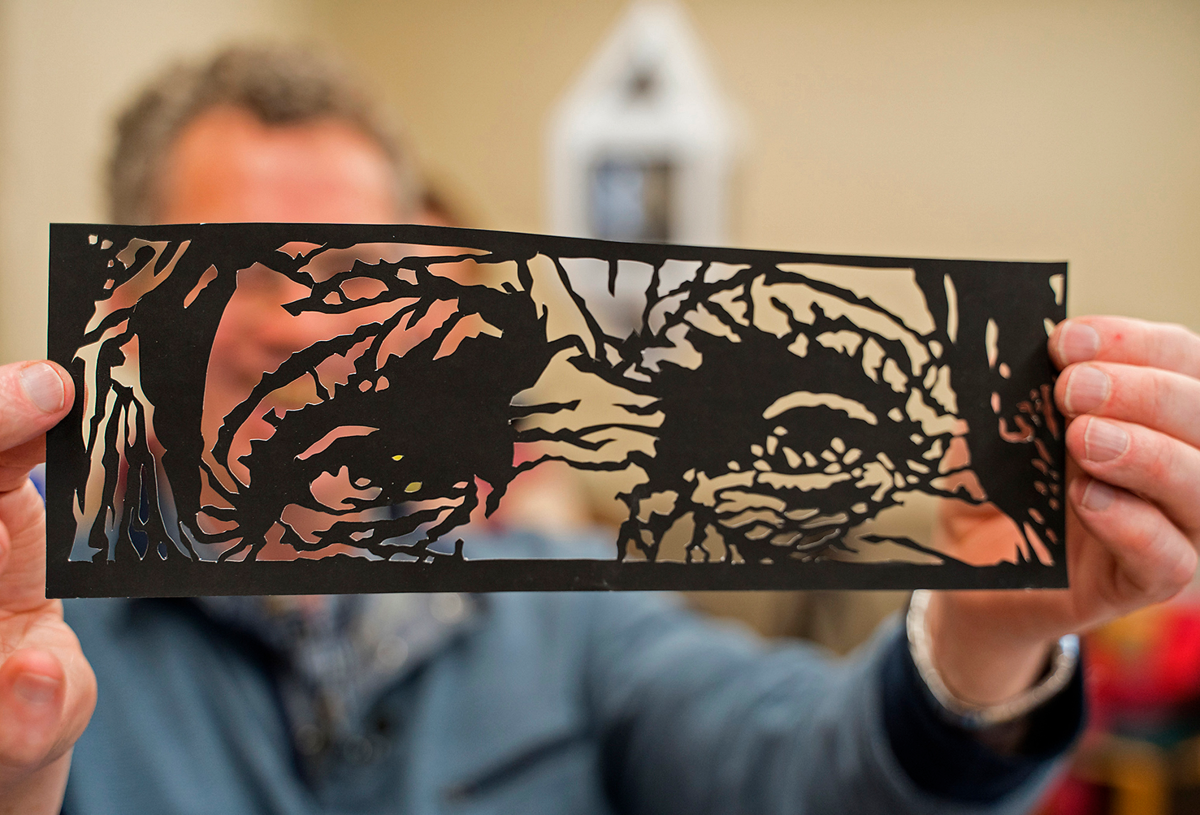
For centuries, people around the world have enjoyed the art of paper cutting. It’s both fun and relaxing, with young and old creating beautiful artworks. Paper cutting is essentially drawing with scissors. You free your design, decorations, and letters from the paper with your scissors. The variations are as diverse as the cutters themselves.
Everyone has used scissors on a piece of paper at some point, but in this workshop, you’ll take it a step further. After a brief introduction to the art of paper cutting, you’ll learn the basic techniques from an experienced cutter. You will then apply these techniques to create your own cutwork from silhouette paper. You’ll also learn how to carefully mount your artwork, and at the end of the workshop, you’ll take home a framed piece of art. Make sure to reserve a spot on your wall at home!
The Dutch Association for Paper Art is a meeting place for both hobbyists and professional artists in the field. The workshop instructors are members of this association and are specially trained to teach interested individuals the intricacies of the craft. Most of them regularly exhibit their work.
Paper cutting art has been listed in the Inventory of Intangible Heritage in the Netherlands since 2013.


In this masterclass, you will learn about the rich heritage of the Meghwaad-Gurjar women. You will discover their specific embroidery techniques while uncovering the story behind them, and learning more about their historical connection with the Netherlands.
Under the guidance of experienced craftswoman Geetaben Meriya and translator/facilitator Lipika Bansal from De Textielfactorij, you will master the art of Kutchi embroidery by creating a brooch. The distinctive effect of this colorful embroidery is highlighted when small mirrors, known as abhla, are sewn into geometric and floral patterns. By the end of the masterclass, you will have embroidered a brooch featuring a mirror and cotton embroidery thread.
Women from the Meghwaad-Gurjar community create intricate embroidery for personal use, for their animals, and for their homes. They are known for their technical skill in embroidery. This art is passed down from mother to daughter, characterized by bold colors, dense stitching, the use of mirrors, and an abundance of floral motifs.
Geetaben Meriya learned the embroidery technique and traditional symbolism from her native community as a young girl, from her mother and grandmother. As a sixth-generation embroiderer, she is strongly motivated to preserve and promote Meghwaad-Gurjar embroidery to a diverse audience.


Create your own unique herbal blend! Guided by tea sommelier Benita Roetman from Thee & Kaart, embark on a journey through scents and flavors to develop your personal tea blend. Let your sense of smell lead you and create a tea that perfectly suits you. Be surprised and inspired during this workshop. And after the workshop, you can continue to enjoy your personal tea at home.
In this fascinating herbal workshop, you will discover the art of brewing the perfect cup of herbal tea. Step by step, you will learn how to create a balanced herbal blend, using only your sense of smell to select the herbs. By setting aside your thoughts and following your intuition, you’ll find yourself making choices that you might not have expected. The exciting part is that you won’t know which herbs you are smelling, allowing you to select them purely by scent. This ensures a unique and surprising experience.
One thing is certain: at the end of the workshop, you will go home with your own unique, personal herbal blend that you have created yourself. So you can continue to enjoy this special workshop at home.


Have you ever wondered how those delightful, crunchy pearls in your bubble tea are made? In this unique workshop, you’ll get the chance to discover the process and make your own popping pearls! Learn all about the different flavors, colors, and textures of these little bursts of flavor.
Why this workshop is so much fun:
Interactive: You’ll get hands-on experience in making popping pearls.
Educational: Learn about the various flavors, textures, and colors of popping pearls.
Creative: Experiment with your own flavor combinations.
Delicious: Enjoy tasting your very own bubble tea creation.
Social: Meet other bubble tea enthusiasts and share your passion.
In short, this is a 100% vegan workshop you don’t want to miss!
“At BobaQtea, we’re always on the lookout for new recipes and creative ideas. Popping pearls are special because they provide a unique taste and mouthfeel. We wondered how they were made and if we could make them ourselves. We look forward to sharing our knowledge and passion for bubble tea in this workshop.”


Discover the magic of Moroccan carpet knotting under the guidance of Mina Abouzahra and Fadma Ait Oukhechif.
Learn the art of weaving and knotting on a mini loom. Fadma Ait Oukhechif is a master weaver from Taznakht. In this region, five hours south of Marrakech, the craft of weaving is still alive and well, with at least one loom in every household.
During this workshop, you will work on a small loom and make a small tapestry with wool that you can take home with you.
The craft of carpet knotting is passed down from generation to generation. Berber carpets are unique pieces full of identity and heritage. An experienced weaver can make an average of 10,000 knots per day, with carpets taking months or even years to complete. Each carpet and knot tells its own unique story, the story of the weaver.
For the Amazigh, wool has a special power, full of invisible blessings. Rituals and songs accompany the making of carpets, making them not only works of art, but also carriers of culture and tradition.
Fadma Ait Oukhechif leads the Kasbetaznakhte weaving cooperative in Taznakht, the village she calls home and where she learned the art of carpet knotting. She likes to experiment with colours, especially blue, a colour associated with Taznakht. Her weaving cooperative works with Mina Abouzahra, and their collaboration unites Dutch design and Moroccan craftsmanship. Together they hope to ensure that the weaving craft with its rich history can continue to exist sustainably.


Festival address:
NDSM Loods
NDSM-Plein 85
1033 WC Amsterdam
Postal address:
Stichting Ambacht in Beeld
Kalf 158
1509AH Zaandam
The Netherlands