Create a personalized phone case from ‘waste’ leather.
In this workshop, you will learn to work with leather and how to hand-stitch it. We use the saddle stitch, an ancient and very strong stitch. We will guide you extensively through the making process. You will learn the basic techniques for working with leather and how to create a beautiful, simple, and functional accessory.
Atelier Rosanne Bergsma creates shoes and accessories designed to last a lifetime. Through a combination of craftsmanship and a passion for functionality, we have developed a timeless collection. Everything we make is handcrafted using the best and most sustainable materials. We also produce on demand, ensuring nothing goes to waste.
Thanks to Leer en Meer for sponsoring supplies.

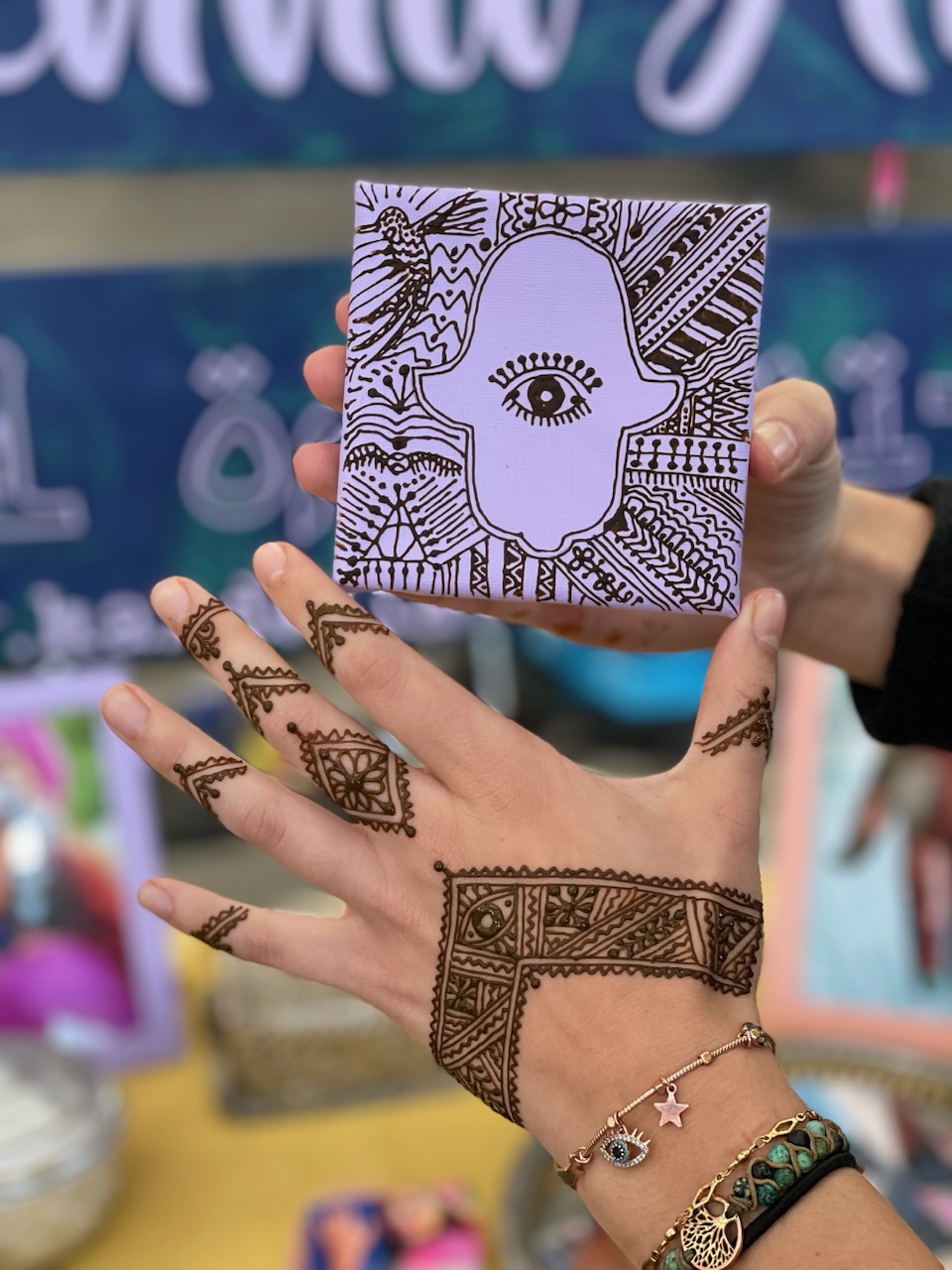
During this workshop, we start with a brief introduction to the world of Moroccan henna art. Do you know, for instance, why henna is used and the meanings of certain patterns? What technique is used to apply the patterns? During the workshop, you will learn this and also get hands-on with the technique. Using a cone filled with henna paste, you will create a pattern on a small canvas in five steps. This needs to dry, so by the end of the day, you can pick up your henna artwork and take it home. With a bit of luck, you might also get a decoration on your hand from our professional henna artist.
Moroccan henna art is a craft traditionally passed down from mother to daughter or spread organically within women’s communities. The craft is characterized by a specific technique, namely applying henna with a cone. Geometric patterns are often applied to hands and feet. The henna binds to the keratin in the skin, making the orange-brown decorations visible for 1 to 2 weeks.
Henna is best known as a ceremonial part of a Moroccan wedding, where the bride’s hands and feet are decorated with henna. But henna is much more than a beautiful skin decoration. It encompasses a whole world of symbolism, meaningful rituals, and empowering traditions.
At the age of four, Fatima Oulad Thami experienced her first henna ritual during a visit to her grandmother in Morocco. A neighbor girl drew a herringbone pattern on her hands and feet with a stick and henna paste. This experience would change her life forever. Every summer, the henna ritual became a fixed tradition of the holiday. At the age of fourteen, she began to self-teach to become a neqacha. Now she has 30 years of experience and is a sought-after henna artist both nationally and internationally. With Moroccan henna art as her expertise and her passion as her drive, she has achieved much under the name Hand of Fatima. She has an online learning platform, a webshop with henna supplies, the Henna Academy for group lessons, commissioned work, a master-apprentice trajectory via the Cultural Participation Fund, and much more. Fatima is now not only a neqacha but also a speaker, teacher, artist, and socially engaged creator.
NB: Fatima also teaches a masterclass during the festival.


The goal of this masterclass is to decorate a bndir with henna patterns. A bndir is a traditional round hand drum made from animal hide. This parchment can be painted with henna, which is traditionally done. Unlike on living skin, a henna decoration on parchment is permanent, making the bndir a beautiful art object that you can hang on the wall or place a light behind for an extra beautiful effect.
During this masterclass, you will first receive an introduction to Moroccan henna art. What is the cultural background? What meanings are associated with the patterns, and why is henna used? Then participants will then move on to the practical part. We will practice the piping technique: how to draw long, thin lines, how to make drops and leaves in one movement, and how to balance speed and pressure.
Moroccan henna art is a craft traditionally passed down from mother to daughter or organically spread within women’s communities. The craft is characterized by a specific technique, namely applying henna with a cone. Geometric patterns are often applied to hands and feet. The henna binds to the keratin in the skin, making the orange-brown decorations visible for 1 to 2 weeks.
Henna is best known as a ceremonial part of a Moroccan wedding, where the bride’s hands and feet are decorated with henna. But henna is much more than a beautiful skin decoration. It holds a whole world of symbolism, meaningful rituals, and empowerment traditions.
At the age of four, Fatima Oulad Thami experienced her first henna ritual during a visit to her grandmother in Morocco. A neighbor girl drew a herringbone pattern on her hands and feet with a stick and henna paste. This experience would change her life forever. Every summer, the henna ritual became a fixed tradition of the holiday. At the age of fourteen, she began to self-teach to become a neqacha. Now she has 30 years of experience and is a sought-after henna artist both nationally and internationally. With Moroccan henna art as her expertise and her passion as her drive, she has achieved much under the name Hand of Fatima. She has an online learning platform, a webshop with henna supplies, the Henna Academy for group lessons, commissioned work, a master-apprentice trajectory via the Cultural Participation Fund, and much more. Fatima is now not only a neqacha but also a speaker, teacher, artist, and socially engaged creator.
NB: Fatima also teaches a workshop during the festival.

Gold leaf has been used for centuries to enrich and beautify objects, from religious icons to architectural details, making them appear more precious and esteemed. A fascinating application was in ancient manuscripts, where scribes meticulously applied gold leaf to letters and margins, creating dazzling effects that captured the light and symbolised the sacred or important nature of the text. This practice not only enhanced visual appeal but also reflected the wealth, power, and devotion of the patron who commissioned the work. The ability of gold leaf to elevate the status of objects continues to fascinate and inspire even today.
Dietmar Feldmann from Lower Bavaria is a master craftsman, running a restoration company with ten employees for 40 years. His signature adorns 70 churches, and he has restored over 1,500 paintings and 100 altars. Additionally, he has reconstructed or repainted 20 altars and trained more than 20 apprentices and 800 master students as a renowned course leader. Fun fact: he also gilded the guitars of hardrock band The Scorpions.
Join this master class on Sunday or have a look here for the beginner workshop on Saturday. In this master class, you will have the opportunity to gild your own treasures. Bring your shells, stones, or other objects that hold memories and emotions, and learn to use gold leaf, metal leaf, adhesives, and tools like gilding brushes. In this advanced course professional applications and the combination of adhesives, Instacoll, and Permacoll are taught and practised.
In collaboration with The ARCH.


Gold leaf has been used for centuries to enrich and beautify objects, from religious icons to architectural details, making them appear more precious and esteemed. A fascinating application was in ancient manuscripts, where scribes meticulously applied gold leaf to letters and margins, creating dazzling effects that captured the light and symbolised the sacred or important nature of the text. This practice not only enhanced visual appeal but also reflected the wealth, power, and devotion of the patron who commissioned the work. The ability of gold leaf to elevate the status of objects continues to fascinate and inspire even today.
Dietmar Feldmann from Lower Bavaria is a master craftsman, running a restoration company with ten employees for 40 years. His signature adorns 70 churches, and he has restored over 1,500 paintings and 100 altars. Additionally, he has reconstructed or repainted 20 altars and trained more than 20 apprentices and 800 master students as a renowned course leader. Fun fact: he also gilded the guitars of hardrock band The Scorpions.
Join this beginner workshop on Saturday or have a look here for his master class on Sunday. In this workshop, you will have the opportunity to gild your own treasures. Bring your shells, stones, or other objects that hold memories and emotions, and learn to use gold leaf, metal leaf, adhesives, and tools like gilding brushes. In this basic course, modern adhesives are simply practised. In the advanced course on Sunday, further professional applications and the combination of adhesives, Instacoll, and Permacoll are taught and practised.
In collaboration with The ARCH.

All shoemakers are leatherworkers. Even though custom shoemaking cannot be learned in one day, during this workshop by Sepatu Studios, you can still gain experience in leatherworking and create your own 3D shape.
Before the advent of the sole stitcher, shoemakers hand-stitched shoe soles after glueing and hammering on the shaft. Of course, the holes were first punched before the waxed pitch thread was pulled through. In this workshop, you will replicate the glueing of the shaft and the hand stitching. You will also learn how to use hole punches, insert metal eyelets, and cut leather.
Your mini-pouch will be 17 cm long and 10 cm wide and will be tied with paracord.


This workshop focuses on Shibori, an ancient Japanese dyeing technique known for creating intricate patterns on fabric through folding, binding, clamping, and stitching. Shibori involves blocking certain areas of the fabric from dyeing, resulting in beautiful hand-crafted patterns.
Bring your own white T-shirt to dye during the workshop.
Roua Atelier is a sustainable, natural dye studio dedicated to making a positive impact on the textile industry by developing natural dye pigments, new techniques, and materials. We work closely with textile companies and designers to incorporate eco-friendly materials into their production and design. We collaborate with farmers to grow local plants and spread knowledge about our natural dye methods. One of our main activities is educating people about the magic of our natural dyes and helping them integrate these practices into their daily routines and uses.
Roua Alhalabi is a Syrian natural dye developer. She learned about the magic of color from her grandmother. She absorbed all the knowledge her grandmother shared with young children and expanded it by learning from various experts. This led her to develop her own methods and techniques for creating colors. She wants to share her love for color with others, which is why she will teach a different technique each day at the festival. Have a look here at the other workshop on Saturday.


This masterclass focuses on high-level techniques, particularly rust dyeing. When iron comes into contact with water and various elements like humidity and temperature, it forms rust, as naturally occurring in the environment. Rust dyeing offers a magical way to create unique patterns on fabrics using different natural materials. Participants will learn various techniques during this 3-hour masterclass. We will design a bag or bandana that you can take home with you.
Roua Atelier is a sustainable, natural dye studio that aims to make a positive impact on the textile industry by developing natural dye pigments, new techniques, and materials. We work closely with textile companies and designers to incorporate eco-friendly materials into their production and design process. We collaborate with farmers to grow local plants and spread knowledge about our natural dye methods. One of our key activities is educating people about the magic of natural dyes and helping them integrate this into their daily practices and uses.
Roua Alhalabi is a Syrian natural dye developer. She learned about the magic of color from her grandmother. She absorbed all the knowledge her grandmother shared with the young children and expanded it by learning from various experts. This led her to develop her own methods and techniques for creating colors. She wants to share her love for color with others, which is why she will teach a different technique each day at the festival. Have a look here at the other workshop on Sunday.


For centuries, people around the world have enjoyed paper cutting. It’s fun and relaxing, with people of all ages creating beautiful artworks. With so many cutters, there are countless variations. This unique craft is rightfully included in the Inventory of Intangible Heritage in the Netherlands. The Dutch Association for Paper Cutting is the meeting place for both hobbyists and professional artists.
Everyone has used scissors on a piece of paper at some point, but in this workshop, you’ll take it a step further. After a brief introduction, you’ll learn the basic techniques from experienced cutters. You’ll then apply these techniques to a simple project on your own. At the end of the workshop, you’ll take home one or two cut-out artworks. Success is guaranteed.
The workshop leaders are members of the Dutch Association for Paper Cutting, specially trained to teach interested individuals the intricacies of the craft. Most of them regularly exhibit their work.


Under the guidance of Tanja Rakic, learn how to create a weaving booklet.
Double sheets are used, into which loose pages are woven. The loose pages are secured with thin strips of sturdy paper. The paper we will use includes Gampi, which is made from the bark of the Abacá tree. Gampi paper resembles fabric and can also be used for embroidery.
Aaldert de Lange was immersed in a love for books and bookbinding from a young age. At eleven, he already helped his parents with the sale of books in their antiquarian bookstore. Because his father repaired books with Bison glue, which caused the book to no longer open, Aaldert learned bookbinding. In addition to teaching workshops and selling bookbinding materials and tools, he also repairs books at the Bookbinding Center in Echten.
For over 20 years, Tanja Rakic has been involved in offering courses and workshops in bookbinding. She also enjoys organizing bookbinding-related events and trips, such as a workshop at the Abbey of Berne and the Bookbinding Fair in Sint-Niklaas (Belgium).
Boektotaal is a bookbinding and restoration studio located at the Bookbinding Center in Echten (Drenthe province). Boektotaal specializes in offering various bookbinding-related workshops and courses (also on location), and they sell everything related to hand bookbinding, including various tools, decorative papers, folding bones, bookbinding glue, and linen for covering books.


Festival address:
NDSM Loods
NDSM-Plein 85
1033 WC Amsterdam
Postal address:
Stichting Ambacht in Beeld
Kalf 158
1509AH Zaandam
The Netherlands