Participation at your own risk. Do not wear highly flammable clothing!
After a brief explanation of the history of the poppy, you will create a flower from copper yourself. Using a hammer, you will work the provided copper petals on an anvil into graceful flower petals. The petals are then shaped on a hollowed-out plastic disc. The brass stem is threaded so that the petals can be attached to the stem.
In addition to iron/steel, several other metals can be used, such as copper, aluminum, bronze, and tin. Copper is a metal that we also work with in our forge. Copper is a relatively soft material that is easy to work with. We shape the copper by hammering it on an anvil and a plastic mold. Sometimes copper is heated to process it properly, but relatively thin copper can also be worked as is.
Having started as a freelancer in the metal industry, Cees Pronk conducted research on blacksmithing courses in the Netherlands in 1999/2000. However, a good vocational training no longer existed, which led him to develop a blacksmithing course himself. The end terms he wrote, approved by the Ministry of Education, Culture, and Science (OCW), served as the basis for compiling and writing teaching materials for the Blacksmithing Course in Andelst and the establishment of Mondra Training. In addition to the Blacksmithing Course, various workshops and masterclasses are also offered for young and old, artists, and primary school students. All of this takes place at the Cornelis Pronk Forge, the place to gain knowledge about forging techniques.
As of January 1, 2024, Cornelis Pronk Forge has been handed over to his daughter Lotte Pronk, keeping the business in the family.


Participation at your own risk. Do not wear highly flammable clothing!
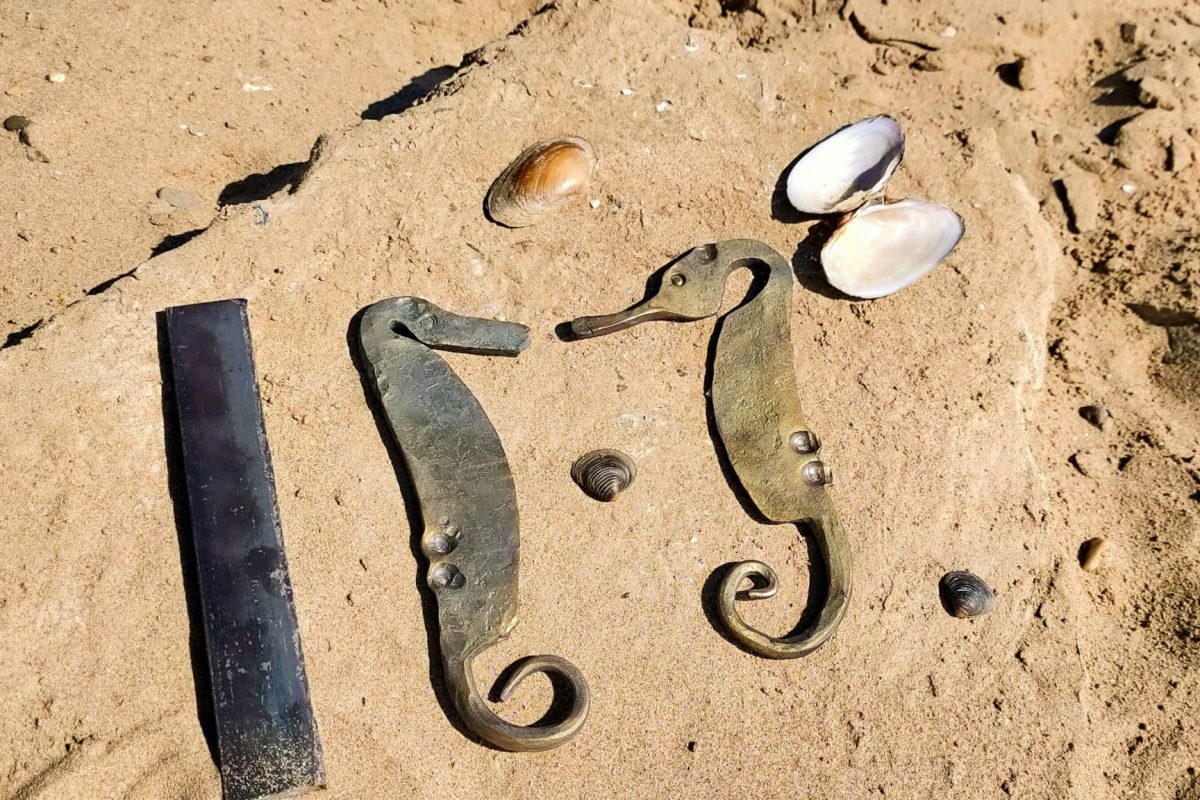
From a hard piece of metal, a seahorse is born through heat and force.
After a brief explanation from the blacksmith, you will forge a seahorse yourself. A provided strip of metal will be heated in the fire, and then you’ll hammer your very own seahorse on the anvil. This will be done with extensive guidance and example drawings from the blacksmith.
Having started as a freelancer in the metal industry, Cees Pronk conducted research on blacksmithing courses in the Netherlands in 1999/2000. Finding that a good vocational training no longer existed, he developed a blacksmithing course himself. The end terms he wrote, approved by the Ministry of Education, Culture, and Science (OCW), served as the basis for compiling and writing teaching materials for the Blacksmithing Course in Andelst and the establishment of Mondra Training. In addition to the Blacksmithing Course, various workshops and masterclasses are also offered for young and old, artists, and primary school students. All of this takes place at the Cornelis Pronk Forge, the place to gain knowledge about forging techniques.
As of January 1, 2024, Cornelis Pronk Forge has been handed over to his daughter Lotte Pronk, keeping the business in the family.

Children’s workshop (age 11 and up). Parents/guardians are responsible at all times. Participation at your own risk, do not wear highly flammable clothing.
Together with the blacksmith, a bar of iron is heated in the fire, and this glowing iron is forged into a keychain. This is done by hammering the hot material on an anvil. You will go home with a unique keychain.
Two children can forge per 20-minute slot, with hourly time slots, so you may have to wait your turn.
Having started as a freelancer in the metal industry, Cees Pronk conducted research on blacksmithing courses in the Netherlands in 1999/2000. However, a good vocational training no longer existed, which led him to develop a blacksmithing course himself. The end terms he wrote, approved by the Ministry of Education, Culture, and Science (OCW), served as the basis for compiling and writing teaching materials for the Blacksmithing Course in Andelst and the establishment of Mondra Training. In addition to the Blacksmithing Course, various workshops and masterclasses are also offered for young and old, artists, and primary school students. All of this takes place at the Cornelis Pronk Forge, the place to gain knowledge about forging techniques.
As of January 1, 2024, Cornelis Pronk Forge has been handed over to his daughter Lotte Pronk, keeping the business in the family.

Discover the lost art of French beading. By learning a combination of techniques, you’ll create your own everlasting flower—skills that you can use in the future to craft your own stems and designs.
This course is suitable for all levels, under the inspiring guidance of Holly Parr from Beaded Blooms (UK).
With small glass seed beads and wire, you’ll be amazed at how ethereal your finished stem looks. Although it’s a solid, sculptural piece, these glass bead designs appear soft and delicate, transforming under various light conditions. Patterns are provided to assist you, along with demonstrations and plenty of personal support as you are guided through creating your chosen stem.
By the end of the course, you will have completed a design that will stand the test of time.
You can choose from four different workshops, per workshops one design is created:
Saturday morning 10:30 – 12:30 uur Wheat stem
Saturday afternoon 14:30 – 17:30 uur Daisy stem
Sunday morning 10:30 – 12:30 uur Lavender stem
Sunday afternoon 14:30: 17:30 uur Cornflower stem
French Beading is a 19th century art form that has gone through waves of popularity. Believed to have originated in both Italy and France the craft was predominantly favoured by women in order to earn a little money of their own and to decorate their homes. There was even a time when French beading patterns were accessible in popular literature and magazines. In the Victorian era French Beading became associated with the passing of a loved one as many memorials were created using the technique. French beading is beginning to become popular once again. With beads of just about every colour available it is possible to create stunning flowers, even when they are out of season.
Holly researches each natural bloom she replicates before designing the flower she has selected. With flowers having such a powerful impact on us, creating memories, improving our mental health and sending messages it is really important to Holly that her designs are as accurate as possible and that they capture the splendour of the blooms she replicates.


Marqueterie de Paille, or Straw Marquetry, originated in 17th-century France. In this masterclass, you will be introduced to the technique of marqueterie de paille. You will learn how to select and process the straw. For two hours, you will immerse yourself in this unique technique and go home with a handmade book featuring a straw marquetry cover. With simple tools and a few basic techniques, you will create a luxurious gift for yourself or someone else.
Originally, this technique was practiced by prisoners and monks. Since the beginning of the last century, marqueterie de paille has seen a strong revival. It can be applied to various objects such as furniture, jewelry boxes, wall panels, and accessories. The technique uses colored straw that is carefully flattened to create beautiful patterns and designs. The result is a stunning play of colors that gives each creation a unique shine and appearance. Due to the simplicity of the materials and the complexity of the technique, marqueterie de paille is both accessible and challenging for beginners and experienced artists alike. It is fascinating to see how a simple material like straw, with its natural luster, can produce such a special effect.
Arlette Damiaens on why this craft means so much to her: “Sometimes a material can cross your path and you are immediately captivated. The vibrant colors and mysterious shine of the straw made it love at first sight. Two days after I first saw a photo of the processed straw, I was in Paris to discover what the straw and the technique could mean for me. I now know that the mysterious shine of the straw is very natural. No varnish is involved. I love to share the beauty of the colorful straw in the hope that the craft will also captivate others.”


Due to great success in 2023, this workshop returns to the festival: join us and learn all about traditional and authentic Korean fermentation!
In this Kimchi workshop by Mina from House of Fermentation, you will be guided through making a unique kimchi recipe from Jinju, South Korea. Additionally, you will learn about the differences between fermentation methods worldwide, kimchi variations, and kimchi recipes.
All participants will work together to complete one large batch of kimchi, which will be shared at the end of the workshop, just like in Mina’s childhood when all the neighbors would come together to make a huge batch of kimchi to feed the entire village.
With the Korean kimchi recipe, the fermentation process continues practically forever. You can open the jar as often as you like to take some kimchi out; it will keep fermenting. Making kimchi is a craft that relies on the harmony between ingredients, microorganisms, nature, and us, humans.
During the festival, the traditional Korean ‘Hang ah ri,’ a 2000-year-old cooling instrument still in use in Korea, will also be exhibited. You can taste naturally fermented kimchi that has been fermenting for about 3 months in the Hang ah ri. This Hang ah ri, made by the government-registered (and protected) craftsman Choong-Ghil Hwang, was imported directly from South Korea by Mina in 2021 through crowdfunding.
Mina was born and raised in Jinju, South Korea. She studied nursing at university, which helped her research and verify the traditional recipe. She moved to the Netherlands and in 2019 started House of Fermentation to reintroduce the legacy of kimchi making and pass on Korea’s rich cultural heritage.

Step into the world of a student at the Hout- en Meubileringscollege (HMC). In the Creative Craftsman program, students learn to combine the latest techniques with traditional craftsmanship.
The leather pattern pieces for the make-up bag are cut out using a laser machine. You choose the leather and thread color you want to use. During the workshop, you will be introduced to hand stitching and learn various decorative stitches. After the workshop, you will leave with a hand-stitched makeup bag.
Since 1929, HMC has been an independent vocational school. As a relatively small school, we offer a personal and safe environment. We train students for careers in interior design, furniture, technology, and design. We offer programs for various professions including furniture maker, interior advisor, creative craftsman, home sales advisor, carpenter, upholsterer, and piano technician. We also provide courses and training for adults.


During this workshop, you will make your own wooden photo frame. It starts with choosing from three different types of wood. Then, we will create the frame using traditional methods with various machines and tools. You will learn to work with the miter press, band saw, and dovetail router. We will also make a Polaroid photo that can be immediately placed in the frame. At home, you can replace it with a photo of your choice!
Students from the Hout- en Meubileringscollege will enthusiastically guide you through this workshop. Most of them are enrolled in a woodworking program.
HMC (Hout- en Meubileringscollege) has been an independent vocational school since 1929. We are a relatively small school, which contributes to a personal and safe environment. We train students for careers in interior design, furniture, technology, and design. We offer programs for various professions including furniture maker, interior advisor, creative craftsman, home sales advisor, carpenter, upholsterer, and piano technician. We also offer courses and training for adults.

You might think of lace making in terms of traditional costumes, lace collars in paintings by the old masters, or doilies at your grandmother’s house. Perhaps you have no idea how lace is made. Maybe you’ve watched a lace-making pillow with bobbins darting every which way and wondered how anyone knows which bobbin goes where and when.
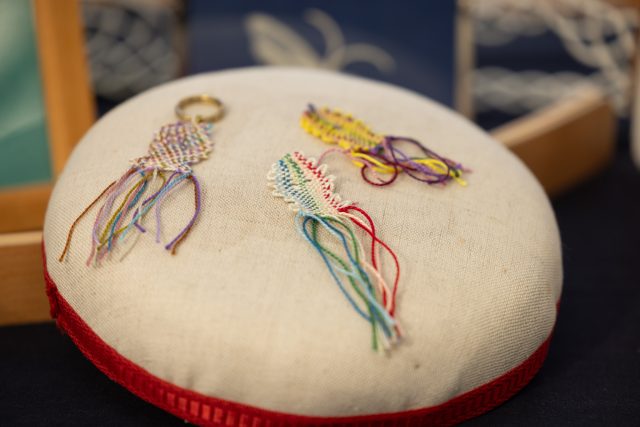
In either case, we invite you to experience for yourself what it’s like to sit behind a lace-making pillow and create something small with bobbins. You will leave with a cheerful little fish and an idea of how experienced lacemakers know which bobbin goes where and when.
We (Corrie and Rit) met through various lace-making courses we have taken both domestically and internationally. Corrie is currently pursuing a teaching qualification in Germany, and Rit is the chairperson of a large lace-making group in the Netherlands.
With other enthusiastic lacemakers, we have formed a group (Lace Group Kanthousiast) that meets once a month to exchange information about lace-related topics. This ranges from new techniques to interesting lace-making books, designs, colors, and more.

During the workshop, you will learn the basics of engraving under the guidance of glass engraver Alie Winters. She has been engraving for 37 years, working on commissions for businesses and individuals.
You will start with a practice piece on a flat glass plate to get accustomed to the equipment and get a sense of your skills. Next, you will design your own drawing to be engraved on a drinking glass. You will have access to various types of engraving tools, each with a different function. Before you know it, you’ll be taking home a beautiful, self-made creation.
You will use engraving machines and receive protective gear that you must use. Participation is at your own risk, and participants must follow the safety instructions.
Engraving dates back to prehistoric times. Engraving is the predecessor of etching. Unlike etching, which uses acid to create the design, engraving involves scratching the design directly into the glass. An engraver uses a hand tool with a diamond tip.
Alie Winters from Lemsterglas engraves by hand in a traditional craft manner. She learned the trade as an apprentice to the master glassmaker Jaap Deen in Sloten and is eager to share her knowledge at the Ambacht in Beeld Festival.


Festival address:
NDSM Loods
NDSM-Plein 85
1033 WC Amsterdam
Postal address:
Stichting Ambacht in Beeld
Kalf 158
1509AH Zaandam
The Netherlands