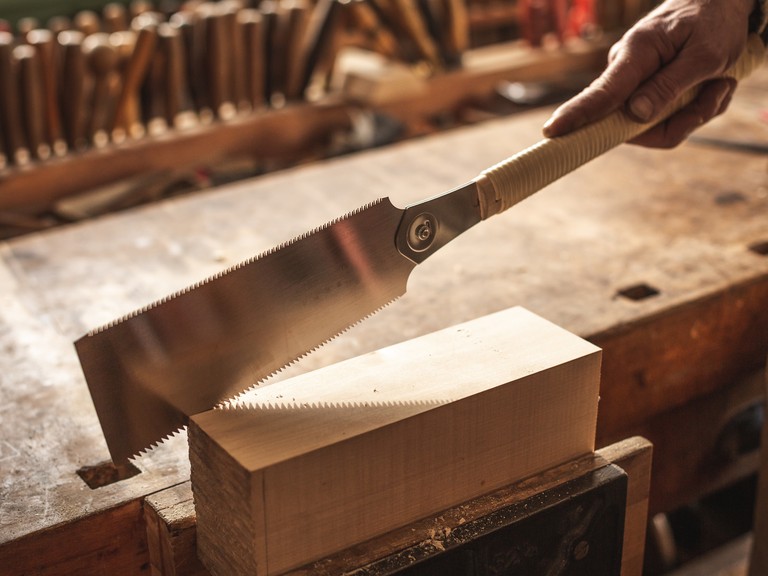
Japanese woodworking is rooted in its own unique philosophy. During this workshop, you will experience the distinctive Japanese approach to woodworking. The key difference from familiar Western techniques is working “towards yourself” using hand tools, known as the “pull stroke.”
You will get hands-on experience trying out a traditional Japanese pull plane and pull saw. Practically, you will craft a genuine Japanese wood joint.
Het Ambachtshuis Brabant is a leading educational institution for practical craft training, operating with a contemporary master-apprentice model. Their doors are open to all (young) adults eager to work with head, heart, and hands—regardless of education, background, or skills. Everyone can discover and develop their passion for crafts through authentic vocational training. Craftspeople are increasingly appreciated and in the spotlight! Het Ambachtshuis Brabant aims to promote honest products and meaningful experiences with a story, contributing to the preservation and renewal of crafts through their courses.
Peter Pothoven, the workshop instructor, has a deep passion for Japan and Japanese woodworking. In his projects, he uses Japanese tools with great precision and attention to detail. He mainly crafts bonsai tables, boxes for valuables, and display cases for treasured objects. His company is named Kanzen, a Japanese word meaning “perfection” and “completeness.”
At Het Ambachtshuis Brabant, Peter teaches basic woodworking and traditional furniture making courses, as well as these specialized Japanese woodworking workshops—delivered with extra passion.
Practical information:


Nieuwenhuijs & Peetoom will give live demonstrations of traditional windmill construction.
They will be working on a mill sail and gear wheels, and if you’re feeling inspired, you’re welcome to try it yourself!
Bart Nieuwenhuijs began collecting antique items from Zaan-region windmills and houses as a child and was an active member of the model-building club at Molen Het Pink in Koog aan de Zaan. This early interest sparked his lifelong passion for windmills, Zaan timber construction, and traditional craftsmanship. After completing a carpentry program at a vocational school (LTS), Bart continued his training through the SPB apprenticeship system and worked at De Zeug, a Zaan restoration company specializing in historic wooden interiors. He later completed specialized training in restoration carpentry and a night course in construction management, and in 2002, he founded his own business.
Together with his partner Giel Peetoom, Bart now proudly runs the renowned restoration company Nieuwenhuijs & Peetoom.
They also offer apprenticeships and trainee placements for young people interested in becoming future craftspeople.
Giel Peetoom also discovered the craft at a young age, joining the same model-building club at just ten years old. “Giel started as my apprentice and has now become my business partner. How beautiful is that!” Bart says proudly.
In addition to live demonstrations, Bart Nieuwenhuijs will also give a lecture about a remarkable restoration project.

Giel Peetoom and Bart Nieuwenhuijs. Photo Danielle Lakeman
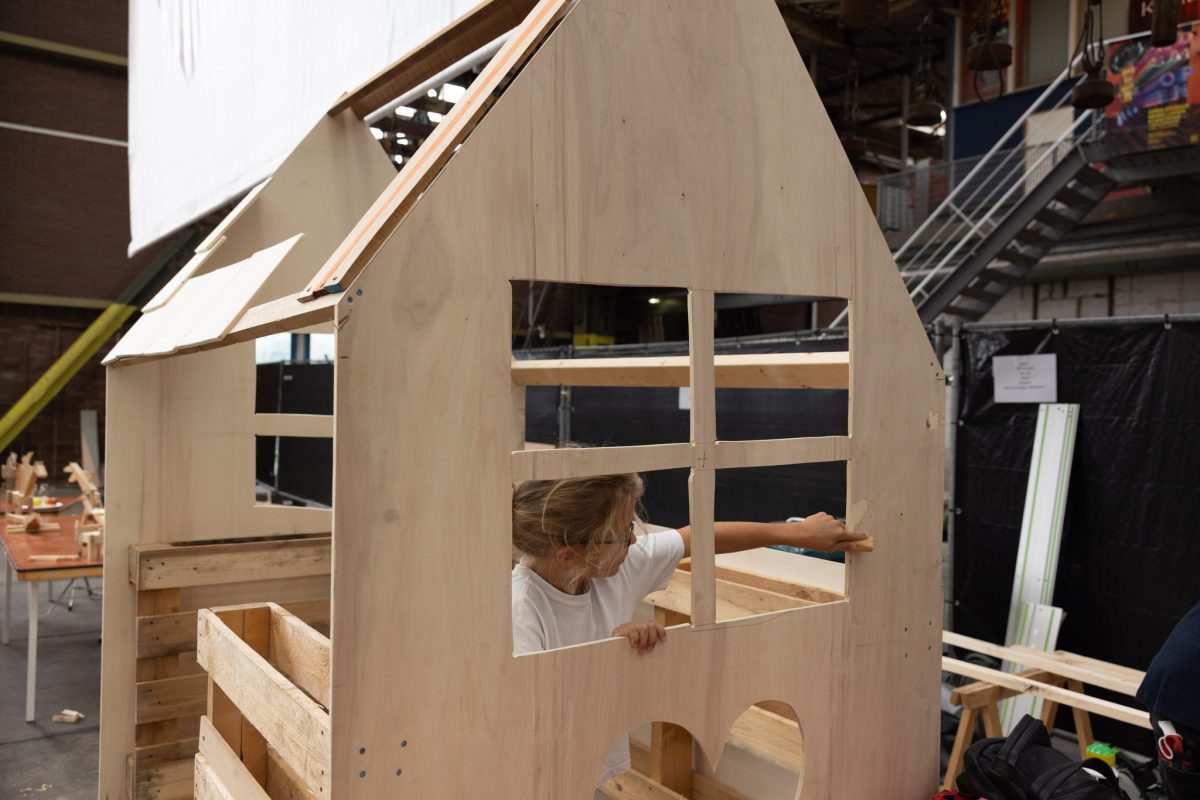
Together with a team of enthusiastic carpenters, both women and men, you will get to work with wood, hammers, and drills to build a real tiny house (in miniature, of course)!
Perfect for anyone who wants to saw, drill, screw, hammer, or simply enjoy working with their hands.
The workshop is led by a group of skilled craftspeople who are passionate about sharing their love for wood and building with the next generation of makers.
For young and older children who are excited to create something wonderful!
The team includes Claudia Glazener, Basile Marée, Remy Becker, Daan van de Gender, Boris Bus, Eva de Boer, Brandaan Hofman, and Lika Kortmann.
Young children must be supervised by a parent or guardian. Parents/guardians are always fully responsible for their child. The festival accepts no liability.

In this masterclass, you’ll discover how to craft a traditional wooden tub.
You will learn how to fit the wooden staves together, apply the galvanized iron hoops, insert the base, and finally, finish the tub. During the process, you’ll use a hammer and driver to secure the rings to the body. After a final inspection by instructor Marleen Bonami, you will sand the tub to complete it.
Did everything go well? If your tub holds together, you can proudly take your finished creation home!
A cooperage is a workshop where wooden tubs and barrels are made. Barrels are traditionally used to store and transport liquids, think wine and beer. They were also essential in historic shipbuilding. The term “cooperage” also refers to the craft itself.
The profession of traditional cooper is nearly extinct, as barrels and tubs are now mostly machine-made. Nevertheless, the craft remains highly relevant, especially for repairing large barrels, ranging from 200 to an impressive 27,000 litres, used in breweries.
Marleen Bonami still makes tubs by hand for laurel and boxwood growers. She is currently working on flower tubs for the Rubens House in Antwerp, where citrus trees will be planted in preparation for the museum’s reopening.
Due to great success at Ambacht in Beeld Brussels, this workshop now comes to Amsterdam!
Practical Information

In this workshop, you’ll discover various weaving techniques suitable for building a beautiful and durable bird feeder. The workshop offers a hands-on experience, guiding you step by step, from selecting the right materials to weaving and finishing the feeder.
At the end of the workshop, you’ll take home your very own bird feeder, ready to welcome birds into your garden.
Weaving with willow (Salix, Belgian red) is an age-old craft that has seen a resurgence in recent years. This technique uses flexible willow branches to create a variety of functional and decorative items. From baskets and bowls to garden furniture and art pieces, the possibilities are endless. Weaving requires skill and patience, with the willow carefully interlaced to form strong and aesthetically pleasing structures. Creative weaving offers space for personal expression and innovation, making each piece unique. The natural appearance and durability of willow make it a popular choice for both functional and decorative purposes. Moreover, working with natural materials supports a sustainable lifestyle.
Toon Nabuurs is a passionate weaver and active member of the Association for Weavers Netherlands and Belgium. In his own studio, Toon regularly gives lessons and workshops, where he shares his knowledge and love of weaving. Toon owns an osiery, a willow bed, where he cultivates the best materials for his projects. He masters various weaving techniques, including the 1-over-1 technique and the three-strand weave, with which he creates beautiful and durable pieces. His work combines craftsmanship with artistic expression, and he strives to make every project a unique work of art.
Practical Information:

From a square stick, make an almost round peg that you can then drive into a piece of wood to lock a joint. You will learn how to plane with a hand plane and how to make cuts with a chisel. You will also learn about proper working posture while planing and how to adjust the plane blade. We work with spruce or larch wood.
After the workshop, you get to take your own bow peg home. Advanced woodworkers can also learn to make a spiral cut (worvel) with the chisel. Of course, we are happy to tell you more about the Wood and Restoration Technician training program.
At our booth, we’ll have a scale model of a Zaan house to showcase traditional timber construction. Students are busy fitting a tub section into a staircase, creating a Douglas fir structure, and even wooden shovels. There are several examples of intricate workpieces on display. In short, there’s a lot to see.
The Wood and Restoration Technician program is the only fully-fledged MBO level 3 program for becoming a restoration carpenter. It’s offered in five locations in the Netherlands: Hengelo, Arnhem, and Zaandam. Since this year, Groningen and Roermond have also been added. During this three-year program, you’ll learn to work with wood using hand tools, power tools, stationary machines, and even CNC machines. This will equip you to handle the workshop and on-site work. Restoring paneling and buildings is the core of the program. Constructing new wood is also a key skill you’ll learn during this program.


A first introduction to carpentry of small artistic objects, for children (and their parents) under the guidance of Ruben La Cruz and Karolien Helweg. If desired, the object can also be painted. The theme is animals. You can build by following an example or use your own imagination.
La Cruz and Helweg have been working together for over 20 years developing and delivering relevant art projects and workshops for children (and their parents).

At the booth of Amsterdamsche Fijnhout, you will find exceptional pieces of wood with beautiful grain, texture, and colour perfect for woodcarving, woodturning, bases, cutting boards, and much more. In addition to wood, Japanese saws are also sold. These pull saws provide a perfect, fine cut, and you are warmly invited to try one out.
The Amsterdamsche Fijnhouthandel is a family business that has been around since 1898. Starting as a furniture workshop in the Jordaan district, it has grown into one of the most specialized timber merchants in the Netherlands. Wood is an incredibly versatile product, attracting a diverse clientele from boat builders to artists, from furniture makers to gardeners everyone knows how to find their way to Amsterdam.
Amsterdamsche Fijnhout increasingly buys and promotes various European wood species such as oak, ash, and maple. Tropical woods are preferably purchased with an FSC certification and are always traceable to their source. Additionally, old stocks of special wood are acquired, ensuring new supplies without the need for cutting new trees.
Since 2021, the company has been located in a new facility designed to be as energy-neutral as possible. With the help of 300 solar panels, the sawmill runs mostly on solar energy throughout the year. The forklifts are fully electric. Waste is minimized by selling or giving away even the smallest pieces of wood as samples.
For Ambacht in Beeld, Amsterdamsche Fijnhouthandel is sponsoring the wood for the tiny house children’s workshop.


In this one-on-one workshop, you will learn woodturning techniques to create a flat, round shape. A variety of wood types will be available for you to choose from.
You will go home with your finished pendant set in brass, complete with a cord just like in the photo – ready to wear right away.
Woodturning on a lathe is an age-old technique. The earliest lathes were powered by a bow (the fiedelbank), and later by foot (the spring pole lathe). Eventually, motor-powered lathes were introduced; these machines became larger and heavier and no longer fit in small spaces. It was not until after the Second World War that electrically powered lathes became more common, including smaller models. Nowadays, there is a renewed interest in woodturning.
In the Netherlands (Radius), Belgium (Vlaams Gilde van Houtdraaiers), and other surrounding countries, associations have been founded with the goal of promoting woodturning as a traditional craft.
Gerald Ligthart, of the Dutch Association of Woodturners RADIUS, is a Dutch woodturner who has gained recognition for his demonstrations of turning so-called “Chinese balls” complex wooden spheres considered a technical tour de force in the world of woodturning.
RADIUS consists of sixteen active regional chapters. The association publishes a full-colour quarterly magazine called AktieRadius and organizes an annual Woodturning Day at a central location in the Netherlands. This event features demonstrations, lectures, informational sessions, and the sale of woodturning tools and supplies by various vendors.
Practical Information:

Learn how to turn a wooden bowl on the lathe, with a maximum diameter of 20 cm. In this workshop, you will receive information about techniques and design.
You will go home with your own handmade wooden bowl.
This year, Mark is bringing two workbenches, so that two participants can take the workshop at the same time. Last year, this workshop sold out within 10 minutes, so do not wait if you want to get a taste of the traditional craft of woodturning!
Woodturning on a lathe is an age-old technique. The earliest lathes were powered by a bow (the fiedelbank), and later by foot (the spring pole lathe). Eventually, motor-powered lathes were introduced; these machines became larger and heavier and no longer fit in small spaces. It was not until after the Second World War that electrically powered lathes became more common, including smaller models. Nowadays, there is a renewed interest in woodturning.
In the Netherlands (Radius), Belgium (Vlaams Gilde van Houtdraaiers), and other surrounding countries, associations have been founded with the goal of promoting woodturning as a traditional craft.
Mark Steltenpool is a versatile Dutch woodturner, furniture maker, and restorer. His passion for woodworking began as a hobby and developed into a professional craft. He studied furniture making and restoration at the Hout- en Meubileringscollege in Amsterdam.
The Dutch Association of Woodturners RADIUS consists of sixteen active regional chapters. The association publishes a full-colour quarterly magazine called AktieRadius and organizes an annual Woodturning Day at a central location in the Netherlands. This event features demonstrations, lectures, informational sessions, and the sale of woodturning supplies by various vendors.
Practical Information:
Festival address:
NDSM Loods
NDSM-Plein 85
1033 WC Amsterdam
Postal address:
Stichting Ambacht in Beeld
Kalf 158
1509AH Zaandam
The Netherlands