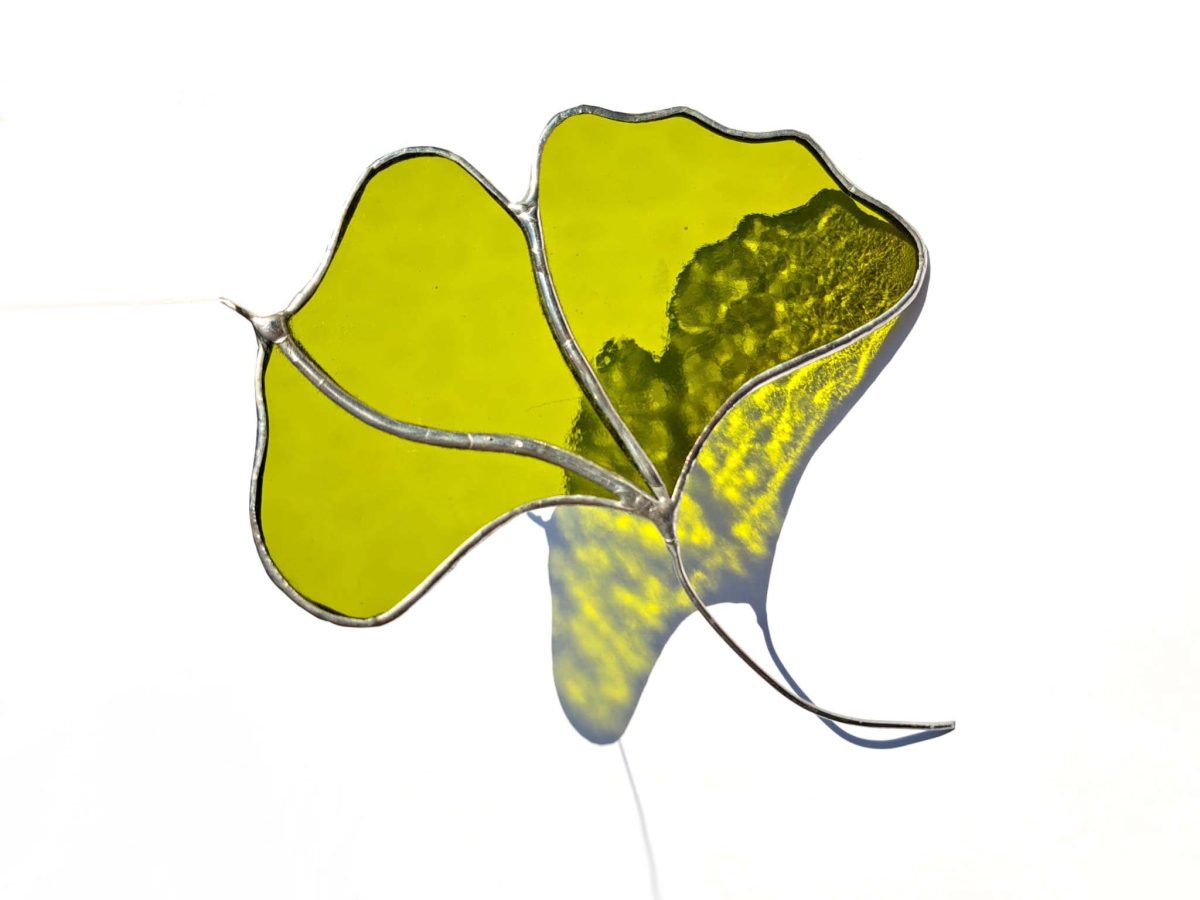
In this workshop, you can choose between two designs: a ginkgo leaf or a graphic garland. You will work with your chosen glass, a glass cutter, glass grinder, copper foil, and of course solder and a soldering iron. No prior experience with glass is needed to take part. You will be guided step by step through the entire making process.
You will go home with a stained glass window hanger.
In the Tiffany technique, custom-cut pieces of glass are ground and then wrapped in copper foil. The stained glass work is then assembled like a puzzle. After this, the copper foil seams are soldered together. Unlike traditional stained glass, this technique allows for more organic and dynamic designs.
Nanouck van Iersel designs, creates, restores, and repairs stained glass. All designs are made by hand using hand tools, allowing for almost endless possibilities in colour, form, structure, and the creation of beautiful line compositions.
Sustainability is a top priority, which is why Nanouck works exclusively with reclaimed glass, except for restoration work.
During her first studies in interior design at the Hout- en Meubilering College, she was introduced to light and its importance for people. After this, she continued her studies at the Willem de Kooning Academy. Through her experience with colour, light, and design, and her desire to combine these in a traditional craft, she discovered stained glass. “It gives atmosphere to a space and evokes a feeling: and honestly, who doesn’t love watching sunlight playing through coloured glass?”
The glass for this workshop is sponsored by Silent Art Glas in Lood groothandel.


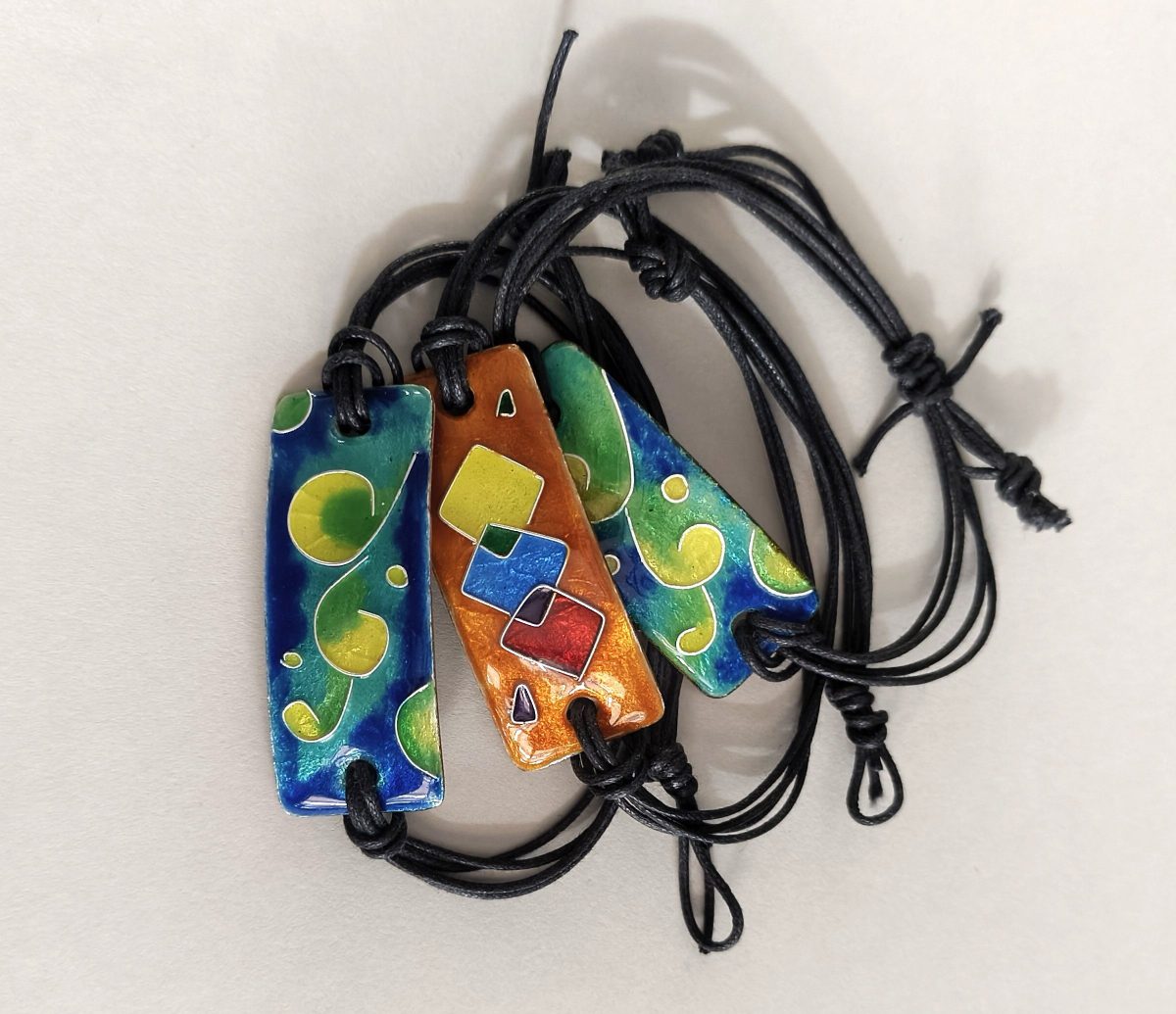
In this workshop, you will make a bracelet: a slightly curved copper plate with cloisonné enamel, attached to a wax cord with a sliding knot. You will be guided through the process step by step. First, you sprinkle a base layer of enamel powder onto the copper plate. This is fired in the kiln at 825 degrees Celsius, causing the powder to melt into glass on the plate. Next, you apply thin silver foil, with silver cloisonné wire on top that you have shaped into specific forms. After that, you apply enamel again, this time in a wet form. Once this layer has dried, it is fired in the kiln until it becomes one solid piece. Sometimes this process needs to be repeated a second time. After each step, the bracelet is fired again, comes out glowing red hot, and as it cools, the final colors slowly appear. This is truly a magical moment!
You will go home wearing a unique bracelet on your wrist.
Enameling is the process of melting glass powder onto metal at high temperatures. The final result is resistant to climate and weather conditions. This technique was already used long before our era. Depending on the color and composition of the glass powder, the firing temperature varies, but is usually between 750 and 950 degrees Celsius. Enamel can be applied to steel, copper, silver, and gold. There are various materials and techniques that can be used in the process. You can create very small pieces or very large ones: functional objects, jewelry, and autonomous artworks. There is always some unpredictability: how will it come out of the kiln? Did the colors turn out exactly as planned, has nothing shifted, are there no unintended oxides? This makes enameling an exciting process.
During the festival, the workshops are led by experienced artists and teachers. They have exhibited nationally and internationally and have mastered various techniques. They are all members of the Vereniging van Nederlandse Emailleurs (VNE), founded in 1983 with the aim of promoting enameling as both a craft and an art form. The VNE organizes several workshops each year in Amersfoort and exhibitions in galleries or museums. Twice a year there is a general members’ meeting, four times a year a newsletter is published, and members are kept informed of activities and events in other ways as well. Members can also visit each other’s studios to exchange knowledge and skills.
Regular
€10.00 pre-sale online
€12.50 at the door
CJP
€7.50 pre-sale online
€10.00 at the door
Children up to 12 years
Free entrance (with entrance ticket < 13 years).
Stadspas
Free entrance (only at the door upon presentation of your Stadspass, cannot be reserved online).
The prices mentioned include: VAT & service costs.
Please note: everyone who visits the festival needs an entrance ticket, even if you are going to attend a workshop or masterclass.

Neon was discovered in Great Britain, and the first neon gas tube was illuminated in London in 1898.
Neon lights are remarkably simple: neon gas, extracted from the air we breathe, is sealed in a vacuum glass tube and activated with electricity. Neon lamps are 100% recyclable, 100% biodegradable, and as energy efficient as LEDs.
In 2022, the craft of neon-making was added to the Heritage Crafts Red List of Endangered Crafts.
During this masterclass, participants will have a rare opportunity to learn how to make a neon lamp.
Starting with a straight glass tube, you’ll learn to cut, bend, and blow glass using a flame over a circular template. Your instructors will then process your glass with an Electron Bombardier and fill it with neon gas, the rare noble gas that glows red when electrified.
We don’t expect you to make a perfect “O” that would take many hours of practice. Instead, our goal is for you to leave with your own beautifully imperfect version of a neon circle. Light up your home with it, as a reminder and tribute to this endangered craft.
We will work with clear glass tubing and neon gas, which emits a red glow when charged with electricity.
Richard William Wheater is an artist who uses neon in performances and installations. In 2010, he founded Neon Workshops Ltd., a company specializing in the development and production of neon lighting for the creative industries. The organization also runs an annual exhibition program featuring neon-related work and maintains a public library focused on the subject of neon.
Practical Information


In this workshop, you can choose between two designs: a ginkgo leaf or a geometric garland.
You’ll work with glass, selected by you, a glass cutter, grinder, copper foil, solder, and a soldering iron. No prior glass experience is needed; you’ll be guided step by step through the entire process!
You’ll go home with your very own stained glass window hanger.
In the Tiffany technique, custom-cut glass pieces are edged with copper foil after grinding. You then assemble your stained-glass piece like a puzzle. The copper foil edges are soldered together, allowing for more organic and dynamic designs than traditional stained glass.
Nanouck van Iersel designs, creates, restores, and repairs stained glass artworks. Every piece is handmade using hand tools, allowing for nearly endless possibilities in colour, shape, texture, and line work.
Sustainability is a top priority, Nanouck works exclusively with reclaimed glass (except for restoration projects).
Her journey began at the Hout- en Meubileringscollege (Wood and Furniture College), where she studied interior design and discovered the emotional power of light. She later studied at the Willem de Kooning Academy. Her passion for combining light, colour, and design in a traditional craft led her to stained glass.
“It brings atmosphere to a space and stirs emotion, because let’s be honest, who doesn’t love watching sunlight dance through coloured glass?”
Practical Information
The glass for this workshop is generously sponsored by Silent Art Stained Glass Wholesale.
Example of a garland
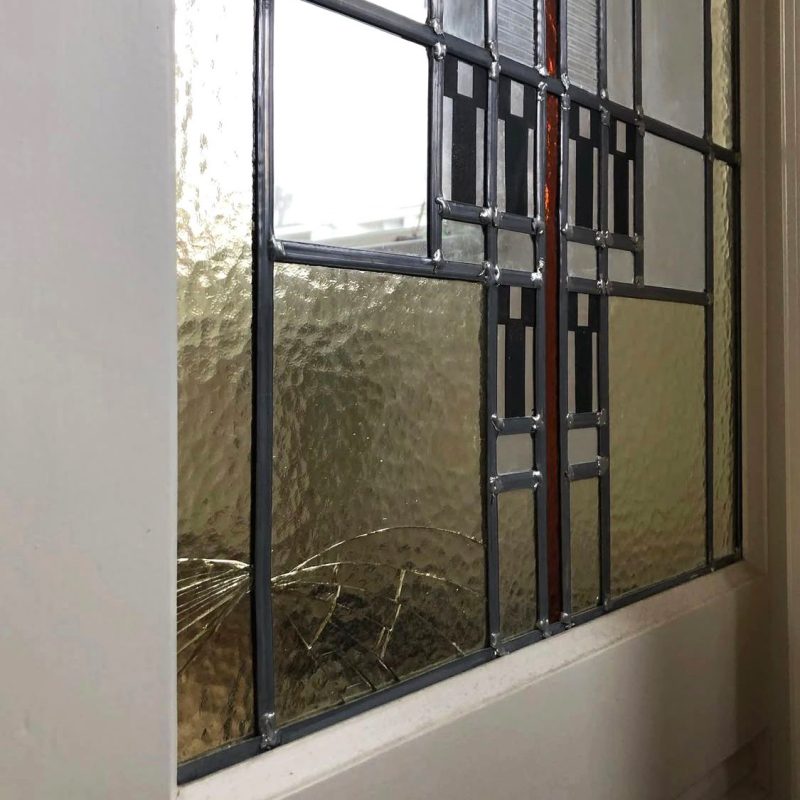
Part of this year’s Repair Shop is Glasloderij ’t Lemmet.
Do you have a stained-glass window or door (!) with a single broken pane? Bring it along and have it expertly and free of charge repaired during the festival.
During the repair, the cracked or missing piece of glass will be replaced with new glass that matches the original. Want to make sure we bring the right type of glass for you? Then email info@ambachtinbeeldfestival.nl with photos of the entire piece and close-ups of the broken or missing section, along with rough dimensions and a description of the colour/texture of the damaged glass. (Having trouble capturing the colour in a photo? Try holding a white piece of paper behind the glass and take the picture again.)
In addition to on-site repairs, the craftswomen will also give demonstrations of stained-glass restoration. Restoration is needed when the lead structure becomes old and brittle. In such cases, not only are broken or missing panes replaced, but the entire lead framework is rebuilt. During these live restorations, you’ll be able to see every step of the process, including cutting, breaking and grinding glass, shaping lead came, setting the glass into the lead, closing the seams, soldering, cementing, and patinating.
Glasloderij ’t Lemmet was founded by Tiara Roquas, whose love for the craft was nurtured and supported by a group of like-minded women with years of experience in the field. Today, the core team of Glasloderij consists of Tiara Roquas & Tess van de Coevering, and they regularly collaborate with other skilled artisans who practice the craft with the same passion and precision.


Regular
€7.50 pre-sale online
€10.00 at the door
CJP
€5.00 pre-sale online
€7.50 at the door
Children up to 12 years
Free entrance (with entrance ticket < 13 years).
Stadspas
Free entrance (only at the door upon presentation of your Stadspass, cannot be reserved online).
The prices mentioned include: VAT, service costs and €1.50 entertainment tax for the municipality of Amsterdam.
Please note: everyone who visits the festival needs an entrance ticket, even if you are going to attend a workshop or masterclass.
Festival address:
NDSM Loods
NDSM-Plein 85
1033 WC Amsterdam
Postal address:
Stichting Ambacht in Beeld
Kalf 158
1509AH Zaandam
The Netherlands