Make design from waste! Learn how to make your own belt from discarded fire hoses. By carefully observing a material, you can discover its unused beauty. With this mindset, you will get to work yourself. First, you choose your hose from one of the many shades of red. In pairs, you cut the material into strips using belt cutters. Then you trace the patterns, make holes with a spindle, and attach the buckle. Finally, you size the belt to fit you perfectly.
You will go home with your own belt.
Ilse Evers of Eversom has many years of experience making theatre sets. This has taught her to look at what is possible rather than what is intended. With a great love for craftsmanship, she combines different materials and tools to create entirely new designs. This investigative approach has led to Eversom’s diverse collection. Eversom transforms discarded fire hoses into powerful and sustainable designs from exclusive bags to monumental rugs, from quirky gifts to intriguing room dividers.
To process the material, techniques and tools from leather, textile, and woodworking have been combined and further developed. We use traditional methods like chair caning and weaving in a modern way. The bag patterns optimize the qualities of the hoses and fit precisely to the specific size of each fire hose. It is precisely this exploration of the unique material that makes designing with circular materials so fascinating.
Practical information


Ilse Evers, photo: Evy Hachman
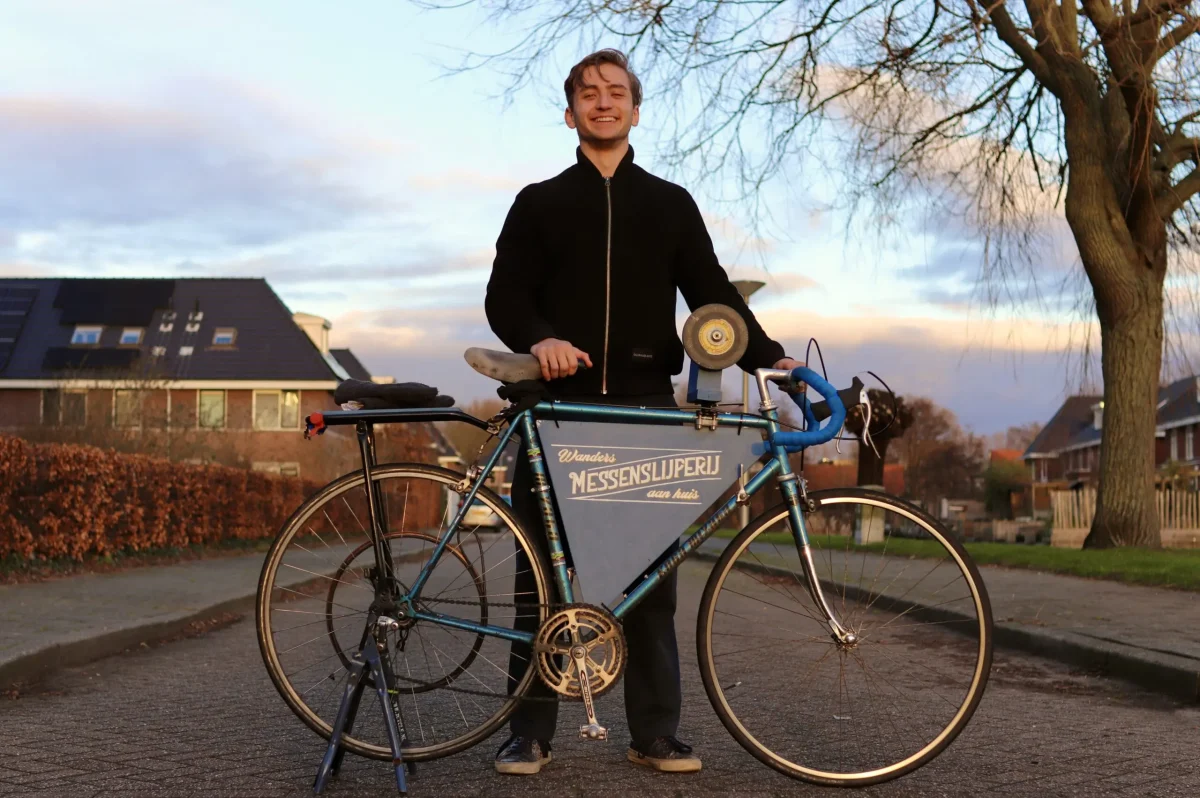
Have your chisel, planer, or scissors sharpened by the knife sharpener.
In the past, the scissor grinder (knife sharpener) would ring his bell, and everyone would rush out to have their knives sharpened. Nowadays, the profession is almost extinct. Knife smith Wander Vanhoucke has brought this ancient craft back to life. With his vintage racing bike converted into a mobile knife sharpening workshop, he will be at the repair shop so everyone can work again with sharp tools.
Wander Vanhoucke started sharpening knives when he was fourteen after struggling to cut through a tomato while cooking. Now, at twenty-two, he forges knives for (star) chefs across Europe. With great attention to detail, he tailors the type of steel, wood, shape, and balance exactly to the customer’s needs. Last winter, Wander went viral with his mobile knife sharpening service, sharpening knives at people’s homes to combat throwaway culture.
Practical information
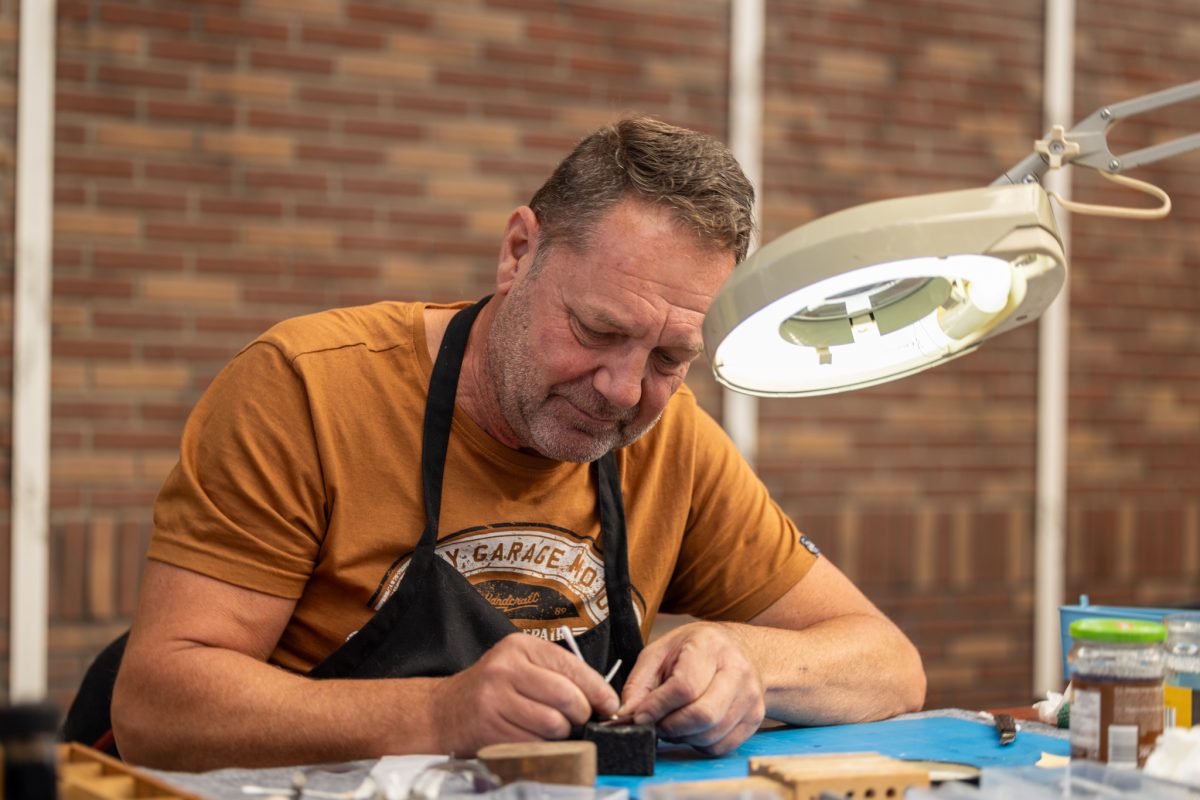
Is your fountain pen not writing anymore or not writing smoothly? Give your pen a second life by coming for maintenance, repair, or restoration (free of charge!) with artisan fountain pen repairer Carlo de Croock.
Carlo de Croock of D’n Ouwe Vulpen Repair Shop specializes in restoring and repairing old and antique fountain pens.
Please also read this message from Carlo: “I often use parts from other old fountain pens, called donor pens. If anyone has fountain pens lying around that they no longer use and want to donate, I would be grateful. This way, I can continue repairing pens using original parts and keep repair costs low.”
Practical information

On silk organza stretched over a small embroidery frame, you will create a dazzling piece of embroidery. You will have access to over 100 different beads, sequins, cannetilles, and other materials, the same ones used in the major embroidery ateliers. You will learn several techniques to achieve special effects with these beads and sequins.
Broderie d’art is the exquisite embroidery we know from haute couture — think of creations by Chanel and Dior, for example. These rich embroideries often have a three-dimensional effect, achieved by combining varied materials. This type of embroidery is often used as an appliqué on garments, but it is also used to create jewellery such as brooches and earrings. Surprisingly, the technique also has a sustainable side: by creating something beautiful for your clothing, you tend to treat it with more care, you may use an appliqué to hide a flaw, and the garment lasts longer!
You will go home with an embroidery frame holding your work, a booklet with examples and instructions in a little box, and extra materials to finish your piece at home.
Monique van Munster has a fascination with the endless possibilities of traditional embroidery with needle and thread. She experiments with historic embroidery techniques from haute couture to develop new forms of artistic expression. Gold embroidery has become one of her specializations, which she has developed into a unique personal style. Her passion for this refined artisanal craft has brought her into contact with various couturiers and designers who have incorporated her broderie d’art into their collections. Her work has been showcased in fashion shows in Paris, Dubai, and more recently in Palm Springs.
Since 2023, her work has been listed in the Inventory of Intangible Cultural Heritage of the Netherlands. Monique loves to share her knowledge through lessons, masterclasses, and workshops at her studio in Tilburg, at vocational schools across the Netherlands, through the Dutch Fashion Crafts Association, and at other organizations where she is invited to teach.
Practical Information


Moniquenwerk Broderie d’art is the shop for materials for broderie d’art and gold embroidery, run by Monique van Munster.
Broderie d’art is the artistic embroidery used in haute couture in Paris. Monique regularly travels to Paris to source the most beautiful beads and sequins. The shop also specializes in silk embroidery threads and other fine threads.
Monique has been involved in needlework her entire life. Since 2013, she has had an embroidery studio in Tilburg. In her studio, Monique teaches broderie d’art, gold embroidery, and 3D embroidery. Her students come from all over the Netherlands, and even from Germany and Belgium to attend her classes. Since 2023, Monique van Munster’s broderie d’art has been included in the Inventory of Intangible Cultural Heritage in the Netherlands.
Because she often works with hard-to-find materials, she began sourcing them for her students. The product range grew out of the lessons but has since expanded into a treasure trove for embroiderers who love experimenting with unique materials.
At Ambacht in Beeld (Craft in Focus), Monique sells materials for gold embroidery such as gold thread and cannetilles, silk embroidery threads, beads and sequins, coloured silk organza, several types of ribbons and trims, silk velvet, and materials to make handmade buttons.
During the festival, Monique also teaches masterclasses Beautiful embroidery.

Join the whole process of making a rope from the start till the end. You will learn about the importance of rope in Norway’s history. We will use an old technique that requires very few and simple tools. You can easily make the tools yourself at home with different materials. The participants will work together to make one rope, which can also be parted to take home. The fibers we use are from the Linden tree. We will actually make ropes in the same way as the Vikings did during the Middle Ages.
You will take home a piece of self made rope.
Norwegian rope making is a traditional craft that has deep historical roots in Norway, especially in its coastal and seafaring communities. Rope was essential for fishing, sailing, and farming
Ingunn Undrum is a 47 years old rope maker from Norway. She is very experienced in making ropes from different materials such as hemp, bast from the Lime tree, manila, skin and horsetail. This also involves the whole process of preparing the fiber, spinning yarn, twisting strand and closing the finished rope. Ingunn started as an apprentice in 1998 and worked together with her master for three years until she passed her final exam. Since then, she worked as a rope maker for 24 years and made thousands of meters of rope. Her costumers have been mostly traditional wooden sailing boat owners in Norway. Currently she is also an arts and crafts teacher at a local school.
Practical information

Photo: Lars A. Oma/Hardanger fartøyvernsenter.

Regular
€7.50 pre-sale online
€10.00 at the door
CJP
€5.00 pre-sale online
€7.50 at the door
Children up to 12 years
Free entrance (with entrance ticket < 13 years).
Stadspas
Free entrance (only at the door upon presentation of your Stadspass, cannot be reserved online).
The prices mentioned include: VAT, service costs and €1.50 entertainment tax for the municipality of Amsterdam.
Please note: everyone who visits the festival needs an entrance ticket, even if you are going to attend a workshop or masterclass.

Kintsugi is a traditional Japanese restoration technique that breathes new life into broken ceramics. By using Urushi, the natural sap of the Urushi tree, and decorating the repaired fractures with gold, silver or vermilion, each piece becomes a beautiful work of art.
Kintsugi is more than a craft – it is a philosophy rooted in acceptance and resilience. By emphasizing scars rather than hiding them, this age-old method teaches us to embrace flaws and imperfections.
Participants will learn traditional restoration techniques, including the history of Kintsugi and its key material—Urushi, a Japanese lacquer. Each participant will receive a bowl for Kintsugi and a container designed to aid in transportation and drying the paint. During the three-hour session, you’ll follow the process step-by-step: gluing, cleaning, filling, painting, and finally sprinkling gold powder to
complete your unique creation. By the end of the workshop, participants will take home their very own Kintsugi pottery.
Yuki Tessler teaches Kintsugi workshops and courses in the Netherlands, France, Denmark and Belgium. Originally from Saitama, Japan, her journey as a lighting designer began in Tokyo, where she worked for ten years. Her deep fascination with traditional Japanese art and culture has always shaped her work. Theatre technology gave her practical insights into Japanese craftsmanship and its long tradition. During her studies in philosophy, specializing in Buddhism, she explored the concepts of wabi-sabi and zen that underpin the Japanese cultural mentality. The Kintsugi and Urushi art that are part of this allow her to embrace imperfection. Sharing the Kintsugi philosophy through workshops has become a way to promote cultural exchange and celebrate Japanese artistry.
Practical information


Festival address:
NDSM Loods
NDSM-Plein 85
1033 WC Amsterdam
Postal address:
Stichting Ambacht in Beeld
Kalf 158
1509AH Zaandam
The Netherlands