In this workshop, you will embroider a small sock on Aida fabric using traditional darning patterns.
You will learn the technique of decorative darning and discover how to use colour and rhythm to create a beautiful little piece.
You’ll go home with a uniquely embroidered sock and a new skill.
Embroidery is an ancient craft technique that uses needle and thread to add beautiful patterns, text, or images to fabric. It’s a creative and personal way to embellish textiles, from clothing to home decor.
MerkWaardig is the embroidery association of the Netherlands, with over a thousand members sharing their love for hand embroidery. Whether it’s classic samplers or modern styles like visible mending, embroidery is alive and thriving! At the festival, MerkWaardig will showcase how the technique of darning, once a practical skill for repairing sheets and socks, is being reinvented. Where holes once had to disappear invisibly, darning is now decorative, colourful, and unique. It gives old textiles a second life, with a nod to the past and an eye on the future.
Willeke te Biesebeek is a passionate embroiderer and knitter. She recently contributed to fashion designer Duran Lantink’s collection, which dazzled at Paris Fashion Week and won the prestigious Woolmark Prize. For the Ambacht in Beeld Festival, she has delved into the art of sock darning to show how repairing can be not only sustainable, but also stylish.
Practical Information


Save Your Favorite Sock! In this workshop, you’ll learn how to mend a hole or reinforce a worn spot using a needle, thread, and a classic darning mushroom. Bring your worn-out sock and get started, materials will be provided!
You will go home with a repaired sock and a new skill.
Embroidery is an ancient craft technique that uses needle and thread to add beautiful patterns, text, or images to fabric. It’s a creative and personal way to embellish textiles, from clothing to home decor.
MerkWaardig is the embroidery association of the Netherlands, with over a thousand members sharing their love for hand embroidery. Whether it’s classic samplers or modern styles like visible mending, embroidery is alive and thriving! At the festival, MerkWaardig will showcase how the technique of darning, once a practical skill for repairing sheets and socks, is being reinvented. Where holes once had to disappear invisibly, darning is now decorative, colourful, and unique. It gives old textiles a second life, with a nod to the past and an eye on the future.
Willeke te Biesebeek is a passionate embroiderer and knitter. She recently contributed to fashion designer Duran Lantink’s collection, which dazzled at Paris Fashion Week and won the prestigious Woolmark Prize. For the Ambacht in Beeld Festival, she has delved into the art of sock darning to show how repairing can be not only sustainable, but also stylish.
Practical Information

In the children’s workshop Make Your Own Surinamese Celebration Scarf!, you’ll create your own colourful shoulder scarf, just like the ones worn by Indigenous children in Suriname during special celebrations.
What will you do?
Come join us to discover, create, and celebrate!
Take home a piece of Surinamese magic and help keep this unique heritage alive. Colourful fun guaranteed!
For the parents:
During this creative workshop, children will explore the rich cultural heritage of Suriname’s Indigenous peoples in a playful and engaging way. Not only will your child create a beautiful keepsake, but they’ll also learn about meaningful traditions from the Amazon region.
Carla, Martha Sabajo, and Marilyn van Rijn, born in Suriname, are proud culture bearers of the Lokono community. As members of Stichting Wasjikwa, they devote their time to preserving and passing on Indigenous cultural heritage.
Their motivation comes from a deep connection to their roots. They believe that traditional techniques cannot be separated from the stories, values, and spirituality woven into them. For Carla, Martha, and Marilyn, passing on Indigenous knowledge is about more than just teaching technique, it’s about sharing an entire way of life.
During their workshops, they create a warm, community-centered atmosphere where participants not only learn practical skills but also hear personal stories about the importance of culture and community.
Practical Information


Learn to make your own mini hammock during the workshop The Lost Art of Surinamese Hammocks, under the expert guidance of Carla & Martha Sabajo.
Step into the nearly forgotten world of traditional hammock-making, an ancient Lokono craft from Suriname. This unique technique, held by only a few Indigenous masters, is on the verge of disappearing.
Experience how this ingenious creation comes to life, step by step, knot by knot. This is more than just a creative workshop, it’s your chance to help preserve an endangered tradition!
You’ll go home with your own mini hammock.
There are now very few Indigenous knowledge holders who still master and pass on the traditional art of hammock-making. This technique originates specifically from Suriname and is practiced by the Lokono, one of the Indigenous peoples of the region. Traditional hammocks are made from palm fibre or cotton, which are processed from raw material or plant: de-seeding, cleaning, forming yarn, spinning, weaving, and knotting. An original hammock is a brilliantly efficient invention, easy to carry, highly durable, and environmentally friendly. It stems from a time when Indigenous communities lived nomadically and carried little with them as they moved from place to place.
Carla, Martha Sabajo, and Marilyn van Rijn, born in Suriname, are proud culture bearers of the Lokono community. As members of Stichting Wasjikwa, they devote their time to preserving and passing on Indigenous cultural heritage.
Their motivation comes from a deep connection to their roots. They believe that traditional techniques cannot be separated from the stories, values, and spirituality woven into them. For Carla, Martha, and Marilyn, passing on Indigenous knowledge is about more than just teaching technique, it’s about sharing an entire way of life.
During their workshops, they create a warm, community-centered atmosphere where participants not only learn practical skills but also hear personal stories about the importance of culture and community.
Practical Information


In this workshop, participants will learn the basics of wheel throwing in a one-on-one, 30-minutes session with highly experienced potters Floortje Roetemeijer and Tanja van Schagen.
You’ll go home with your own handmade creation.
Floortje Roetemeijer studied ceramics in Gouda. From 2002 to 2011, she worked at Mobach Ceramics, where she specialized in throwing and designing new forms. Since 2012, she has been running her own studio, Het Serviesfabriekje, where she handles every step of the process herself: from design and throwing to glazing and firing. Her designs focus on simple, elegant forms without unnecessary embellishments, always aiming to balance beauty and functionality. She also teaches group workshops and throwing classes for both children and adults in her studio in Driebergen.
Tanja van Schagen has been working at Mobach Ceramics since 2000 as a potter and designer of stoneware. She studied ceramics and painting/printmaking at the Gerrit Rietveld Academy in Amsterdam, as well as ceramic training at SBB Midden Holland in Gouda. In addition to her work at Mobach, she creates her own work and has recently specialized in raku ceramics, a unique Japanese firing technique. Tanja also teaches wheel throwing in her own studio and at Atelier Werfklei in Utrecht.
Practical Information

In this workshop, you’ll print a soft and summery Etamine de Laine scarf with your own custom pattern using a variety of leaves.
The instructors from Hawar Textile Institute will show you exactly how to do this, teaching you about the natural dyes released by different leaves and how to create crisp, detailed prints.
You don’t need to bring anything for the workshop; a wide selection of leaves will be available. But if you enjoy experimenting, feel free to bring your own plant, tree, or flower leaves. The colours they release are often a beautiful surprise that makes the result even more special!
Leaves can transfer natural colour onto fabric. In eco-dyeing, also known as botanical printing, leaves from various plants are used to print patterns on fabric. Since the publications by India Flint, this dyeing method has become increasingly popular. The trick is to achieve more than just a coloured blotch; the leaf’s vein structure should also be clearly visible in the print.
You’ll go home with your own handmade summer scarf!
Part of the process includes fixing the print, which takes about an hour. You don’t need to stay for this step, but keep in mind that your scarf won’t be ready to take home immediately after the workshop.
Floor de Bruijn runs the family business Hawar Textile Institute, originally founded by Meinie Wardenier and Harm Harms. In their large and atmospheric studio in Oldeberkoop, national and international teachers share their expertise in textile craft and textile art. Alongside the studio, there’s a well-stocked shop and an inspiring gallery, making Hawar a creative hub where old and new textile materials and techniques are (re)discovered. Floor and her team will be teaching the workshops at the festival.
Practical Information

In this workshop, you’ll discover various weaving techniques suitable for building a beautiful and durable bird feeder. The workshop offers a hands-on experience, guiding you step by step, from selecting the right materials to weaving and finishing the feeder.
At the end of the workshop, you’ll take home your very own bird feeder, ready to welcome birds into your garden.
Weaving with willow (Salix, Belgian red) is an age-old craft that has seen a resurgence in recent years. This technique uses flexible willow branches to create a variety of functional and decorative items. From baskets and bowls to garden furniture and art pieces, the possibilities are endless. Weaving requires skill and patience, with the willow carefully interlaced to form strong and aesthetically pleasing structures. Creative weaving offers space for personal expression and innovation, making each piece unique. The natural appearance and durability of willow make it a popular choice for both functional and decorative purposes. Moreover, working with natural materials supports a sustainable lifestyle.
Toon Nabuurs is a passionate weaver and active member of the Association for Weavers Netherlands and Belgium. In his own studio, Toon regularly gives lessons and workshops, where he shares his knowledge and love of weaving. Toon owns an osiery, a willow bed, where he cultivates the best materials for his projects. He masters various weaving techniques, including the 1-over-1 technique and the three-strand weave, with which he creates beautiful and durable pieces. His work combines craftsmanship with artistic expression, and he strives to make every project a unique work of art.
Practical Information:

Make design from waste! Learn how to make your own belt from discarded fire hoses. By carefully observing a material, you can discover its unused beauty. With this mindset, you will get to work yourself. First, you choose your hose from one of the many shades of red. In pairs, you cut the material into strips using belt cutters. Then you trace the patterns, make holes with a spindle, and attach the buckle. Finally, you size the belt to fit you perfectly.
You will go home with your own belt.
Ilse Evers of Eversom has many years of experience making theatre sets. This has taught her to look at what is possible rather than what is intended. With a great love for craftsmanship, she combines different materials and tools to create entirely new designs. This investigative approach has led to Eversom’s diverse collection. Eversom transforms discarded fire hoses into powerful and sustainable designs from exclusive bags to monumental rugs, from quirky gifts to intriguing room dividers.
To process the material, techniques and tools from leather, textile, and woodworking have been combined and further developed. We use traditional methods like chair caning and weaving in a modern way. The bag patterns optimize the qualities of the hoses and fit precisely to the specific size of each fire hose. It is precisely this exploration of the unique material that makes designing with circular materials so fascinating.
Practical information


Ilse Evers, photo: Evy Hachman

In this duo workshop for parent and child, you will be introduced to the Japanese Shibori technique. Learn to experiment with various natural colours and create shapes and patterns by folding, clamping, and tying fabric.
During this dyeing workshop, you will work with natural dyes to create a unique festive garland. You will experiment with plant-based colours such as indigo, madder root, onion skins, turmeric, weld, and logwood. You will learn how the natural dyeing process works, how to create patterns using the Shibori technique, and how to blend colours by layering dyes on the fabric.
Together, you will make 24 flags, enough for a beautiful, personalized garland to take home that will last a lifetime!
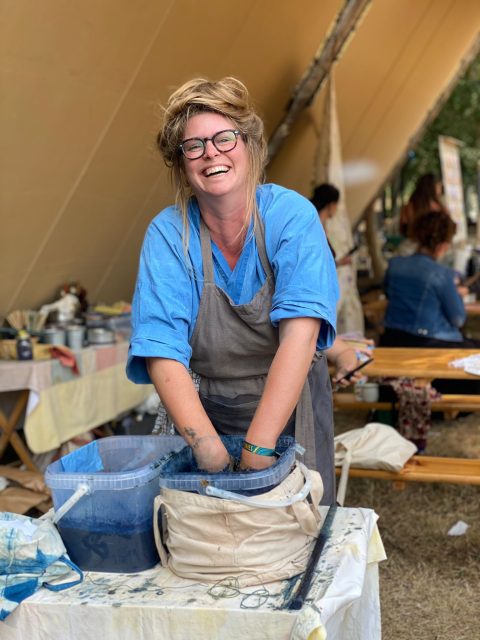
Marte Haverkamp is a visual artist who gives the traditional craft of natural dyeing a contemporary twist. She works with dyes derived from plants, flowers, and kitchen waste to colour textiles in a sustainable way. Each colour is a synergy of material, time, and care – a process that requires patience, experimentation, and a connection with nature. In her workshops, Marte demonstrates how this centuries-old technique remains accessible and relevant in today’s world.
Practical information
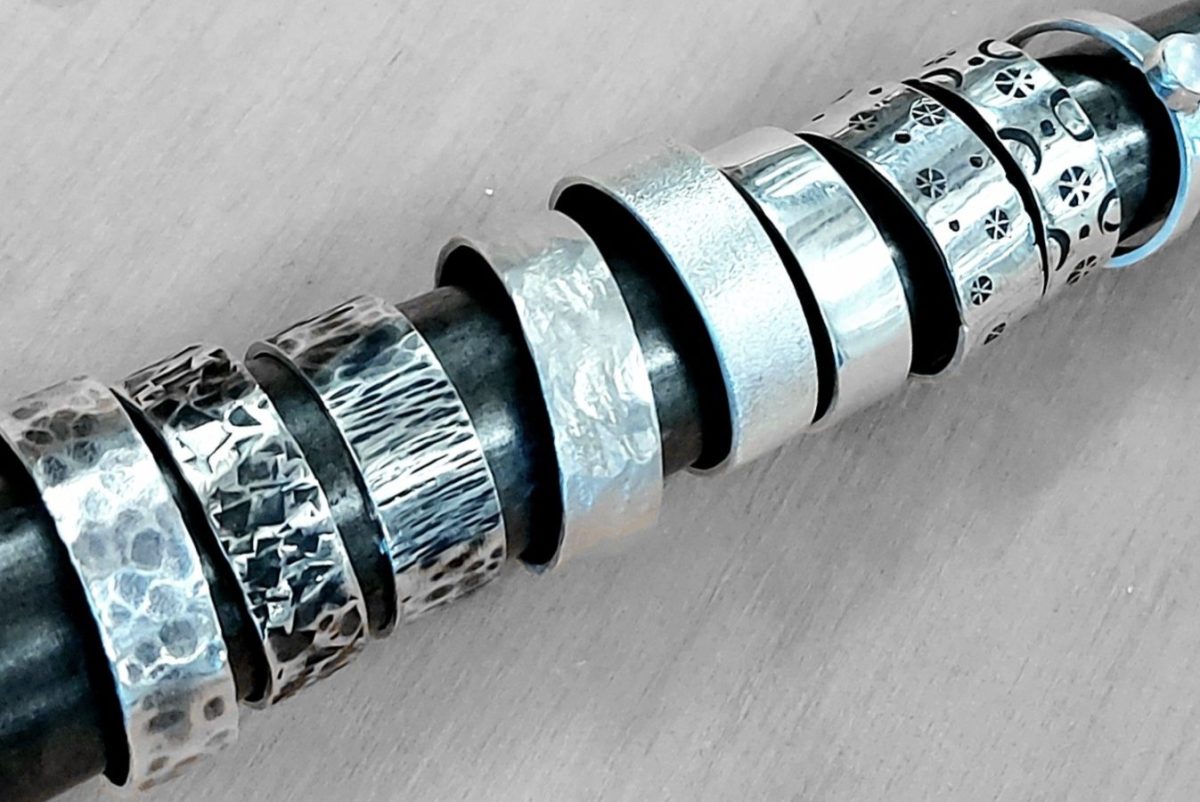
During this workshop, you will create a real silver ring with a finish of your choice.
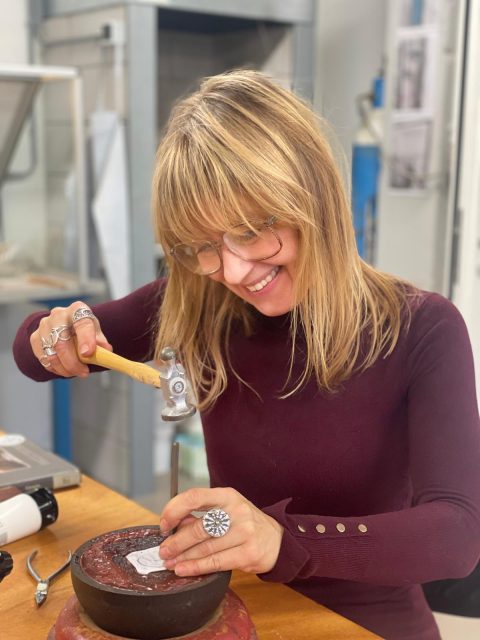
You’ll be introduced to every step of the process, from a flat piece of metal to a finished ring: measuring, marking, sawing, filing, sanding, bending, soldering, and finishing. You will shape the material according to your own ideas; you can add texture with hammers or create patterns using various stamping tools. A range of sample designs will be available for inspiration. You will proudly take home your own handmade ring.
Sacha Ofman has been a goldsmith since 1999. She trained at the School for Goldsmithing (Vakschool voor Edelsmeden) in Amsterdam. Sacha designs and creates unique handcrafted jewellery in a distinctive style — ranging from organic forms to wearable art pieces. She transforms old buttons from her grandmother’s button box into jewellery, giving them a new life as if they were gemstones. Seven years ago, she began teaching at the art centre Fluxus in Zaandam, where playful learning and joy in the creative process are central to her approach.
Practical information
Festival address:
NDSM Loods
NDSM-Plein 85
1033 WC Amsterdam
Postal address:
Stichting Ambacht in Beeld
Kalf 158
1509AH Zaandam
The Netherlands