Enamelling is applying powdered glass to metal under high temperatures. This gives you a composition that is resistant to climatic and weather influences. This technique was already used many centuries before Christ. Depending on, for example, the colour and composition of the glass powder, the temperature during firing is higher or lower (but usually between 750 and 950 degrees Celsius). You can apply enamel to steel, copper, silver and gold. There are different materials and techniques you can apply to it. You can make and enamel utensils, jewellery, and autonomous works of art. You can create tiny works and very large ones. There is usually a degree of unpredictability: how does it come out of the kiln? Did the colours turn out exactly as planned, even relative to the other colours? Did no unintended oxides emerge? This makes enamelling an always exciting and magical process.
In this workshop entitled ‘Magical Enamel’, we will take you into the magic of making a piece of work in enamel. We will first tell you something about the age-old process of enamelling. What is enamel, what is it used for, since when, what applications are there, and why is the material so unique? Very different pieces of work are on display. We will point out the various techniques used.
Museum Elburg and its cloister garden display works of art by members of our association and foreign artists. We have the catalogue of that exhibition with us for inspiration. Now that you have got some idea of what is possible with enamel, you will get to work yourself with the basic techniques. We will teach you how to clean a copper plate and apply enamel powder. This may seem easier than it is, but we take you through this step by step. The work is fired in an oven at 850 degrees.
The work comes out very hot and red-hot. This is a magical moment! Slowly, the colour appears, and the powder becomes glass. Afterwards, you can edit the piece further by adding dyes or materials, and then it goes back into the kiln. You will eventually go home with a unique piece of work.
In addition, you will have gained some knowledge and experience about the craft process and its application in art. Have we made you enthusiastic about learning more about enamelling? We will tell you where you can take classes or workshops and what you need for your workshop.
The Association of Dutch Enamelists (VNE) was founded in 1983, so this year marks its 40th anniversary. To mark the occasion, a jubilee exhibition with over 200 enamel works of art by Dutch and foreign artists has been set up in Museum Elburg. According to its statutes, the VNE promotes enamelling as an artistic expression. The VNE currently has over 70 members and several donors. A general members’ meeting (ALV) is held twice a year. In addition, the VNE organises several workshops in Amersfoort every year (also open to non-members) and, if possible, an exhibition in a gallery or museum. A Newsletter is published four times a year, and members are also kept informed of activities and events by other means. Members can also visit each other’s studios and exchange knowledge and skills.


Amsterdam-based artist Daan Wille, also known as Blazin, has mastered calligraffiti, a fusion of calligraphy and graffiti. Taking inspiration from the well-known graffiti artist Shoe, Daan is now an allround designer who creates logos, fonts and especially calligraphy.
In this workshop, you will closely examine Blazin at work and, with his help, create your own artwork with your name on it.
We first offered this workshop in 2015, collaborating with the Street Art Museum Amsterdam. Daan also gave workshops during Craft in Focus New York in 2017 and 2019. This year, due to success, again in Amsterdam!

An ancient technique with a modern twist: you will make a wind light during this workshop.
A wind light or lamp made of wool gives off a beautiful diffused light that you will continue to enjoy. Not only will you learn the basics of wet felting, but you will also apply the techniques of transparent and three-dimensional felting. You work with loose wool fibres that you place around a mould, then wet with water and soap. Friction creates a solid substance.
You will go home with a wind lamp, including a tea light and holder and a hardener, so you can make another lamp at home if necessary. You don’t need any experience for this workshop. We work with wool from Dutch sheep.
WOL IT Felt atelier is located in Kollum. Hennie Henstra: “About 15 years ago, I came into contact with wet felting. It has been my passion ever since. After following a course at the Dutch Felt Academy, I started a business where I enjoy giving workshops. Passing on knowledge and gaining new knowledge is fantastic. The possibilities of felting are endless. The many types of wool, with their different properties and structures, still challenge me. Which wool is suitable for which product? Felting is about meeting yourself. You have to work calmly, especially in the initial process. And that in a time when everything goes fast. Making choices: colour, shape, add something else? Felting is making your world smaller for a moment and being busy creating.”
This workshop is organised in collaboration with the Pleed Foundation.
“Wool is a beautiful natural material that has kept us warm for centuries. Yet most wool from the 800,000 Dutch sheep is discarded as waste or ends up in the incinerator. At the same time, we massively buy cheap clothes made of polluting synthetic fibres from low-wage countries. Community initiative Pleed explores how wool can be made of value again.”


“Drawing with the sewing machine” is what Riëtte Sommerdijk calls her craft. Among connoisseurs, it is also known as free-motion embroidery. A specific sewing machine setting allows the needle to move freely over the fabric. Quilters widely use this craft. Using this technique differently, you can draw yourself, using the needle as a pencil, on cloth. You can create the most beautiful representations by moving the fabric with your hands under the needle. You can stitch freely or use an existing image as a starting point. Various transfer techniques can be used. Furthermore, you can endlessly vary and combine with other techniques.
During the workshop, you will learn the principles and create a small drawn embroidery in a short time. You will work with stencils that you transfer to fabric with a water-soluble marker. Feel free to bring your fabric (size A4, not stretchy.) Or else use my second life textile. You will go home with a homemade thread drawing in an embroidery hoop. No experience is needed. You will surprise yourself.
Under the name ‘Riëtte geeft VORM‘, Riëtte works in a beautiful studio near the Textielmuseum in Tilburg on products related to textiles. In different ways, she (re)uses fabrics. Among other things, she is inspired by old painters and nature. The products are characterised by refinement and humour. She also makes personalised butterflies, panels, comfort gifts and stitched portraits on commission. Now and then, she picks up her old profession as a costume designer.

English spoken workshop.
The price includes the materials, tools, glaze, and fire service.
This is a fun and exciting opportunity for you and your child to get creative. Join us at a fantastic clay workshop where you can spend an hour and a half creating your beautiful clay mask.
Which character will you make?
In this workshop, you will create the clay mask using hand-building techniques. Each one will make their mask using different shapes and textures and decorate it with colours. Kesem will demonstrate and help throughout the making process.
When the project is finished, you will leave it to get dry. Then, your project will be first baked, dipped in clear glaze, fired again in the kiln, and will be ready for pick up after two weeks from the studio in Amsterdam centre (Nieuwmarkt area).
Prices are per ticket. Each parent/grandparent / other adult caretaker and child (or children) needs a ticket.
This workshop is taught by Kesem Yahav, a ceramic designer and a Creative Coach. She has worked with Clay for the last 20 years and runs her Clay studio Kesemy Design in Amsterdam, making small-batch ceramics collections and working B2B with European shops.
She has been teaching for 20 years. She has taught different clay workshops and hosted many groups for their team-building events and party workshops at her studio in Amsterdam.
Please arrange a time/date for pickup with Kesem. The address is Kesemy design studio, Korte Koningsstraat 21, 1011 EX Amsterdam. She can also ship the finished masks. Costs are around €13 to be paid separately.
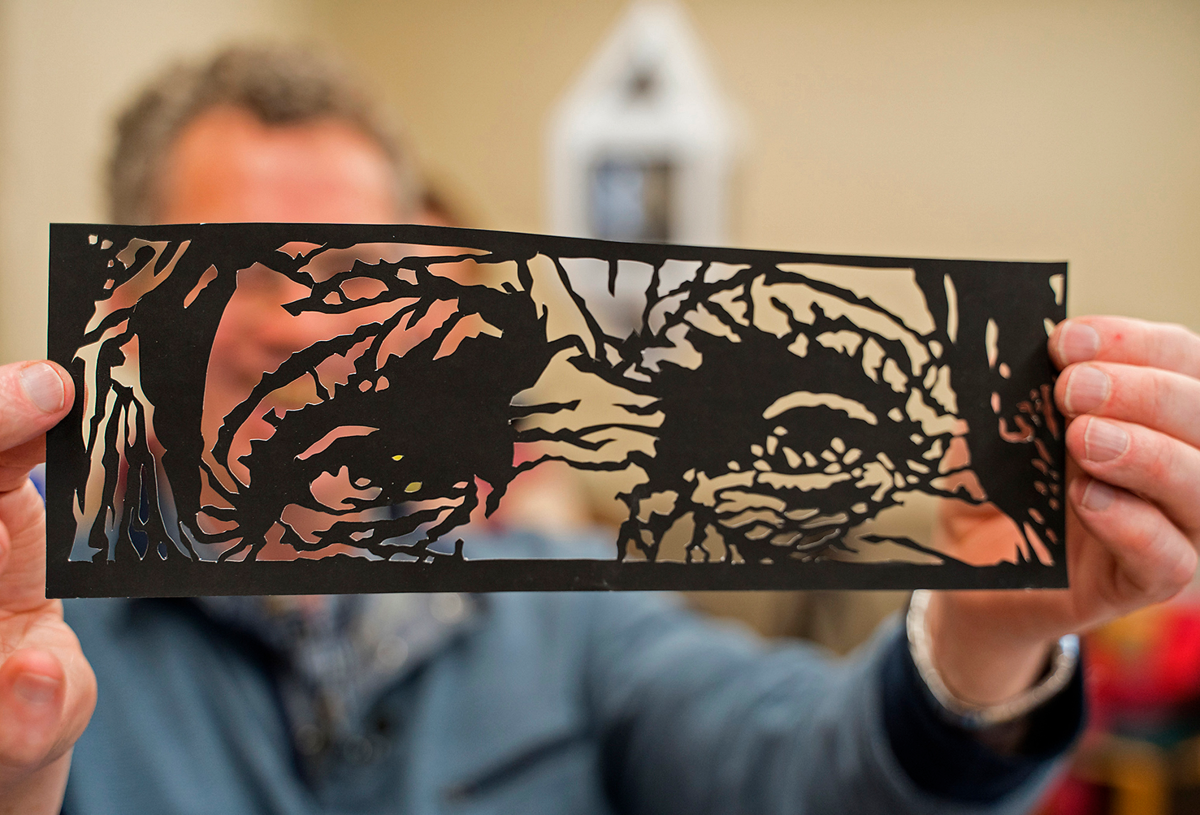
Paper cutting is enjoyed by thousands of people worldwide. It is fun and relaxing, with which young and old create beautiful works of art: so many cutters and variations. The Dutch Society for Paper Art is the meeting place for leisure cutters and professional artists.
Paper cutting is included in the Inventory of the Dutch Centre for Intangible Cultural Heritage.
Everyone can get to work with scissors and paper. First, you will learn the basic techniques from experienced cutters. Then you apply them yourself and eventually go home with one or two cut pieces of art.
The workshop organisers are members of the Dutch Society for Paper Art who have been specially trained to teach interested parties the tricks of the trade. Most of them regularly exhibit their work.


Floortje Roetemeijer and Tanja van Schagen will teach the workshop ‘Learn to turn on a potter’s wheel’. Both are very experienced turners.
In this workshop, participants will learn the principles of turning on a potter’s wheel, one-on-one, in half an hour.
Floortje Roetemeijer studied ceramics in Gouda. From 2002 to 2011, she worked at Mobach-Keramiek, where she specialised in turning and designing new forms. Since 2012, she has had her own studio, Het Serviesfabriekje, where she carries out every part of the making process herself: design, turning, glazing, and firing. In design, she is always looking for shapes that are beautiful in their simplicity, without frills. Then she looks at functionality because beauty and functionality come together in the best designs. She also teaches pottery lessons to children and adults in her studio in Driebergen.
Tanja van Schagen has worked at Mobach-Keramiek since 2000 as a turner and designer of stoneware ceramics. She studied ceramics and painting/graphics at the Gerrit Rietveld Academy in Amsterdam. She also took the ceramics course at the SBB Midden Holland in Gouda. In addition to her work at Mobach, she creates her own work. In recent years, Tanja has specialised in raku ceramics, a Japanese firing technique. She also teaches turning lessons in her studio and at Werfklei studio in Utrecht.
Purchase your ticket quickly (from 1 September). During previous editions, this workshop was completely sold out!
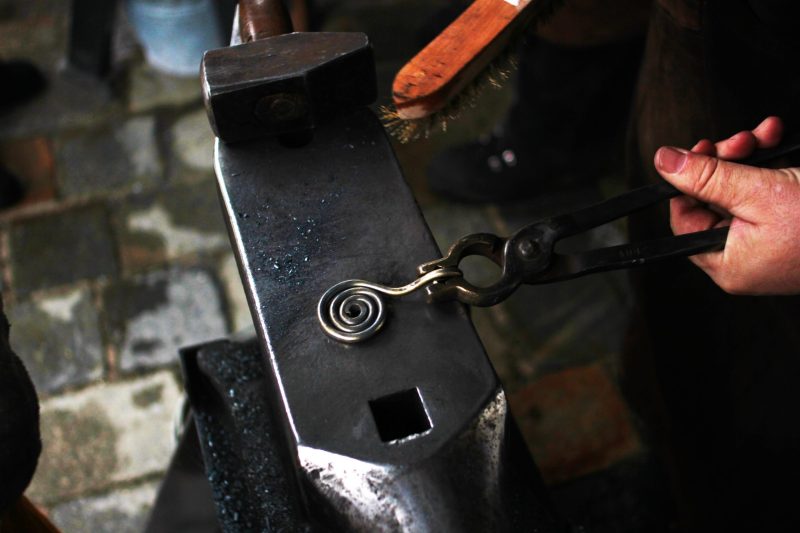
Children’s Workshop. Minimum age 11 years old. Parents/guardians are responsible at all times. Participation at your own risk, do not wear highly flammable clothing.
A bar of iron is heated in a fire with the blacksmith, and this glowing hot iron is forged into a keychain. This is done using a hammer to work the hot material on an anvil. You will go home with a unique keychain.
There can be two children forging per 20 minutes, the time slot goes by the hour, so you may have to wait your turn.
Once started as an independent worker in the metal industry, Cees Pronk already did research in 1999/2000 about training in the field of forging in the Netherlands. It turned out, however, that an excellent vocational training program no longer existed, which was why he developed his own training in blacksmithing. The final attainment targets he wrote, approved by the Ministry of Education, Culture and Science, were the starting point for compiling and writing teaching materials for the Opleiding Smeden in Andelst and the establishment of Mondra Opleidingen. Besides the Opleiding Smeden, various workshops and master classes are given for young and old artists and elementary school pupils. All this takes place in the Forge Cornelis Pronk, the place to gain knowledge about forging techniques.
Step into the world of a student at the Hout en Meubileringscollege (HMC). During the Creative Craftsman course, students learn to combine the latest techniques with craftsmanship.
The leather pattern parts for the make-up bag are cut out on the laser machine. You choose which leather and which thread color you want to use. During the workshop you will be introduced to hand stitching and learn different decorative stitches. After the workshop you will go home with a hand-stitched make-up bag.

Elendrea Cachola (Rhea) of Tuindorp Deli-cious is happy to teach visitors from all ages how to make colorful paper flowers.
You can choose to make flowers of different seasons, like tulips, magnolias or a Christmas star. With the shaped flower stalk, they form a cheerful ensemble.
Filipina Rhea connects the four seasons with the life of a woman, and is eager to tell you more about her philosophy.
At the table next to the food stand of Tuindorp Deli-cious at the foodcourt.
Festival address:
NDSM Loods
NDSM-Plein 85
1033 WC Amsterdam
Postal address:
Stichting Ambacht in Beeld
Kalf 158
1509AH Zaandam
The Netherlands