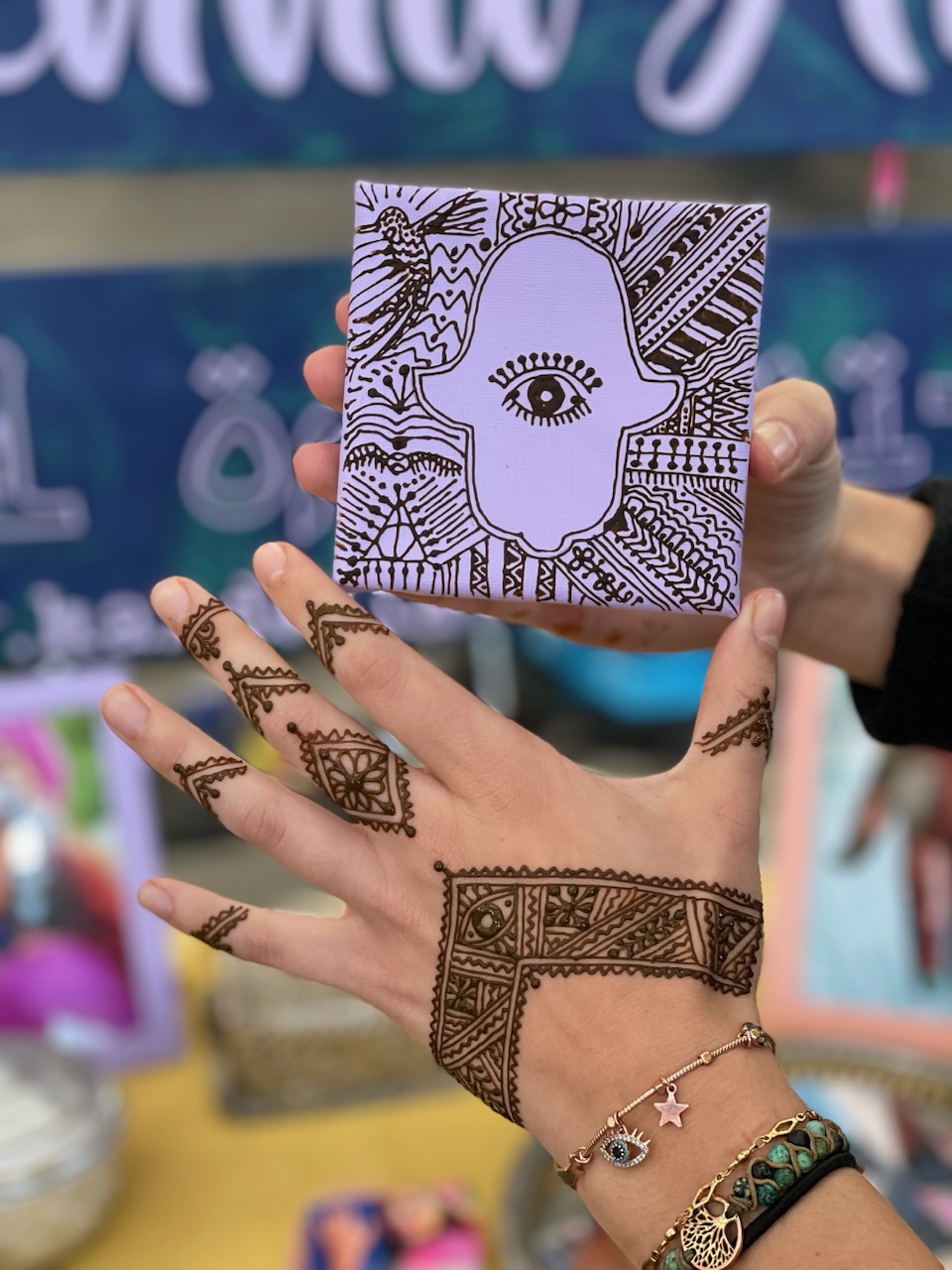
During this workshop, we start with a brief introduction to the world of Moroccan henna art. Do you know, for instance, why henna is used and the meanings of certain patterns? What technique is used to apply the patterns? During the workshop, you will learn this and also get hands-on with the technique. Using a cone filled with henna paste, you will create a pattern on a small canvas in five steps. This needs to dry, so by the end of the day, you can pick up your henna artwork and take it home. With a bit of luck, you might also get a decoration on your hand from our professional henna artist.
Moroccan henna art is a craft traditionally passed down from mother to daughter or spread organically within women’s communities. The craft is characterized by a specific technique, namely applying henna with a cone. Geometric patterns are often applied to hands and feet. The henna binds to the keratin in the skin, making the orange-brown decorations visible for 1 to 2 weeks.
Henna is best known as a ceremonial part of a Moroccan wedding, where the bride’s hands and feet are decorated with henna. But henna is much more than a beautiful skin decoration. It encompasses a whole world of symbolism, meaningful rituals, and empowering traditions.
At the age of four, Fatima Oulad Thami experienced her first henna ritual during a visit to her grandmother in Morocco. A neighbor girl drew a herringbone pattern on her hands and feet with a stick and henna paste. This experience would change her life forever. Every summer, the henna ritual became a fixed tradition of the holiday. At the age of fourteen, she began to self-teach to become a neqacha. Now she has 30 years of experience and is a sought-after henna artist both nationally and internationally. With Moroccan henna art as her expertise and her passion as her drive, she has achieved much under the name Hand of Fatima. She has an online learning platform, a webshop with henna supplies, the Henna Academy for group lessons, commissioned work, a master-apprentice trajectory via the Cultural Participation Fund, and much more. Fatima is now not only a neqacha but also a speaker, teacher, artist, and socially engaged creator.
NB: Fatima also teaches a masterclass during the festival.


This workshop focuses on Shibori, an ancient Japanese dyeing technique known for creating intricate patterns on fabric through folding, binding, clamping, and stitching. Shibori involves blocking certain areas of the fabric from dyeing, resulting in beautiful hand-crafted patterns.
Bring your own white T-shirt to dye during the workshop.
Roua Atelier is a sustainable, natural dye studio dedicated to making a positive impact on the textile industry by developing natural dye pigments, new techniques, and materials. We work closely with textile companies and designers to incorporate eco-friendly materials into their production and design. We collaborate with farmers to grow local plants and spread knowledge about our natural dye methods. One of our main activities is educating people about the magic of our natural dyes and helping them integrate these practices into their daily routines and uses.
Roua Alhalabi is a Syrian natural dye developer. She learned about the magic of color from her grandmother. She absorbed all the knowledge her grandmother shared with young children and expanded it by learning from various experts. This led her to develop her own methods and techniques for creating colors. She wants to share her love for color with others, which is why she will teach a different technique each day at the festival. Have a look here at the other workshop on Saturday.


During a previous edition of Ambacht in Beeld Festival, our youngest visitors created this fantastic creature!
This year, children can once again join in for free to build and paint a life-sized, colorful fantasy creature made of paper-mâché, guided by visual artist Edson Bruno Filho.


For centuries, people around the world have enjoyed paper cutting. It’s fun and relaxing, with people of all ages creating beautiful artworks. With so many cutters, there are countless variations. This unique craft is rightfully included in the Inventory of Intangible Heritage in the Netherlands. The Dutch Association for Paper Cutting is the meeting place for both hobbyists and professional artists.
Everyone has used scissors on a piece of paper at some point, but in this workshop, you’ll take it a step further. After a brief introduction, you’ll learn the basic techniques from experienced cutters. You’ll then apply these techniques to a simple project on your own. At the end of the workshop, you’ll take home one or two cut-out artworks. Success is guaranteed.
The workshop leaders are members of the Dutch Association for Paper Cutting, specially trained to teach interested individuals the intricacies of the craft. Most of them regularly exhibit their work.


Create your own unique herbal blend! Guided by tea sommelier Benita Roetman from Thee & Kaart, embark on a journey through scents and flavors to develop your personal tea blend. Let your sense of smell lead you and create a tea that perfectly suits you. Be surprised and inspired during this workshop. And after the workshop, you can continue to enjoy your personal tea at home.
In this fascinating herbal workshop, you will discover the art of brewing the perfect cup of herbal tea. Step by step, you will learn how to create a balanced herbal blend, using only your sense of smell to select the herbs. By setting aside your thoughts and following your intuition, you’ll find yourself making choices that you might not have expected. The exciting part is that you won’t know which herbs you are smelling, allowing you to select them purely by scent. This ensures a unique and surprising experience.
One thing is certain: at the end of the workshop, you will go home with your own unique, personal herbal blend that you have created yourself. So you can continue to enjoy this special workshop at home.


Have you ever wondered how those delightful, crunchy pearls in your bubble tea are made? In this unique workshop, you’ll get the chance to discover the process and make your own popping pearls! Learn all about the different flavors, colors, and textures of these little bursts of flavor.
Why this workshop is so much fun:
Interactive: You’ll get hands-on experience in making popping pearls.
Educational: Learn about the various flavors, textures, and colors of popping pearls.
Creative: Experiment with your own flavor combinations.
Delicious: Enjoy tasting your very own bubble tea creation.
Social: Meet other bubble tea enthusiasts and share your passion.
In short, this is a 100% vegan workshop you don’t want to miss!
“At BobaQtea, we’re always on the lookout for new recipes and creative ideas. Popping pearls are special because they provide a unique taste and mouthfeel. We wondered how they were made and if we could make them ourselves. We look forward to sharing our knowledge and passion for bubble tea in this workshop.”


Beadwork has a long history in East Africa and often carries significant cultural meaning. Colors and patterns can indicate age, ethnic group, or marital status. Women typically learn beadwork from their mothers and grandmothers, making it a skill they can carry with them, rely on, celebrate, and pass down to their children. South Sudanese women are talented bead stringers and have used this heritage skill as a means of generating income after being forcibly displaced.
In this workshop, two forcibly displaced South Sudanese women, working with MADE51, a global brand by UNHCR, will teach participants about their heritage skill of beadwork. Participants will leave this workshop with an understanding of the cultural significance of beadwork in South Sudan and a bracelet to take home.
The workshop begins with an introduction to the two artisans, who will familiarize the participants with their equipment, including a loom, needle, thread, and beads. They will then demonstrate the stringing technique and offer tips for making bracelets. Participants can choose from three patterns to create their bracelets for the rest of the workshop. Meanwhile, the artisans will walk around to assist in the bracelet-making process and share stories about their heritage craft and experiences with displacement.
NB Due to visa challenges, this workshop will be taught via video connection, with live assistance.
More than 120 million people worldwide are forcibly displaced, driven from their homes by war, persecution, or disaster. Among this vast group are incredible artisans who possess the talent, culture, and heritage to create objects of true beauty.
MADE51 is a global brand, an initiative of UNHCR, the UN Refugee Agency, connecting these artisans with social enterprises. Using Fair Trade principles, they support the design, development, and marketing of the unique products that form the MADE51 collection. Through MADE51, those forced to flee have the opportunity to earn an income while in displacement. For consumers, these pieces are more than beautiful examples of craftsmanship and heritage; they are expressions of hope.
Sunday Adee Michael is a South Sudanese refugee living in Kenya. She is a member of the Kalobeyei Women’s Handicraft Cooperative and specializes in beadwork. At 21 years old, she is the youngest leader in the cooperative. In 2016, Sunday arrived at the Kakuma refugee camp at the age of 13 with her 9-year-old brother. As a young girl, Sunday took full responsibility for her brother and herself, ensuring they received education and met their essential needs as the head of her household. Beadwork with the cooperative has played a crucial role in paying for their school fees and books.
Sunday demonstrates resilience in every situation. She joined the cooperative at 19 in 2021 and has since become one of its leaders. She hopes to complete her education and eventually attend university to earn a degree in business administration. After completing her studies, she plans to start her own small business and employ members of her community.
Nyanachiek Padiet is an internally displaced South Sudanese woman living in South Sudan. Nyanachiek has been working with Roots, a MADE51 social enterprise partner, for over eight years. She specializes in beadwork, a traditional skill passed down from her mother, and supports Roots with storekeeping, training artisans, and quality control for large orders. Nyanachiek is a member of the MADE51 Artisan Speakers Group and uses her voice to help others understand her refugee experience and the importance of craft in her life. On World Refugee Day 2023, she spoke remotely at a MADE51 event at the UK House of Lords. She also participated with MADE51 at the 2023 Global Refugee Forum in Geneva.


Photo credits: Erin Flannery en Ala Kheir

Join this inspiring workshop and learn how to make your own natural cosmetics. We’ll use our star ingredient shea butter, along with other pure, nourishing ingredients, to create products that leave your skin silky smooth.
What can you expect from our workshop? Learn step-by-step how to work with shea butter, essential oils, and other organic ingredients. The workshop is led by Altagracia Kotzebue, founder of Urban Africa Naturals. With her passion for natural skincare and years of experience in creating natural products, she shares her expertise and enthusiasm with all participants. Receive handy tips and tricks to continue at home and take your self-made, skin-friendly products with you.


We take you on a journey into the magic of enameling during this workshop. First, we’ll discuss the ancient process of enameling, a technique that has been used for many centuries BC. What is enamel, what is it used for, since when has it been used, what are its applications, what different techniques exist, and why is this material so unique? We’ll also show examples of artworks created with enamel. Enamel can be applied to steel, copper, silver, and gold, using various materials and techniques.
We’ll start with simple basic techniques. A copper plate will be cleaned, and we’ll teach you how to apply enamel powder. It may seem easier than it is. The piece will then be fired in an enameling kiln at temperatures of 800-950 degrees Celsius. When it comes out of the oven, it will be red-hot, and as it cools down, the colors will emerge, transforming the powder into glass. This moment is truly magical!
There is usually a degree of unpredictability: how will it look coming out of the oven? Have the colors turned out exactly as planned? Are there unintended oxides that have surfaced? This unpredictability adds excitement to the enameling process. After cooling, the piece can be further embellished by adding colors or materials before being fired again. This can be repeated several times. Everyone will leave with one or two unique pieces and a hands-on experience in the craft and application of enameling in art.
At the Craft in Focus Festival, six experienced artists and instructors will lead the workshops. Christine vd Ree, Marrie Schipper, and Hanneke Klievink will be there on Saturday; Annemarie Timmer, Hoi-Shan Mak, and Mariet Lohman on Sunday. They have exhibited their work nationally and internationally and have mastered various techniques. All are members of the Association of Dutch Enamelers (VNE), founded in 1983 with the aim of promoting enameling as an art form. The VNE currently has over 70 members and several donors. They organize workshops annually in Amersfoort and hold exhibitions in galleries or museums.


Transform Empty Wine Bottles into Unique Glasses. Learn the art of cutting, sanding, and painting. Discover the magic of upcycling and take home your own painted glass along with new skills to continue experimenting!
With a focus on sustainability and craftsmanship, we will cut the bottles in half using a glass cutter and thermal shock method (ice water and boiling water). We will then sand the sharp edges smooth and decorate them with glass paint. These unique glasses can serve as drinking glasses, charming tealight holders, and much more. You will also learn various painting techniques to personalize your creations. Explore the joy of rescuing your glassware from the recycling bin and turning them into beautiful, functional art pieces!
IMPORTANT INFO: Don’t forget to bring your own empty bottles. For this workshop, please bring two empty wine bottles made of dark glass (green or brown). Please remove any label. Champagne bottles are not suitable for this workshop.
Luna Schröer says, “The goal is not only to promote the reuse of waste materials but also to show people that with minimal creative experience and a small investment in basic supplies like glass paint, you can create beautiful items for your home. Moreover, there’s nothing more satisfying than using your own unique creations, such as beautiful drinking glasses and reusable oil bottles, every day! My work emphasizes the beauty of imperfection in handmade products. I strongly believe in the positive impact of a creative outlet. In a world where the emphasis often lies on academic achievements and business success, many people unfortunately lose sight of their creative side. Through La Salamandre studio, I aim to help people relax more and show them how enjoyable it is to work with your hands.”


Festival address:
NDSM Loods
NDSM-Plein 85
1033 WC Amsterdam
Postal address:
Stichting Ambacht in Beeld
Kalf 158
1509AH Zaandam
The Netherlands