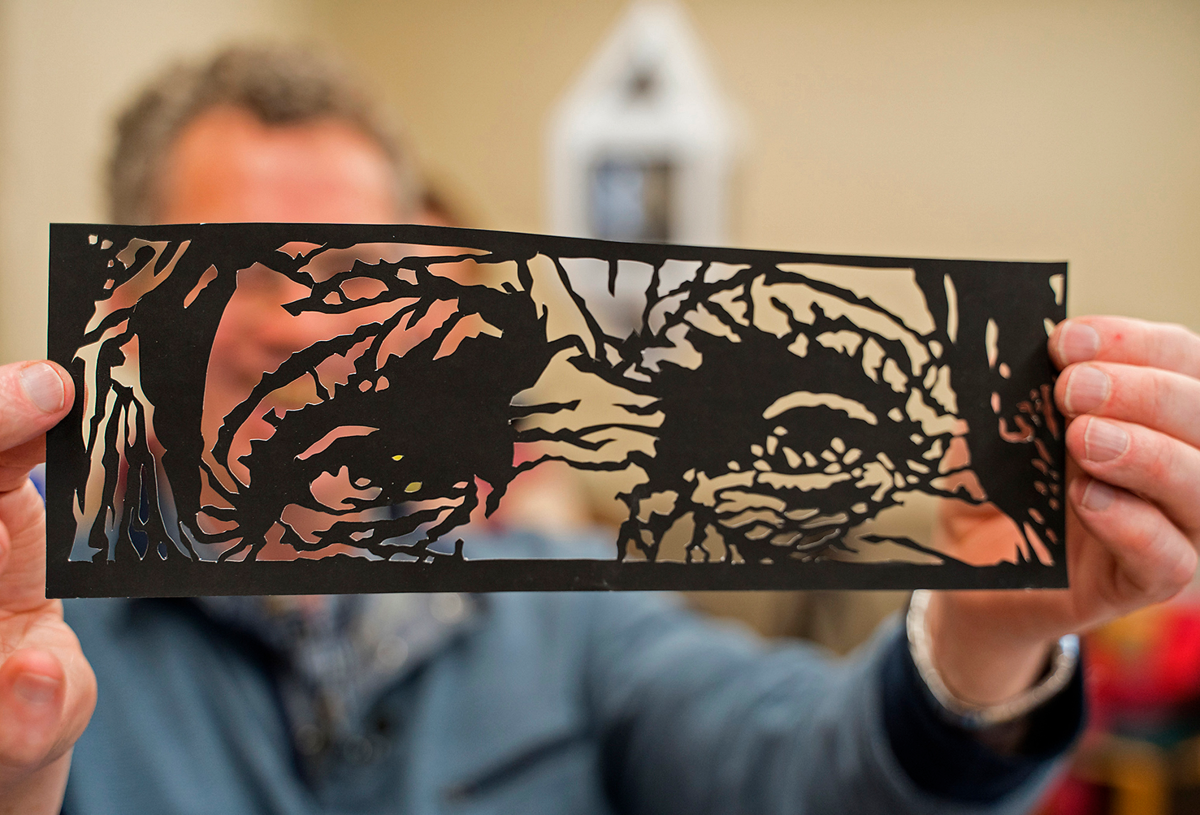
Paper cutting is enjoyed by thousands of people worldwide. It is fun and relaxing, with which young and old create beautiful works of art: so many cutters and variations. The Dutch Society for Paper Art is the meeting place for leisure cutters and professional artists.
Paper cutting is included in the Inventory of the Dutch Centre for Intangible Cultural Heritage.
Everyone can get to work with scissors and paper. First, you will learn the basic techniques from experienced cutters. Then you apply them yourself and eventually go home with one or two cut pieces of art.
The workshop organisers are members of the Dutch Society for Paper Art who have been specially trained to teach interested parties the tricks of the trade. Most of them regularly exhibit their work.


This workshop teaches you how to turn loose wool fibres into thread with a spinning wheel. The washed wool will be carded with carding brushes to make spinning easier. You will go home with a nice thread.
Tineke van der Zweep runs an artisanal machine wool spinning mill in northern Friesland. “I have been working with wool and making woolen clothes for years. I teach workshops in spinning, knitting, crocheting, weaving and sewing. My inspiration is the wad, both for the designs and the colours. Wool is a fantastic natural product with many benefits and is widely available. It is warm, durable and has endless possibilities for processing. It is a wonderful product that I can’t get enough of.”
This workshop is organised in collaboration with Pleed Foundation. “Wool is a beautiful natural material that has kept us warm for centuries. Yet most wool from the 800,000 Dutch sheep is discarded as waste or even ends up in the incinerator. At the same time, we massively buy cheap clothes made of polluting synthetic fibres from low-wage countries. Community initiative Pleed explores how wool can be made of value again.”

Raku firing is an originally Japanese firing technique in which the glaze of a piece of work crackles. The crackle is coloured black by a smoking process.
The ceramic piece is first fired and then glazed. It is fired outside in a gas oven very quickly to 950 degrees. The piece is removed from the oven and exposed to the outside air. The rapid cooling causes the glaze to crackle. The workpiece is then placed in a barrel with sawdust. The sawdust ignites and produces smoke. The smoke soaks into the crackle. The interplay of wood, fire, water and oxygen produces spectacular results.
During this workshop, you will learn about ceramics in general. You will learn to glaze a selected biscuit-fired ceramic work. You attend the 45-minute raku firing process, which takes place outside the building in a gas-fired oven. You clean your work and the spectacular colours and craquelé become visible under your hands. Your work goes straight home with you.
Years ago, Danielle van Assema became inspired by the fascinating raku process, an artistic form that results in unique creations every time. Just like life itself, which is also unique in its outcome. Even without experience or the belief that you are not creative, you can create something special with this firing art. ‘It is an amazing experience for me to guide this process. Working with fire brings excitement and inspiration.’

Floortje Roetemeijer and Tanja van Schagen will teach the workshop ‘Learn to turn on a potter’s wheel’. Both are very experienced turners.
In this workshop, participants will learn the principles of turning on a potter’s wheel, one-on-one, in half an hour.
Floortje Roetemeijer studied ceramics in Gouda. From 2002 to 2011, she worked at Mobach-Keramiek, where she specialised in turning and designing new forms. Since 2012, she has had her own studio, Het Serviesfabriekje, where she carries out every part of the making process herself: design, turning, glazing, and firing. In design, she is always looking for shapes that are beautiful in their simplicity, without frills. Then she looks at functionality because beauty and functionality come together in the best designs. She also teaches pottery lessons to children and adults in her studio in Driebergen.
Tanja van Schagen has worked at Mobach-Keramiek since 2000 as a turner and designer of stoneware ceramics. She studied ceramics and painting/graphics at the Gerrit Rietveld Academy in Amsterdam. She also took the ceramics course at the SBB Midden Holland in Gouda. In addition to her work at Mobach, she creates her own work. In recent years, Tanja has specialised in raku ceramics, a Japanese firing technique. She also teaches turning lessons in her studio and at Werfklei studio in Utrecht.
Purchase your ticket quickly (from 1 September). During previous editions, this workshop was completely sold out!

Manual carving of text in wood. Nowadays, everything can be done with computers and milling machines. However, manual carving has many more possibilities, allowing you to be more creative with space and dimensions. It has a charm of its own.
We start the workshop with the basic principle of the letter I. Afterwards, you will make a letter of your choice, with straight lines, because round is still too difficult to cut. The letter can be carved into the wood. The other possibility is to cut away the wood around the letter so that the letter lies ‘on’ the wood.
Sculptor Rein Veldboer works mainly with wood. He makes large solid wooden sculptures. He also makes texts in wood and tries to play with the dimensions of letters. He has been teaching sculpting in wood for many years.
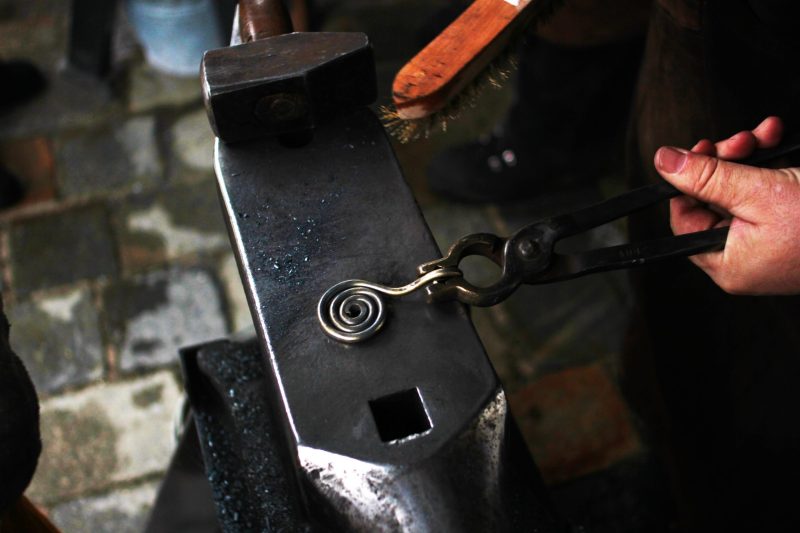
Children’s Workshop. Minimum age 11 years old. Parents/guardians are responsible at all times. Participation at your own risk, do not wear highly flammable clothing.
A bar of iron is heated in a fire with the blacksmith, and this glowing hot iron is forged into a keychain. This is done using a hammer to work the hot material on an anvil. You will go home with a unique keychain.
There can be two children forging per 20 minutes, the time slot goes by the hour, so you may have to wait your turn.
Once started as an independent worker in the metal industry, Cees Pronk already did research in 1999/2000 about training in the field of forging in the Netherlands. It turned out, however, that an excellent vocational training program no longer existed, which was why he developed his own training in blacksmithing. The final attainment targets he wrote, approved by the Ministry of Education, Culture and Science, were the starting point for compiling and writing teaching materials for the Opleiding Smeden in Andelst and the establishment of Mondra Opleidingen. Besides the Opleiding Smeden, various workshops and master classes are given for young and old artists and elementary school pupils. All this takes place in the Forge Cornelis Pronk, the place to gain knowledge about forging techniques.
Step into the world of a student at the Hout en Meubileringscollege (HMC). During the Creative Craftsman course, students learn to combine the latest techniques with craftsmanship.
The leather pattern parts for the make-up bag are cut out on the laser machine. You choose which leather and which thread color you want to use. During the workshop you will be introduced to hand stitching and learn different decorative stitches. After the workshop you will go home with a hand-stitched make-up bag.

Elendrea Cachola (Rhea) of Tuindorp Deli-cious is happy to teach visitors from all ages how to make colorful paper flowers.
You can choose to make flowers of different seasons, like tulips, magnolias or a Christmas star. With the shaped flower stalk, they form a cheerful ensemble.
Filipina Rhea connects the four seasons with the life of a woman, and is eager to tell you more about her philosophy.
At the table next to the food stand of Tuindorp Deli-cious at the foodcourt.
Festival address:
NDSM Loods
NDSM-Plein 85
1033 WC Amsterdam
Postal address:
Stichting Ambacht in Beeld
Kalf 158
1509AH Zaandam
The Netherlands