Sailmaking is one of the oldest professions in the world. Think of the Vikings who set foot all over Europe thanks to their sails or the fishermen who desperately needed sailmakers: ‘no sail, no fishing’.
What will you do? This workshop will introduce you to the materials, tools and techniques a sailmaker uses. Think cotton, hemp, beeswax, the sail hand and corpse rope.
You will go home with a homemade cotton bag in which you will recognize the techniques of the craft.
The Zuiderzeemuseum presents various crafts, one of which is sail-making. There is a master and apprentice, just like in the old days. Both are present to teach a fun and instructive workshop.

Enkhuizen, West Friesland, Netherlands
Teachers of the Zuiderzeemuseum
(Photo by Guillaume Groen )


In this workshop, you will learn all about liquorice, its history, raw materials and how the liquorice culture differs from country to country. After briefly explaining liquorice and Sweden, Arabic gum and apothecaries, block and canned liquorice, Pliny and Pontefract and much more, we get to work.
Through short tastings, you will quickly learn about everything and know how to distinguish the qualities of liquorice. Then we get to work with mortars, spoons, rollers and pans: we make the so-called liquorice dough together, and everyone makes their liquorice. In short, you will know much more about this age-old craft after this hour.
The liquorice (which you can take home) is vegan.
Pauline Gingnagel studied history as well as chemistry. She used the knowledge she gained from this combination to learn all about liquorice and cocoa – the history and how these products were made. For years, she ran her own business on the Zaanse Schans: the Cocoa and Licorice Lab, where through workshops, tastings and tours, people could find out all about these fascinating products.

During this workshop, you will engage in sawing, filing, and sanding a solo instrument with a membrane made from bamboo. It produces a sound similar to a vuvuzela, yet it’s straightforward to play.
The workshop instructors are members of the Nederlandse Pijpersgilde, a bamboo flute association. The association operates under the traditional guild system, where you undergo internal training as an apprentice to advance to the journeyman level. The examination encompasses four components: AMV, construction, playing, and conducting/teaching.


A rip in your favourite pair of jeans? Your grandmother’s silk blouse with a worn collar? That lovely jumper that, unfortunately, has a hole in it? Bring them along to the GOLDEN JOINERY workshop!
Bring a precious but broken piece of clothing from yourself or a loved one, and together we will repair it with ‘gold’. Instead of hiding the repair, it will become a visible golden scar, celebrating life’s imperfections. You add value yourself. This slowly creates a collection of unique garments.
It is a collective gesture against the throwaway mentality, an excellent way to spend a few hours together and make the world a little bit nicer. Experience with needles and thread is not necessary. Techniques and materials will be provided during the workshop. Do bring a torn / broken piece of garment!
Golden Joinery is based on Kintsugi (= golden joinery), an ancient Japanese technique where broken pottery was visibly repaired with gold. Painted Series translated this craft into repairing broken clothing with gold in a way that is not invisible but adds something special to your precious item. Depending on the hole in the garment brought, we will work with darning, the Japanese Boro technique, needle lace, the festoon stitch or appliqué.
Painted Series is a fashion collective led by fashion designer Saskia van Drimmelen and director Margreet Sweerts in alternating collaborations with like-minded people. Known for sharp contemporary couture in which craft techniques take pride, Painted Series explores new ways of developing and distributing fashion, playing with the boundary between fashion and performance and the idea of what a garment can be. With reciprocity as a guiding principle in every relationship, she aims for a loving, non-exploitative relationship with people and materials. The ‘new’ brand Golden Joinery is about taking care of the clothes you already have. A growing collection of clothing featuring visible, golden repairs appears offline and online.


The workshop will be in English or Spanish.
A simple percussion instrument is fun to make and play. Also, it can be a gift to friends and family. In this workshop, you will make four simple percussion instruments: a rain stick, a shaker, a bull roar and a thunder drum. The first two are pretty well known. The last two are less common but have a beautiful sound. The bull roar and the shaker are relatively quick to put together. The rainstick and the thunder drum require a bit more skilla, but Orlando will teach you how to make them successfully. The instruments are suitable for children aged seven and up.
At the end of the workshop, you will have a variety of simple but fully functional percussion instruments that you can play and/or give as presents to friends and family. The difficulty of making them start from very simple to easy to moderately easy.
Orlando Aguilar Velazquez was born and raised in Mexico City. He studied at the National University of Mexico. In 2006 he moved to the Netherlands to study at the Royal Conservatory in The Hague, where he obtained his Master’s degree in percussion. He has performed in North, Central, and South America, Europe and Asia.
Grown in a neighbourhood full of woodworkers and blacksmiths, he began making things as a kid. He has built instruments for various performers, ensembles and orchestras in Mexico, The Netherlands, Germany, other European countries, and the Americas. Currently, Orlando divides his time between performances with various ensembles and as a builder of percussion instruments in his studio in The Hague.

Learn to turn a wooden bowl up to 20cm in diameter on the lathe. In this workshop, you will get information on techniques and design.
Mark will bring two workbenches this year so two students can attend this workshop simultaneously. Last year, this workshop sold out within 10 minutes, so be quick if you want to get acquainted with the craft of woodturning.
RADIUS, the Dutch Association of Woodturners, was founded in 1994 and by now has grown to an association of 750 members. The association consists of 16 active regional sections.
A few members practise woodturning professionally, but most are active hobbyists. They turn their utilitarian and artistic objects at different levels according to their training, experience and interest. Several members enjoy great fame at home and abroad; their creations can be found at prominent exhibitions.
The association publishes a full-colour quarterly magazine called AktieRadius and holds an annual woodturning day at a central location in the Netherlands. This day features demonstrations, lectures, education and sales of woodturning supplies by various suppliers.

Dive into the world of the weaver, a world of threads, textures and colours and weave your own fabric for a cushion. A loom with treadles will be ready for each participant. Choose your threads and colours, and get to work. You will experience what it feels like to weave on a standing loom, and while weaving, you will see how the fabric slowly grows under your hands. After the workshop, you can leave the fabric you wove on the loom. We will sew it into a cushion, and a few days later you will receive your fabric as a cushion at home. (The workshop price includes shipping costs.)
Handweaving is an age-old fabric-making technique but an inexhaustible play of patterns, yarns, textures and colours. Eva Klee revives this old craft in her handweaving shop. Exclusive, high-quality custom-made hand-woven fabrics, one-offs and reproductions of fabrics are created here artisanally. The aim of each fabric design is seductive quality with an eye for detail.
As early as the age of 11, Eva Klee took over her mother’s Swedish loom. Partly because of this, weaving feels like a second skin to Eva. She is constantly searching for new fabric designs in her studio, an inexhaustible interplay of patterns, materials and colours. Small changes in the weaving process can result in unexpected and fascinating changes. The ‘discovering along the way’ and critical questioning of technical perfection fuel her continuous research. Great technical skills combined with creativity characterise her work.
Eva Klee trained as a hand weaver for three years in southern Germany. She then studied Monumental Design at the Royal Academy of Art in The Hague.

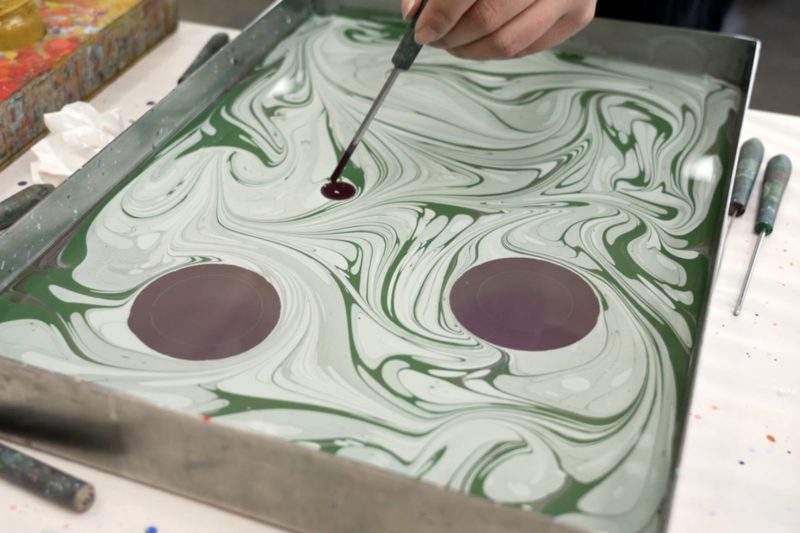
Ebru art is an ancient painting technique that has been around for 1,500 years. In this technique, we paint on water. During the workshop, we will practice ebru art in the most traditional way, with water, paint and brushes, precisely as our ancestors did 1500 years ago.
Okan Akin is an artist born and raised in Turkey. He completed his art education in 1991, specialising in textile design. He worked for five years as a teacher at a vocational school in Turkey. In 1997, Okan moved to the Netherlands. In 2006, he decided to start his studio, Atelier Okan Akin, in Amsterdam, at the NDSM Loods. Here he still works full of enthusiasm and passion as an artist.
“I learnt traditional art techniques at an art academy in Turkey. Besides traditional art, I also studied modern art. My ultimate challenge is to apply and combine general art techniques in my contemporary work. Ebru art (paper marbling) is an example of this.”

When you think about lace making, you may associate it with lace collars in paintings by the old masters and dresses at your grandmother’s house. But even today, there are lace makers who have the dedication and patience for this craft. And of course, this craft, too, has evolved. The lace making technique is not only used in art, textile art, fashion and jewellery. Even steel fencing has been made using the technique of bobbin lace. So, with bobbin lace, much more can be done.
Once you have mastered the basics, you can make choices in which direction and with which application you want to continue. Maybe you have no idea how to make lace. Perhaps you have been looking at a bobbin lace pillow with bobbins shooting in all directions, and you have wondered how someone knows which bobbin goes in which direction and when… In either case, we challenge you to come and experience what it is like to sit behind a bobbin lace pillow and make something small with bobbins. You will go home with a happy little octopus and an idea of how those experienced lace makers know which bobbin, when, should go where.
We got to know each other at various lace bobbin courses at home and abroad. Meanwhile, Corrie has started teacher training in Germany, and Rit is chairman of a large lace society in the Netherlands. We no longer want to keep our enthusiasm for making lace with bobbins to ourselves but share it with the world. That may seem a bit ambitious, but for the Ambacht in Beeld Festival, we are happy to pull out the lace bobbin pillows, bobbins and pins.
Photos: Kika Booy.


A pop-up book is something magical. Every time you turn a page, a three-dimensional and/or moving surprise appears. There are most spectacular pop-up books, hugely complex structures made of paper. But an exciting pop-up does not necessarily have to be complicated if you use the basic techniques cleverly and combine them!
In this workshop, Rianne will take you on an adventure into the world of pop-up books. For inspiration, you will be shown some of her favourite examples. Then you will create the magic yourself. You will learn some simple techniques that form the basics of pop-ups. With these, you will develop at least one design into your own pop-up card. More is, of course, allowed, whether or not bound together into a booklet. Finally, you will take home your sketches, plus a lot of inspiration and tips, so you can experiment further if you feel like it. And if you want to develop more skills during the festival, you can also take this workshop with Rianne.
Rianne van Duin is a Paper Adventurer and professional tinkerer. She invents and creates interactive 2D/3D worlds from paper. For children and with children (from 0-100 years old).
Rianne’s work ranges from illustrated pop-up books to life-size foldable theatre sets, from children’s newspapers to paper animation. Interaction is central to her creations. They stimulate the imagination and invite one to play, manipulate and experience them.
Rianne built her studio on the NDSM-Werf. From there, she works on commission for publishers, theatre productions and festivals, independently or in collaboration with (the work of) illustrators such as Fiep Westendorp and Leo Timmers. She also initiates personal projects such as Your Adventure, her independently published interactive children’s book, without batteries or electronics.
Festival address:
NDSM Loods
NDSM-Plein 85
1033 WC Amsterdam
Postal address:
Stichting Ambacht in Beeld
Kalf 158
1509AH Zaandam
The Netherlands