Moroccan brass engraving, known locally as az-Zuwāq ʿala an-Nuḥās, is an old tradition. The techniques of brass engraving in Morocco, using a chisel and other stamps, and the methods of constructing patterns using a hand-forged divider, date back to early 11th century.
This workshop invites you to be part of this commitment to old techniques and methods that marks transgenerational legacies. This drop-In workshop will showcase the following technical steps:
Hamza El Fasiki is an artisan and author. Hamza has apprenticed under his father at Dar-Attamania Studio in Fes, Morocco between 2011 and 2021. Hamza holds an MA degree on Moroccan Cultural Studies with an academic research focus on the cultural history of Moroccan traditional crafts from Sidi Mohamed Ben Abdellah University in Fes. Hamza is specialist in traditional Moroccan geometric patterns, brass engraving and bookbinding and had published academic works in the field and traveled around 16 countries while learning and teaching Moroccan culture.


Furniture upholstery is the art of renewing and enhancing furniture by re-covering it with fabric, leather, or other materials. This craft combines creativity and skill, transforming an old or worn piece into something completely new.
The process begins with the careful removal of the old upholstery. The frame of the furniture is then inspected and, if necessary, reinforced. Next, the perfect fabric is chosen to match the style and function of the piece. With needle, thread, and a precise hand, the new material is applied, cushions are refilled, and all pleats are carefully pressed. The result is a piece of furniture that is not only comfortable but also a standout feature in any interior.
Upholstering brings new life to cherished pieces. This craft plays with textures, colors, and patterns, adding a personal touch to the decor. It restores not only the functionality of furniture but also makes it a focal point that invites enjoyment.
Gerbine Blankers is a professional upholsterer at her own workshop, Stoffeeratelier Gerbine, and a vocational teacher of upholstery at Het Ambachtshuis Brabant in Breda. She will demonstrate her craftsmanship on Saturday.


On Sunday, Jan Reek Natuursteen will demonstrate how to work with Belgian bluestone. In this demonstration, the back of the stone will remain rough, just as it comes from the quarry, while the front will be worked on.
The text on the stone will say: “Do work that suits you, and you’ll never feel like you’re working. The chain at the top symbolizes the good and bad days and aspects of your profession, but at the center (in the heart) remains the love for your craft. From this, you will derive much satisfaction.”


Throughout the Sunday, Dorrith de Beer will demonstrate the entire process of making leather bags, covering every step involved. Dorrith de Beer is a professional leather bag maker and a vocational teacher at Het Ambachtshuis Brabant in Eindhoven.
Making your own leather bags is not just a creative and practical activity, but also a way to blend personal expression, sustainability, and craftsmanship into a tangible product. These are all skills you can learn in our Professional Leather Bag Making Course for (young) adults.
Creating your own leather bags offers various rewarding aspects that make both the process and the final product special:
Creative Freedom: When designing your own leather bag, you have complete control over the design, materials, and finish. This allows you to create a unique bag that perfectly matches your personal style and needs.
Developing Craftsmanship: Making leather bags requires precision and patience, enabling you to continually improve your skills as a craftsperson. The process of cutting, sewing, and shaping leather can be deeply satisfying, especially as you see your technique and finishing improve with each bag you make.
Uniqueness: A handmade leather bag is truly one-of-a-kind. Even if you use the same pattern multiple times, there will always be small variations in the leather and finish, making each bag special.
Sustainability: Handmade bags are often of higher quality because you can select the best materials and ensure careful construction. As a result, these bags last longer, contributing to sustainability.

Have a look at this exhibition of creations, and meet the makers.
Discover the art of moulage! Step into the world of fashion and creativity! During Ambacht in Beeld you will have the opportunity to experience for yourself how special this design technique is. Under the expert guidance of Inez van der Meer you will start creating a unique garment. Inez will be there to guide you step by step and answer all your questions. Join in and discover the magic of moulage.
The students of the masterclass will show you what they have created and are happy to tell you about their experiences. They have designed unique garments, inspired by works of art by the young artists Rombout Oomen and Sam Andrea. Come along, ask your questions and learn from their creative process.
Fashion show on November 24. To conclude this inspiring project, we will organize a fashion show on November 24 in the Modestraat, the location where the masterclass took place. It promises to be an evening full of surprises and inspiration. This is your chance to admire the creations of our students and experience the magic of moulage up close. You are most welcome!
Participants:
| Chaymae Khamlichi |
| Eva Nib Nyotta |
| Carmela van de Pol |
| Kareem Segler |
| Naziha Elboukhari |
| Frouwkje Smit |
| Malika Boulongne |


At the goldsmith stand, you can have your jewellery cleaned for free so that it sparkles like never before. Also have a look at the discovery laboratory where you can use a microscope to search for the inscription/engraving and impurities in a cut diamond. Using a Mohs hardness scale including rough diamonds, you will learn more about the raw material diamond from the diamond expert and dive into the world of diamond polishing.
The Amsterdam City of Diamonds Foundation will also be present during the Ambacht in Beeld Education Days. They have been offering in-house diamond polishing training for several years. As an apprentice diamond polisher, you go straight to work under the guidance of one of the master diamond polishers, according to the principle of ‘learning on the job’. Within a few years, you can master the trade of diamond polisher.


A first introduction to carpentry of small artistic objects, for children (and their parents). If desired, the object may also be painted. The theme is animals. You may carpenter following an existing shape or use your own imagination.
Under the guidance of La Cruz and Helweg. They have worked together for over 20 years in developing and carrying out appropriate art projects and workshops for children (and their parents).
Continuous from 10:30 to 12:30, 13:30 -15:00 and 16:00 – 18:00.

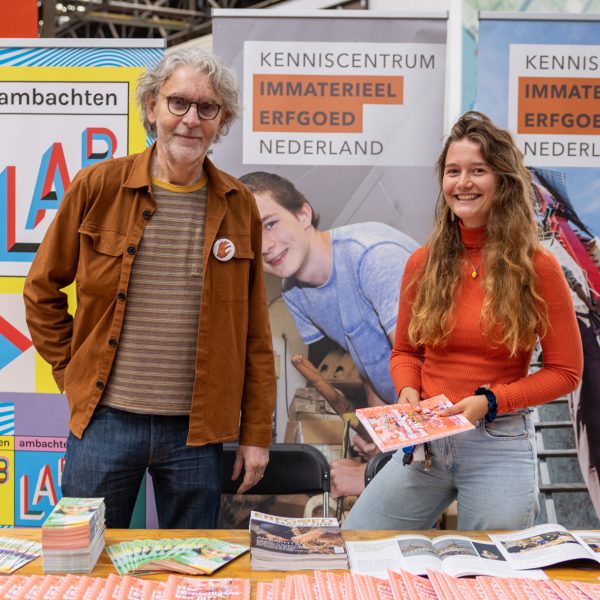
Of course, Kenniscentrum Immaterieel Erfgoed Nederland is present at the Ambacht in Beeld Festival. Practising traditional crafts or trades is an important ‘domain’ of intangible heritage. The Centre helps practitioners of crafts to safeguard intangible heritage, in order to preserve techniques and skills, spread the knowledge and pass it on to future generations.
At the Ambacht in Beeld Festival, the Dutch Centre for Intangible Cultural Heritage will inform you about intangible heritage and we would like to discuss what the Centre can do for your intangible heritage community. Through a personal conversation, we will show you the value of intangible heritage and tell you about the diversity of intangible heritage and opportunities to practise and safeguard intangible heritage.


Using a cardboard box, a slatted board, horsehair, strings and tuning knobs, you will build your own playable stringed instrument!
What will it be: a violin, a guitar or something that doesn’t exist yet?
Sound artist Jacob Plooij will bring everything you need to make a musical instrument that you can actually play!
Offered continuously on Saturday between 11.30 and 14.30 hrs and between 15.00 and 18.00 hrs
Picture: Maarten Laupman
This installation allows every visitor to contribute to a giant circular loom.
Just roll up your sleeves, smile, and create something substantial connecting with all those who have gone before or are following you.
Festival address:
NDSM Loods
NDSM-Plein 85
1033 WC Amsterdam
Postal address:
Stichting Ambacht in Beeld
Kalf 158
1509AH Zaandam
The Netherlands