Children’s workshop (age 11 and up). Parents/guardians are responsible at all times. Participation at your own risk, do not wear highly flammable clothing.
Together with the blacksmith, a bar of iron is heated in the fire, and this glowing iron is forged into a keychain. This is done by hammering the hot material on an anvil. You will go home with a unique keychain.
Two children can forge per 20-minute slot, with hourly time slots, so you may have to wait your turn.
Having started as a freelancer in the metal industry, Cees Pronk conducted research on blacksmithing courses in the Netherlands in 1999/2000. However, a good vocational training no longer existed, which led him to develop a blacksmithing course himself. The end terms he wrote, approved by the Ministry of Education, Culture, and Science (OCW), served as the basis for compiling and writing teaching materials for the Blacksmithing Course in Andelst and the establishment of Mondra Training. In addition to the Blacksmithing Course, various workshops and masterclasses are also offered for young and old, artists, and primary school students. All of this takes place at the Cornelis Pronk Forge, the place to gain knowledge about forging techniques.
As of January 1, 2024, Cornelis Pronk Forge has been handed over to his daughter Lotte Pronk, keeping the business in the family.
Practical information


Participation at your own risk. Do not wear highly flammable clothing!
After a brief explanation of the history of the poppy, you will create a flower from copper yourself. Using a hammer, you will work the provided copper petals on an anvil into graceful flower petals. The petals are then shaped on a hollowed-out plastic disc. The brass stem is threaded so that the petals can be attached to the stem.
In addition to iron/steel, several other metals can be used, such as copper, aluminum, bronze, and tin. Copper is a metal that we also work with in our forge. Copper is a relatively soft material that is easy to work with. We shape the copper by hammering it on an anvil and a plastic mold. Sometimes copper is heated to process it properly, but relatively thin copper can also be worked as is.
Having started as a freelancer in the metal industry, Cees Pronk conducted research on blacksmithing courses in the Netherlands in 1999/2000. However, a good vocational training no longer existed, which led him to develop a blacksmithing course himself. The end terms he wrote, approved by the Ministry of Education, Culture, and Science (OCW), served as the basis for compiling and writing teaching materials for the Blacksmithing Course in Andelst and the establishment of Mondra Training. In addition to the Blacksmithing Course, various workshops and masterclasses are also offered for young and old, artists, and primary school students. All of this takes place at the Cornelis Pronk Forge, the place to gain knowledge about forging techniques.
As of January 1, 2024, Cornelis Pronk Forge has been handed over to his daughter Lotte Pronk, keeping the business in the family.
Practical information

Have you always wanted to weld? Are you curious about what it takes to lay down a perfect weld seam? Do you want to see steel melt under intense heat? This is your chance to get acquainted with it. Do you have that steady hand, the insight, and above all, the feel for the molten pool? The best part is: experience or skill is not required.
In this workshop, taught by De Openbare Werkplaats, you will experience what it is like to TIG weld and what it involves. You will receive a brief explanation of what it is and how it works, but you will primarily experience it by doing it yourself. First, you will practice on some pieces of steel to lay down a nice weld seam by getting the molten pool right. You will learn exactly what this entails during the workshop. Then, you will weld together a small container, and as a test to see if it was successful, we will fill it with water. If the container does not leak, the welding was successful. We provide all the safety equipment, such as a welding helmet, gloves, and possibly an apron or smock.
Metalworking is truly a craft. It requires knowledge, skills, and a lot of practice to become proficient at it. This field ranges from making constructions to creating art and everything in between. One of the most important aspects of metalworking is welding. There are various techniques with different results. To weld metal together in a really beautiful way, or for very fine work, TIG welding is the ideal method. This way, you can lay down the most beautiful weld seam that can either be visible or not, depending on your preference. Both are possible.
De Openbare Werkplaats is the location for craft courses and offers individuals, self-employed persons, and companies the opportunity to use a professional workspace with professional machines on a half-day or project basis.
Practical information


Choose from a dozen objects, from animals to pendants, and create your own piece by casting, sawing, clamping, filing, and polishing with a copper brush or steel wool.
You’ll go home with your handmade figurine in a lovely little pouch.
The craft of pewter casting dates back to Roman times. During the Middle Ages, it was used to make plates, spoons, cups, and pitchers. De Tinnen Lepel practices this age-old craft in a contemporary way, creating animals, pendants, toy soldiers, and various other objects using both traditional and modern casting techniques.
Roger van Driel has been passionately practicing the art of pewter casting for over nine years. He enjoys sharing his knowledge about the different casting and finishing techniques.
Practical Information
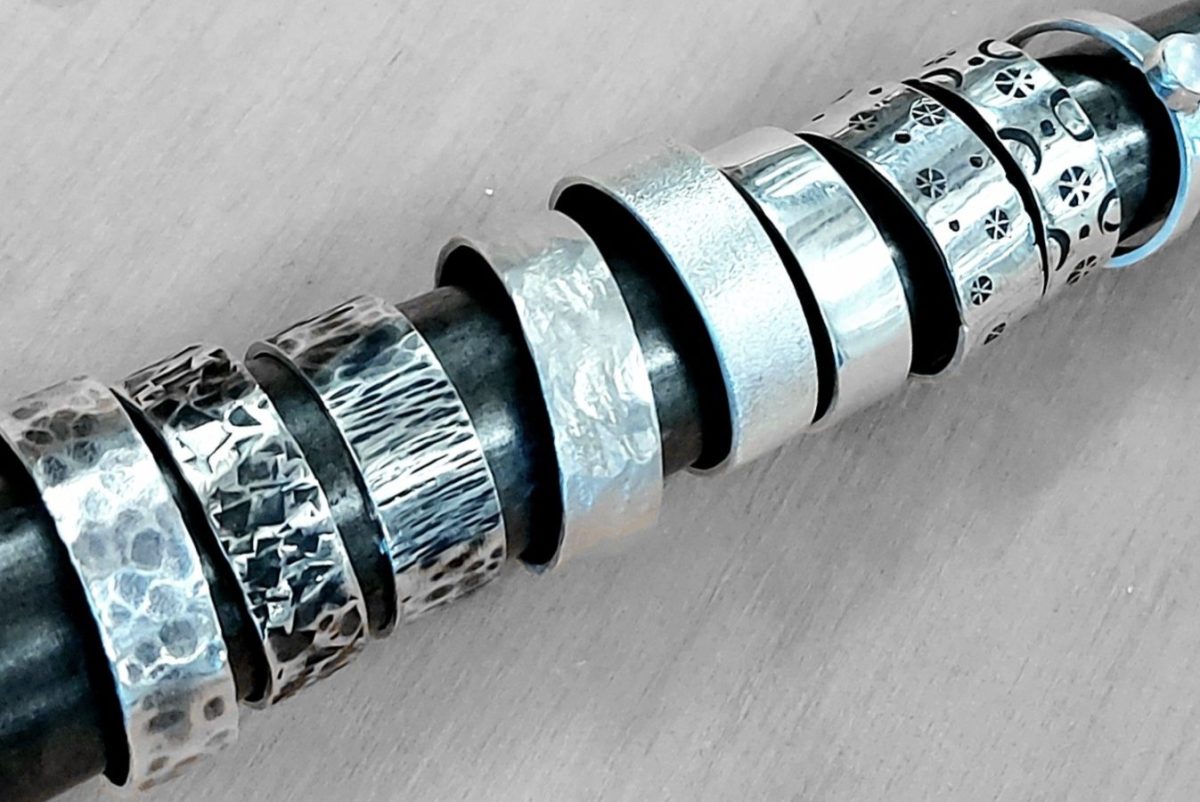
During this workshop, you will create a real silver ring with a finish of your choice.
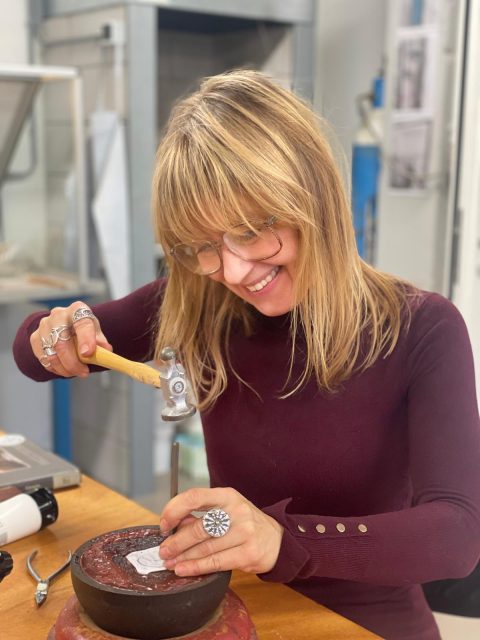
You’ll be introduced to every step of the process, from a flat piece of metal to a finished ring: measuring, marking, sawing, filing, sanding, bending, soldering, and finishing. You will shape the material according to your own ideas; you can add texture with hammers or create patterns using various stamping tools. A range of sample designs will be available for inspiration. You will proudly take home your own handmade ring.
Sacha Ofman has been a goldsmith since 1999. She trained at the School for Goldsmithing (Vakschool voor Edelsmeden) in Amsterdam. Sacha designs and creates unique handcrafted jewellery in a distinctive style — ranging from organic forms to wearable art pieces. She transforms old buttons from her grandmother’s button box into jewellery, giving them a new life as if they were gemstones. Seven years ago, she began teaching at the art centre Fluxus in Zaandam, where playful learning and joy in the creative process are central to her approach.
Practical information

Moroccan brass engraving, known locally as az-Zuwāq ʿala an-Nuḥās, is an old tradition. The techniques of brass engraving in Morocco, using a chisel and other stamps, and the methods of constructing patterns using a hand-forged divider, date back to early 11th century.
This workshop invites you to be part of this commitment to old techniques and methods that marks transgenerational legacies. This drop-In workshop will showcase the following technical steps:
Hamza El Fasiki is an artisan and author. Hamza has apprenticed under his father at Dar-Attamania Studio in Fes, Morocco between 2011 and 2021. Hamza holds an MA degree on Moroccan Cultural Studies with an academic research focus on the cultural history of Moroccan traditional crafts from Sidi Mohamed Ben Abdellah University in Fes. Hamza is specialist in traditional Moroccan geometric patterns, brass engraving and bookbinding and had published academic works in the field and traveled around 16 countries while learning and teaching Moroccan culture.


Regular
€7.50 pre-sale online
€10.00 at the door
CJP
€5.00 pre-sale online
€7.50 at the door
Children up to 12 years
Free entrance (with entrance ticket < 13 years).
Stadspas
Free entrance (only at the door upon presentation of your Stadspass, cannot be reserved online).
The prices mentioned include: VAT, service costs and €1.50 entertainment tax for the municipality of Amsterdam.
Please note: everyone who visits the festival needs an entrance ticket, even if you are going to attend a workshop or masterclass.
Festival address:
NDSM Loods
NDSM-Plein 85
1033 WC Amsterdam
Postal address:
Stichting Ambacht in Beeld
Kalf 158
1509AH Zaandam
The Netherlands