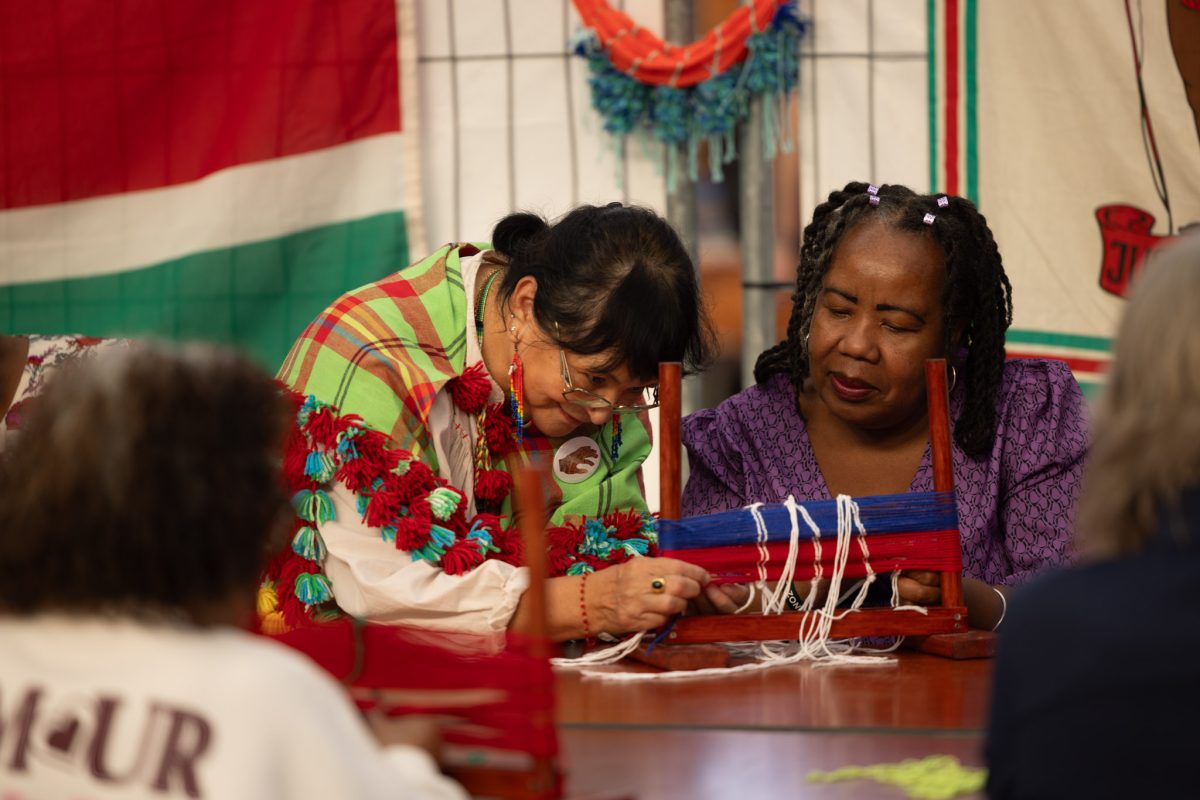
In the workshop “The Lost Art of Surinamese Hammocks”, you will learn how to make your own mini hammock on a weaving frame under the guidance of Carla & Martha Sabajo.
Step into the nearly forgotten world of traditional hammock making: an ancient Lokono craft from Suriname. This special technique, carried by only a few remaining Indigenous masters, is on the verge of disappearing. Experience how this ingenious creation comes to life, step by step and knot by knot. This is more than a creative experience, it is your chance to help preserve a fading tradition.
You will go home with your own mini hammock.
There are still very few indigenous knowledge holders who master and can pass on the traditional craft of hammock making. This technique originates from Suriname and is practiced by the Lokono, one of the indigenous peoples of this region. The hammock is made from palm fibre or cotton. The process includes preparing the raw material from plant fibre or cotton, cleaning and de-seeding, forming and spinning yarn, weaving, and knotting. An original hammock is an efficient invention designed for mobility, highly durable and environmentally friendly. It dates back to the time when Indigenous peoples lived nomadically, moving from place to place with minimal possessions.
Carla, Martha Sabajo and Marilyn van Rijn, born in Suriname, are proud cultural carriers of the Lokono community. As members of Stichting Wasjikwa, they dedicate their time to preserving and passing on Indigenous cultural heritage. Their motivation comes from a deep connection to their roots. They believe that craft techniques can never be separated from the stories, values, and spirituality that are woven into them. For Carla, Martha, and Marilyn, passing on Indigenous skills goes far beyond teaching techniques; it is about sharing an entire way of life.
During their workshops, they create a warm community atmosphere where participants not only learn skills, but also hear personal stories about the importance of community.

Festival address:
NDSM Loods
NDSM-Plein 85
1033 WC Amsterdam
Postal address:
Stichting Ambacht in Beeld
Kalf 158
1509AH Zaandam
The Netherlands