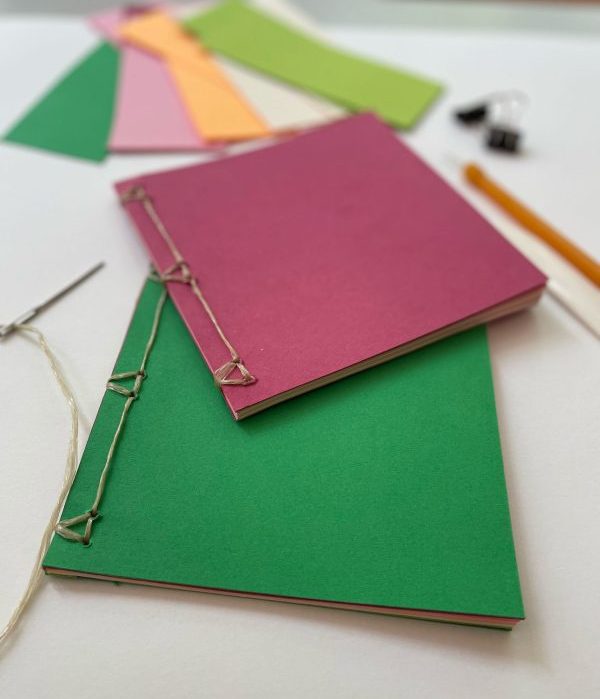
During this workshop for young and old, you will get started with making and binding a booklet in the Japanese style. This binding method was used for the famous Amsterdam School art and architecture magazine Wendingen. In it, artists shared their ideas, inspiration, and work.
You begin by selecting paper: which colours go well together, and which type of paper will you use for the cover? Then you start folding and binding. Using a bone folder, needle, and thread, and guided by instructions on binding, you assemble a booklet. If you have extra time, get inspired by the Amsterdam School artists and personalize your booklet.
You will go home with your very own booklet.
The artists of the Amsterdam School excelled in crafts. In response to industrialization over 100 years ago, they returned to making art objects entirely by hand, often from natural materials. This happened across many disciplines: there were sculptors associated with the movement, as well as ceramic and stained-glass artists, woodcarvers, bookbinders, and many graphic artists. The total product was important, often meaning that multiple artists from different disciplines collaborated on, for example, a building or interior.
Museum Het Schip is located in a whimsical working-class housing complex in Amsterdam West, designed by architect Michel de Klerk. This expressionist housing block was built in 1919 for the housing corporation Eigen Haard. Because of its shape, the building is colloquially called Het Schip (The Ship). It is considered one of the top examples of the Amsterdam School, a movement in architecture and decorative arts that spread throughout the Netherlands and is closely linked to the rise of good social housing through housing corporations.

Festival address:
NDSM Loods
NDSM-Plein 85
1033 WC Amsterdam
Postal address:
Stichting Ambacht in Beeld
Kalf 158
1509AH Zaandam
The Netherlands